
UAE Corporate Tax Audited Financial Statement Requirements Explained
The introduction of the UAE corporate tax has made accurate accounting and financial reporting more important for businesses operating in the United Arab Emirates. Companies need to maintain proper accounting records, prepare reliable financial statements, and keep supporting documents to calculate taxable income and meet Federal Tax Authority (FTA) requirements.
One important area businesses need to understand is whether audited financial statements are mandatory for corporate tax compliance. It is not necessary for every UAE company to have its accounts audited just because it is registered for corporate tax. However, businesses are required to maintain appropriate financial records, and an audit may be required under other laws, licensing conditions, free-zone regulations, or specific business circumstances.
It is very crucial for businesses operating in free zones to comprehend the requirements for UAE Free Zone Financial Reporting Requirements may differ depending on the free zone, business activity, license, and applicable regulatory rules.
Table of Contents
What Are Audited Financial Statements?
UAE Free Zone Financial Reporting Requirements include maintaining accurate accounting records and preparing financial statements. An independent auditor reviews the company’s records, transactions, balances, and reporting procedures before issuing an audit opinion.
Financial statements generally include:
- Statement of financial position
- Statement of profit or loss
- Statement of cash flows
- Statement of changes in equity
- Notes to the financial statements
Following UAE free zone financial reporting requirements helps businesses maintain transparent records and meet applicable financial reporting standards in the UAE. Audited financial statements may also support banking, financing, and UAE Corporate Tax compliance.ng applications, investment decisions, shareholder reporting, business restructuring, and regulatory compliance.
Are Audited Financial Statements Required for Corporate Tax in the UAE?
A common misconception is that every company registered for UAE corporate tax must submit audited financial statements. This is not automatically the case.
Businesses must keep the proper books and records in order to accurately calculate their taxable income, according to corporate tax regulations.Nonetheless, other legal or regulatory requirements may necessitate an independent audit.
For example, an audit may be required because of:
- Free-zone regulations
- Commercial or company law requirements
- Licensing conditions
- Industry-specific regulations
- Bank or financing requirements
- Shareholder requirements
- Investor requirements
- Other regulatory obligations
Therefore, businesses should distinguish between maintaining financial statements for Corporate Tax purposes and having those statements independently audited.
UAE Free Zone Audited Financial Statements Requirements
Companies established in UAE free zones should understand the UAE Free Zone Financial Reporting Requirements applicable to their business. Free zone audit requirements in the UAE can vary between authorities.
Some free zones require companies to prepare and submit audited financial statements in the UAE for annual compliance or licence renewal, while others may follow different reporting rules.
A free-zone company should check the requirements of its specific authority rather than assuming that UAE free zone accounting requirements are the same across all free zones.
This is particularly important for businesses seeking to meet the Qualifying Free Zone Person (QFZP) requirements under UAE Corporate Tax rules
Free Zone Companies and Corporate Tax
The UAE Corporate Tax framework provides specific treatment for qualifying income earned by a qualifying free zone person, subject to meeting the applicable conditions.
To support their corporate tax position, free-zone businesses should maintain proper financial records and documentation.
These may include:
- General ledger
- Trial balance
- Sales invoices
- Purchase invoices
- Bank statements
- Contracts
- Payroll records
- Fixed asset records
- Financial statements
- Records supporting qualifying income
- Related-party transaction records
- Corporate Tax calculations
The UAE Free Zone Financial Reporting Requirements should also be reviewed alongside the requirements of the particular free zone authority.
A company should not assume that obtaining QFZP status automatically removes any audit or financial reporting obligations imposed by its free zone.
Why Financial Statements Matter for Corporate Tax
Corporate Tax calculations generally begin with accounting income and then apply the relevant tax adjustments.
For this reason, accurate financial statements are an important foundation for corporate tax compliance.
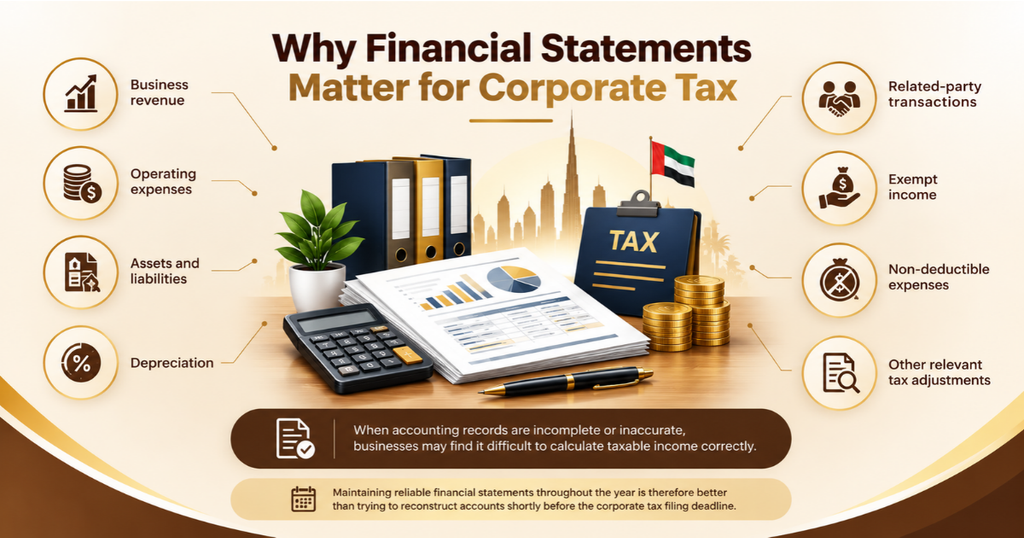
Proper financial reporting can help businesses identify:
- Business revenue
- Operating expenses
- Assets and liabilities
- Depreciation
- Related-party transactions
- Exempt income
- Non-deductible expenses
- Other relevant tax adjustments
When accounting records are incomplete or inaccurate, businesses may find it difficult to calculate taxable income correctly.
Maintaining reliable financial statements throughout the year is therefore better than trying to reconstruct accounts shortly before the corporate tax filing deadline.
UAE Free Zone Audited Financial Statements Requirements and IFRS
Businesses in the UAE should prepare their financial statements using an appropriate accounting framework.
International Financial Reporting Standards (IFRS) are widely used by businesses in the UAE. Depending on the circumstances, eligible smaller businesses may also use an applicable simplified accounting framework, such as IFRS for SMEs.
The accounting framework should be applied consistently so that the company’s financial information can be properly understood and supported.
When reviewing the UAE Free Zone Financial Reporting Requirements, businesses should consider both the accounting framework and any specific reporting requirements imposed by their free-zone authority.
When Is an Audit Required?
An audit may be required when a business is subject to an applicable legal or regulatory requirement.
For example, a free-zone authority may require an annual audit before a company can complete its license renewal. Similarly, a bank may request audited financial statements before approving business financing.
An audit can also be requested by:
- Shareholders
- Investors
- Business partners
- Regulatory authorities
- Financial institutions
- Parent companies
Therefore, companies should review their obligations before the end of each financial year.
For free-zone businesses, reviewing the UAE Free Zone Financial Reporting Requirements early can help avoid delays in annual compliance and license renewal.
Benefits of Audited Financial Statements
Even where an external audit is not specifically mandatory for Corporate Tax purposes, audited financial statements can provide important business benefits.
1. Better Financial Accuracy
An independent audit can identify accounting errors and inconsistencies.
2. Stronger Corporate Tax Records
Reliable financial statements provide a stronger foundation for calculating taxable income.
3. Improved Internal Controls
The audit process can highlight weaknesses in accounting procedures and internal controls.
4. Support for Free-Zone Compliance
Where an audit is required by a free-zone authority, completing the audit on time can help businesses meet their annual obligations.
5. Greater Business Credibility
Audited accounts can provide greater confidence to banks, investors, shareholders, and business partners.
Common Financial Reporting Mistakes
When accounting systems are not kept up to date, businesses may have issues with corporation tax and compliance.
Common mistakes include:
Mixing Personal and Business Transactions
Owners of businesses should keep different records for their personal and professional dealings.
Missing Supporting Documents
Accounting entries should be supported by contracts, invoices, receipts, and payment records.
Incorrect Expense Classification
Companies should carefully consider whether their expenses qualify for corporation tax deductions.
Poor Related-Party Documentation
Related party transactions need to be appropriately documented and backed up.
Ignoring Free-Zone Requirements
One of the common mistakes made by free-zone companies is assuming that every free zone follows the same audit and reporting rules.
The UAE Free Zone Financial Reporting Requirements can vary, so businesses should confirm the rules applicable to their particular free zone.
Delaying Year-End Accounting
Waiting until the last minute to prepare financial statements can create unnecessary pressure and increase the possibility of errors.
How Businesses Can Prepare
Businesses can take several steps to improve their corporate tax and financial reporting readiness.
First, preserve accurate bookkeeping records for the duration of the fiscal year.
Second, reconcile bank accounts regularly and investigate differences promptly.
Third, maintain invoices, contracts, receipts, and other supporting documentation.
Fourth, prepare periodic financial statements rather than waiting until year-end.
Fifth, before filing the tax return, go over the business tax adjustments.
Sixth, determine whether the company has an audit requirement under its free-zone authority, license, company structure, or other regulations.
Finally, businesses should review the UAE Free Zone Financial Reporting Requirements well before their annual filing or license renewal deadline.
Records Businesses Should Maintain
To support their accounting and corporation tax positions, businesses should keep enough records.
Important records can include:
- Sales and purchase invoices
- Bank statements
- General ledger
- Trial balance
- Payroll records
- Fixed asset register
- Contracts
- Financial statements
- Tax calculations
- Corporate Tax returns
- Related-party records
- Transfer pricing documentation, where applicable
Proper record keeping makes it easier to prepare financial statements and respond to potential tax or regulatory queries.
How Professional Accounting Support Can Help
As a company expands, it may become more difficult to handle bookkeeping, financial reporting, corporate tax, and audit obligations.
Professional accounting and tax advisers can help businesses maintain accurate books, prepare financial statements, identify potential compliance issues, and coordinate with auditors where required.
For free-zone companies, professional support can also help businesses review the UAE Free Zone Financial Reporting Requirements applicable to their particular business and regulatory authority.
By doing this, accounting errors can be decreased and crucial compliance deadlines can be met.
Conclusion
Accurate financial reporting is an important part of UAE Corporate Tcorporate taxax compliance. Although Corporate Tax registration does not automatically require every UAE business to obtain an external audit, companies must maintain proper accounting records and supporting documents.
Free-zone businesses should pay particular attention to the UAE free zone audited financial statements requirements applicable to their specific free-zone authority. Requirements can vary depending on the authority, business activity, licence, and other regulatory factors.
Additionally, companies should keep accurate financial records, periodically assess their corporate tax situation, and assess whether an external audit is necessary.
For companies in the United Arab Emirates, Singiri & Co. offers expert accounting, bookkeeping, auditing, tax consulting, financial reporting, and corporate tax compliance assistance.The team can assist companies with maintaining accurate financial records, preparing financial statements, understanding tax obligations, and managing accounting and compliance requirements.
Whether you operate a mainland company or a free-zone business, getting professional financial and tax support can help strengthen compliance and provide a better foundation for sustainable business growth.
FAQS
1. Are audited financial statements mandatory for every UAE business?
No. Corporate Tax registration alone does not automatically make an external audit mandatory for every business. Audit requirements may arise from company law, free-zone rules, licensing conditions, financing arrangements, or other regulations.
2. What rules apply to audited financial statements in the UAE free zone?
The requirements differ between free zones. Some authorities require companies to submit audited financial statements, while others may have different annual reporting requirements. Businesses should check the regulations of their specific free zone.
3. Do free-zone companies need audited financial statements for corporate tax?
Not necessarily. The requirement for an external audit depends on the applicable circumstances and regulations. However,Free-zone companies should keep accurate financial statements and accounting records to bolster their corporate tax stance.
4. Are audited accounts required for a Qualifying Free Zone Person?
Businesses seeking qualifying free zone person treatment should review the applicable corporate tax conditions as well as the regulations of their particular free zone. An audit requirement may arise from the relevant free-zone authority even where it is not imposed solely by corporate tax legislation.
5. Which accounting documents should companies in the UAE keep?
Invoices, receipts, bank statements, ledgers, contracts, payroll records, financial statements, fixed asset records, and other documentation required to support an organization’s accounting and tax status should all be kept on file.
6. How long should corporate tax records be maintained?
Companies must keep their accounting and tax records for the duration mandated by applicable regulations and UAE corporate tax laws.
7. Can audited financial statements help with corporate tax compliance?
Yes. Audited financial statements can offer trustworthy financial data and supporting records. However, an audit does not replace the company’s responsibility to comply with UAE corporate tax legislation.