
What Is E-Invoicing in the UAE and Its Benefits for Tax and Invoice Management?
The UAE is rapidly moving toward digital financial processes, and businesses are increasingly adopting technology to improve accounting, invoicing, tax compliance, and financial reporting. One of the major developments in this area is electronic invoicing, commonly known as e-invoicing.
For businesses operating in Dubai and across the UAE, understanding what is E- invoicing in UAE and its benefits is becoming increasingly important. E-invoicing is not simply the process of creating an invoice as a PDF and sending it by email. Instead, it involves creating and exchanging invoice information in a structured electronic format that can be processed by accounting, business, and tax systems.
The move toward e-invoicing is part of the UAE’s wider digital transformation of business and tax processes. Businesses can use this transition as an opportunity to improve invoice management, reduce manual work, strengthen financial records, and prepare their accounting systems for evolving compliance requirements.
Table of Contents
What Is E-Invoicing in the UAE?
E-invoicing is the electronic creation and exchange of invoices in a structured digital format. Unlike paper or PDF invoices, structured e-invoices can be automatically processed by accounting and tax systems.
For UAE businesses, electronic invoicing UAE supports faster invoice processing, accurate record keeping, and improved e-invoicing compliance. The UAE e-invoicing system can cover the complete invoice process, from creation and validation to transmission, recording, and storage.
Understanding what is E- invoicing in UAE and its benefits helps businesses prepare for digital accounting and evolving UAE tax requirements.
How Does E-Invoicing Work?
Although the technical process can vary depending on the systems being used, the basic e-invoicing process generally includes the following stages:
- Invoice creation: The seller creates an invoice through accounting, ERP, or invoicing software.
- Data validation: Relevant invoice information is checked for accuracy and completeness.
- Electronic transmission: The invoice data is transmitted through the applicable digital infrastructure.
- Buyer receipt: The buyer receives the structured invoice electronically.
- Accounting update: Invoice information can be recorded in the accounting or ERP system.
- Digital record keeping: The transaction information is retained electronically for accounting, tax, and audit purposes.
This approach can reduce repetitive manual data entry and improve communication between businesses, finance teams, accountants, and other stakeholders.
Why Is E-Invoicing Important for UAE Businesses?
Businesses need reliable financial records to manage operations and meet accounting and tax obligations. Invoices are an important source of transaction information, particularly for businesses registered for VAT.
Manual invoicing can create problems such as duplicate invoices, incorrect amounts, missing information, delayed processing, and difficulties in locating historical records.
Learning what is E- invoicing in UAE and its benefits can help business owners understand how digital invoicing can support better financial administration.
E-invoicing can contribute to:
- Improved invoice accuracy
- Faster invoice processing
- Better record keeping
- Organized VAT documentation
- Reduced manual data entry
- Improved payment tracking
- Better financial visibility
- Greater transaction transparency
Key Benefits of E-Invoicing in the UAE
1. Better Invoice Management
E-invoicing can simplify how businesses create, send, receive, store, and retrieve invoices. Understanding What is E- invoicing in UAE and its benefits can help businesses manage digital invoices more efficiently.
Finance teams can access invoice information digitally without relying heavily on physical documents or scattered email attachments. This is especially useful for businesses processing a large number of sales and purchase invoices.
2. Improved VAT Compliance
Accurate invoice records are essential for UAE VAT compliance. Understanding what is E- invoicing in UAE and its benefits helps businesses manage VAT invoices, organize transaction data, and maintain proper tax records through electronic invoicing UAE systems. Businesses should ensure their e-invoicing process meets applicable UAE VAT requirements.
3. Fewer Manual Errors
Manual invoice preparation can result in mistakes involving customer details, invoice numbers, quantities, amounts, tax calculations, or duplicate entries. Understanding What is E- invoicing in UAE and its benefits highlights how digital invoicing systems can introduce automated checks and reduce repetitive data entry. This can help businesses improve data accuracy and reduce the time spent correcting invoice-related mistakes.
4. Faster Invoice Processing
Traditional invoicing often involves printing, scanning, emailing, and manually entering invoice data. Understanding what is E- invoicing in UAE and its benefits shows how digital invoicing can streamline these tasks through electronic data exchange. UAE e-invoicing can speed up invoice processing, improve receivables tracking, and support faster payment follow-ups.
5. Reduced Administrative Work
Paper-based invoices require printing, physical storage, document handling, and administrative effort.
Digital invoice management can reduce these activities and allow finance teams to spend more time on accounting analysis, financial reporting, and business support.
Businesses may need to invest in suitable technology during implementation, but efficient digital processes can reduce repetitive administrative work over time.
6. Better Financial Record Keeping
Maintaining organized financial records is essential for businesses of all sizes.
Digital invoice information can be categorized according to customers, suppliers, dates, invoice numbers, transaction values, and other relevant information. This makes it easier to retrieve historical transactions for accounting reviews, audits, tax reporting, and internal management.
7. Improved Cash Flow Visibility
Understanding what is E-Invoicing in UAE and its benefits can help businesses manage receivables more efficiently. Electronic invoicing UAE systems enable faster invoice delivery, payment tracking, reminders, and reporting, giving businesses better control over outstanding payments and cash-flow planning.
8. Greater Business Transparency
E-invoicing can create a more consistent digital trail of transactions.
Structured invoice information can make it easier for finance teams to identify duplicate transactions, missing records, incorrect entries, or unusual activity. Better transaction visibility can also support internal controls and financial reporting.
E-Invoicing and UAE VAT Compliance
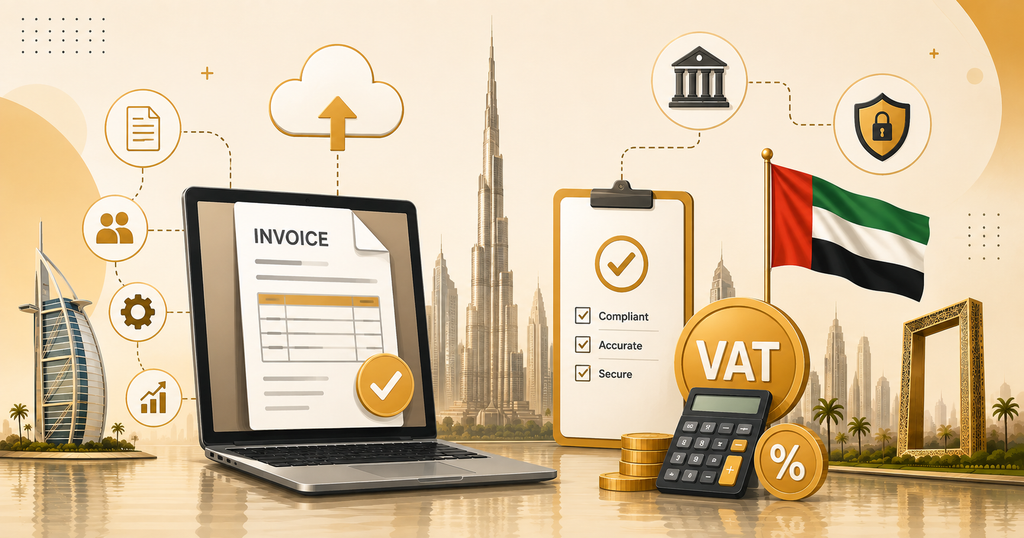
Understanding what is E- invoicing in UAE and its benefits is important for businesses managing UAE VAT compliance. VAT-registered businesses must maintain proper tax invoices and records. Electronic invoicing UAE systems use structured data that can be processed digitally, unlike ordinary PDF invoices.
Businesses should ensure their e-invoicing system meets applicable UAE VAT and accounting requirements and follow updates from UAE authorities as the e-invoicing framework develops.
E-Invoicing vs Traditional Invoicing
| Traditional Invoicing | E-Invoicing |
|---|---|
| May involve paper documents | Digital process |
| More manual data entry | Greater automation |
| Higher possibility of manual errors | Automated validation can reduce errors |
| Physical storage may be required | Digital storage |
| Can require multiple processing steps | Faster electronic processing |
| Limited system integration | Designed for system processing |
The transition to e-invoicing is therefore more than simply purchasing new software. Businesses may need to review their accounting procedures, customer data, internal controls, software integrations, and employee responsibilities.
How Can Businesses Prepare for E-Invoicing?
Businesses can take several practical steps to prepare for digital invoicing.
Review Existing Invoicing Procedures
Businesses should understand how invoices are currently created, approved, issued, recorded, and stored. Identifying manual processes can help determine where improvements may be needed.
Check Accounting and ERP Software
Companies should assess whether their accounting or ERP systems can support applicable e-invoicing requirements and future technical changes.
Review Customer and Supplier Data
Accurate customer and supplier information is essential. Businesses should review names, tax registration numbers, addresses, contact details, and other relevant information.
Train Finance Teams
Employees involved in accounting, invoicing, finance, and tax processes should understand the changes that digital invoicing may bring to their responsibilities.
Review VAT Processes
Businesses should check whether their invoicing procedures correctly apply VAT treatment and maintain appropriate supporting records.
Seek Professional Accounting Advice
E-invoicing can involve accounting, tax, technology, compliance, and internal-control considerations. Professional guidance can help businesses assess their existing systems and identify areas requiring improvement.
Who Can Benefit From E-Invoicing?
E-invoicing can be useful for many businesses that regularly issue or receive invoices, including:
- VAT-registered businesses
- Small and medium-sized enterprises
- Large companies
- Trading businesses
- Professional service providers
- E-commerce businesses
- Businesses with high transaction volumes
- Companies operating across multiple locations
The specific requirements and implementation approach may vary depending on the business structure, transaction volume, systems, and applicable UAE requirements.
Common Challenges of E-Invoicing
While UAE e-invoicing offers efficiency and compliance benefits, businesses may face challenges such as accounting software integration, ERP updates, data management, employee training, and compliance requirements. Small businesses may also need to consider implementation costs and suitable technology.
Early preparation can help businesses improve e-invoicing compliance, identify system gaps, and manage the transition smoothly.
How Singiri & Co Can Support UAE Businesses
The transition to digital invoicing is not only a technology-related change. It can affect accounting procedures, VAT compliance, financial reporting, internal controls, and record keeping.
Singiri & Co, Dubai, UAE, provides accounting, bookkeeping, VAT, corporate tax, auditing, and business advisory services to support businesses with their financial and compliance requirements.
Businesses can seek professional assistance to review their accounting processes, improve financial record keeping, understand VAT requirements, and prepare for changes in the UAE’s digital tax environment.
As businesses continue moving toward digital financial systems, understanding what is E- invoicing in UAE and its benefits can help business owners make informed decisions about their invoicing and accounting processes.
Conclusion
E-invoicing represents an important development in the UAE’s digital business environment. It can help businesses improve invoice management, reduce manual processes, strengthen financial records, and support more efficient accounting operations.
Understanding what is E- invoicing in UAE and its benefits is therefore important for businesses preparing for changes in digital invoicing and tax administration.
Rather than waiting until system changes become urgent, businesses can begin by reviewing their current invoicing processes, accounting software, data quality, VAT procedures, and internal controls.
With proper preparation and professional support, businesses can make the transition toward digital invoicing more organized and efficient while maintaining appropriate accounting and tax records.
FAQS
1. What is e-invoicing in the UAE?
E-invoicing is the electronic creation and exchange of structured invoice data between businesses and relevant systems. It is different from simply sending a PDF invoice by email.
2. Is a PDF invoice considered an e-invoice?
A PDF invoice sent by email is generally not the same as a structured e-invoice. E-invoicing is based on structured data that can be electronically processed by compatible systems.
3. How does e-invoicing help VAT-registered businesses?
E-invoicing can help organize transaction records, reduce manual errors, improve invoice tracking, and support the maintenance of documentation required for VAT and accounting purposes.
4. What are the main benefits of e-invoicing?
Key benefits include faster invoice processing, improved accuracy, better record keeping, reduced manual work, improved transaction visibility, and more efficient invoice management.
5. Do small businesses need to prepare for e-invoicing?
Businesses should monitor the applicable UAE requirements and assess their accounting systems and invoicing processes. Early preparation can help businesses identify technology, data, and process changes that may be required.
6. Can e-invoicing reduce accounting errors?
Digital systems can reduce repetitive manual data entry and use automated validation checks, which may help reduce common invoice errors.
7. Is e-invoicing connected to UAE VAT compliance?
Yes. Invoicing and transaction records are important for VAT compliance. Businesses should ensure their invoicing systems and records meet applicable UAE VAT requirements.