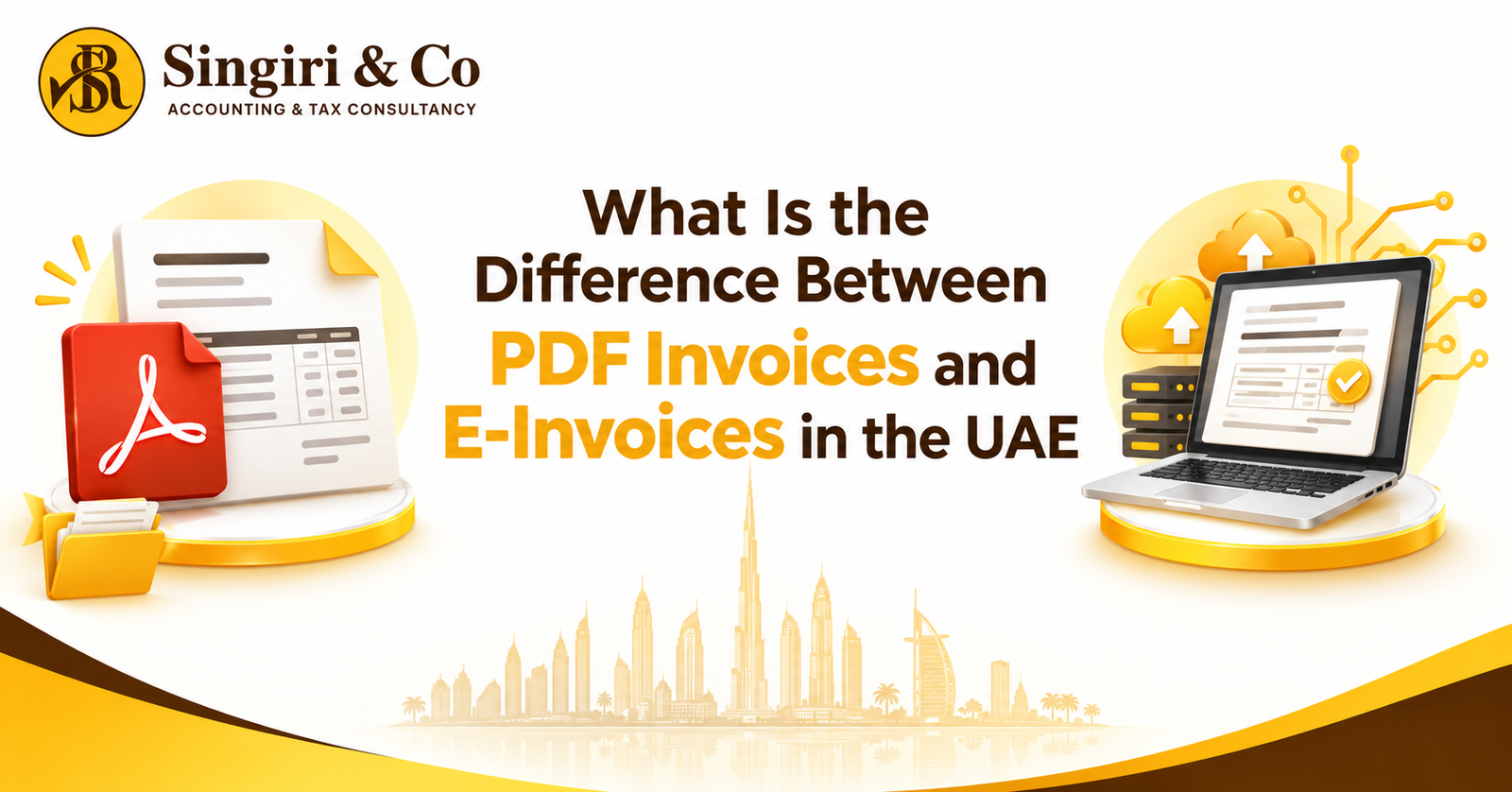
In the UAE, invoicing is moving from traditional documents toward structured digital transactions. For businesses in Dubai and across the country, understanding PDF Invoice vs E-Invoice explained in UAE is becoming increasingly important for VAT compliance and future-ready financial operations.
At Singiri & Co, we help businesses understand changing accounting, VAT, and compliance requirements so they can prepare for digital transformation with greater confidence. Understanding PDF invoice vs e-Invoice in UAE, UAE e-invoicing requirements, and structured e-invoices can help businesses prepare for upcoming changes.
The distinction is simple but significant: a PDF invoice is generally an unstructured document that can be viewed by people, while an e-invoice contains structured invoice data designed to be electronically processed and transferred through the UAE e-invoicing system. PDFs, Word documents, scanned copies, images, and emails are not considered e-invoices.
Table of Contents
What Is a PDF Invoice vs E-Invoice Explained in UAE?
A PDF invoice is a digital representation of an invoice. Businesses can create it using accounting software, invoicing applications, Word, Excel, or other systems and send it electronically to customers.
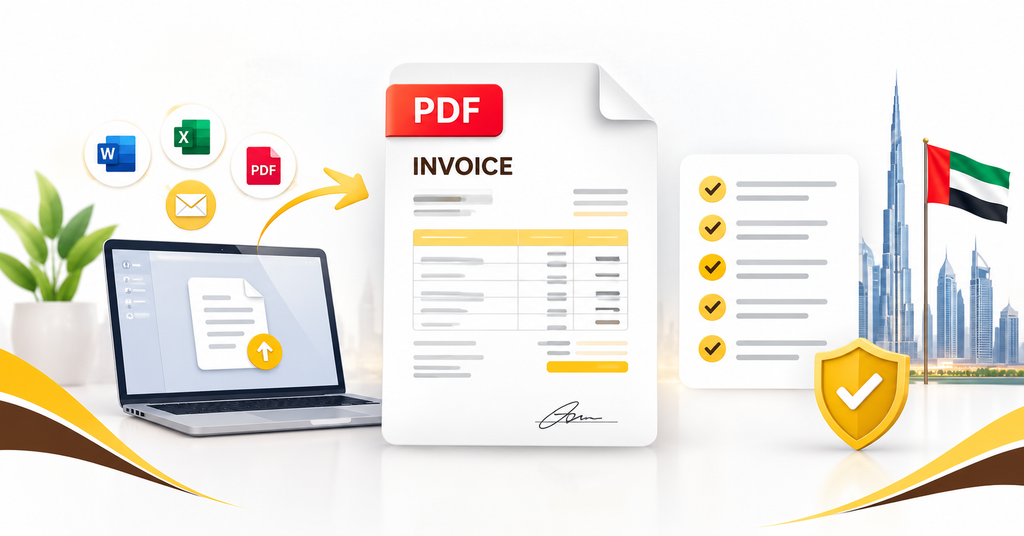
A PDF may include:
- Supplier name and address
- Tax Registration Number (TRN)
- Customer details
- Invoice number and date
- Description of goods or services
- Quantity and prices
- VAT rate and amount
- Total amount payable
For UAE VAT purposes, a tax invoice must meet the applicable requirements. However, a PDF invoice should not automatically be considered a UAE e-invoice.
Understanding PDF Invoice vs E-Invoice Explained in UAE helps businesses identify the key difference between PDF invoice and e-invoices in UAE. A PDF is mainly a digital document, while an e-invoice is structured for automated electronic processing. sing and exchange. t, whereas an e-invoice is structured invoice data exchanged through the electronic invoicing framework.
What Is an E-Invoice in the UAE?
A UAE e-invoice is a structured electronic invoice issued, exchanged, and reported electronically. Understanding PDF Invoice vs E-Invoice Explained in UAE helps businesses prepare for digital invoicing.
Unlike a PDF, an e-invoice supports automated processing by accounting and tax systems. This highlights the key difference between PDF invoices and e-invoices in UAE.
The UAE e-invoicing model connects suppliers, buyers, and their Accredited Service Providers (ASPs) through structured digital exchange. It follows the OpenPeppol framework to support secure data exchange and interoperability.
These UAE e-invoicing requirements are an important part of the country’s digital tax transformation.
What Is the Difference Between PDF and E-Invoice?
Understanding the PDF invoice vs e-invoice explained in UAE comparison becomes easier when you look at how each format works.
| Feature | PDF Invoice | UAE E-Invoice |
| Format | Usually document-based | Structured digital data |
| Human-readable | Yes | Yes, but designed primarily for machine processing. |
| Automated processing | Limited | Designed for automation |
| Electronic reporting | Not inherently reported as an e-invoice | Integrated into the e-invoicing framework |
| Data structure | Generally unstructured | Structured |
| Email attachment | Common | Not the defining feature |
| Accredited Service Provider | Not necessarily required | Part of the UAE e-invoicing model |
| Future e-invoicing compliance | May not satisfy e-invoicing requirements when applicable | Designed for the applicable system |
The most important difference is therefore not whether the invoice is sent electronically. A PDF sent by email is still generally a PDF invoice. The UAE government expressly says that PDFs and similar unstructured formats are not e-invoices.
Does the UAE Still Accept PDF Invoices?
This is one of the most common questions businesses have about PDF Invoice vs E-Invoice Explained in UAE
A PDF invoice and a UAE e-invoice should not be treated as identical. Whether a PDF can continue to be used depends on the transaction, the applicable VAT rules, and whether the business is subject to the UAE Electronic Invoicing System. This makes UAE e-invoicing compliance requirements an important consideration for businesses.
The UAE VAT legislation requires VAT-registered businesses making taxable supplies to issue tax invoices, subject to the relevant rules and exceptions. The legislation now also provides that persons subject to the Electronic Invoicing System must issue and transmit tax invoices in electronic invoice form in accordance with that system.
Therefore, businesses should not simply assume that their existing PDF invoicing process will remain sufficient after their UAE e-invoice implementation requirements become applicable.
UAE E-Invoicing Implementation Timeline
The UAE is introducing e-invoicing in phases rather than requiring every business to change overnight. Understanding PDF invoices vs. e-invoices explained in the UAE can help businesses prepare for the UAE e-invoicing implementation timeline.
Under the published implementation framework, businesses with annual revenue of AED 50 million or more were initially given an earlier timeline. However, the Ministry of Finance announced an extension in May 2026 for appointing an accredited service provider, moving that deadline from 31 July 2026 to 30 October 2026 for businesses within that category.
For businesses with annual revenue below AED 50 million:
- 31 March 2027: Appointment of an Accredited Service Provider
- 1 July 2027: Implementation of the Electronic Invoicing System
Businesses with annual revenue of AED 50 million or more are scheduled to implement the system from 1 January 2027, subject to applicable rules.
The program is being introduced through a phased approach to support businesses in preparing for PDF invoices vs. e-invoices in the UAE. esses time to prepare their systems, processes, people, and service-provider relationships.
Why Is the UAE Moving From PDF to E-Invoicing?
The shift in PDF Invoice vs E-Invoice Explained in UAE is part of a broader move toward digital tax administration.
According to the Ministry of Finance and FTA, e-invoicing is intended to improve digitalization, operational efficiency, transparency, security, and tax compliance. Structured invoice information can also support more automated processes and better financial visibility.
For businesses, potential operational benefits include:
1. Less Manual Data Entry
When invoice data is structured, businesses can reduce the need to manually enter information from invoices into accounting systems.
2. Better Data Accuracy
Automated processes can reduce common errors associated with manually copying invoice numbers, tax amounts, customer information, and totals.
3. Faster Invoice Processing
Structured electronic invoices can move between business systems more efficiently than traditional document-based processes.
4. Better VAT Compliance
The UAE’s e-invoicing framework is designed to support electronic reporting of relevant tax data to the FTA through Accredited Service Providers.
5. Improved Record Management
Digital invoice data can make it easier for businesses to organize, search, analyze, and reconcile transactions.
How Should UAE Businesses Prepare for E-Invoicing?
If your company currently relies heavily on PDF invoices, preparation should start before your mandatory implementation date.
Here are several practical steps.
Review Your Current Invoicing Process
Identify how invoices are currently created, approved, sent, stored, and recorded in your accounting system.
Check Your Business’s Scope
Determine whether your business falls within the scope of the UAE Electronic Invoicing System and which implementation timeline applies to you.
The framework generally focuses on business-to-business and business-to-government transactions, subject to specified exclusions and rules. Businesses should review the official guidance rather than relying on assumptions.
Evaluate Your Accounting Software
Your accounting or ERP system may need to integrate with the UAE e-invoicing framework. Speak with your software provider about compatibility, structured invoice data, and integration capabilities.
Understand Accredited Service Providers
The UAE e-invoicing model relies on accredited service providers. Businesses should evaluate available providers based on their technical capabilities, integration requirements, security, support, and commercial terms.
Review Your VAT Invoice Data
Make sure your current invoices contain the information required under UAE VAT rules. PDF Invoice vs E-Invoice Explained in UAE helps businesses understand the difference between standard PDF invoices and structured e-invoices.
Train Your Finance Team
E-invoicing is not only an IT project. Finance, accounting, sales, procurement, and management teams may all need to understand the new workflow.
Common Mistakes Businesses Should Avoid
When preparing for PDF Invoice vs E-Invoice Explained in UAE, businesses should not assume that a PDF invoice qualifies as an e-invoice. They should also plan early for software integration, data mapping, testing, and staff training.
Businesses must consider different transaction types and applicable requirements. Always check official UAE guidance for the latest UAE e-invoicing compliance requirements.
PDF Invoice vs. E-Invoice in the UAE: What Should Businesses Do Now?
The practical lesson from the PDF Invoice vs E-Invoice Explained in UAE comparison is straightforward: businesses should start preparing for structured digital invoicing instead of assuming that a PDF-based process will automatically meet future UAE e-invoicing compliance requirements.
This is an excellent moment to check if your company’s accounting software can meet UAE regulations. If your invoicing process is largely manual, you may need additional preparation.
Professional accounting and tax support can also make the transition easier. Singiriandco Dubai, UAE, can support businesses in reviewing their accounting and VAT processes and preparing for evolving PDF Invoice vs E-Invoice Explained in UAE
Conclusion
The UAE e-Invoicing Mandatory Implementation 2026 programme is changing how businesses issue, exchange, and retain invoices. Understanding PDF Invoice vs E-Invoice Explained in UAE is essential for businesses preparing for this transition.
Businesses should review their deadlines, accounting systems, ASP requirements, master data, and internal controls before implementation. With mandatory implementation starting in January 2027 for businesses with annual revenue of AED 50 million or more, early preparation is important.
Businesses should follow the UAE Ministry of Finance for official e-invoicing updates and requirements.
FAQS
1. Is e-invoicing mandatory in the UAE?
No. The UAE Ministry of Finance and Federal Tax Authority state that PDF files, Word documents, images, scanned copies, and emails are not considered e-invoices. A UAE e-invoice is structured invoice data exchanged electronically through the applicable e-invoicing framework.
2. What makes a PDF invoice different from an electronic invoice?
The main difference is the structure and method of electronic exchange. A PDF is generally an unstructured document intended for human viewing, while an e-invoice contains structured data designed for automated processing, exchange, and reporting.
3.When does mandatory e-invoicing start?
Businesses with annual revenue of AED 50 million or more are scheduled to implement e-invoicing from 1 January 2027. Businesses below AED 50 million are scheduled for 1 July 2027, while in-scope government entities are scheduled for 1 October 2027.
4.What is the ASP appointment deadline for large businesses?
Businesses must designate an Accredited Service Provider by October 30, 2026, if their yearly sales exceeds AED 50 million.
5.What standard does the UAE use?
The UAE e-invoicing framework uses the OpenPeppol standard and PINT-AE specifications for structured electronic invoices.
6. Does sending an invoice by email make it an e-invoice?
No. Sending a PDF invoice by email does not make it a UAE e-invoice. The FTA specifically distinguishes email and PDF documents from structured e-invoices.
7. Are PDF invoices considered UAE eInvoices?
No. PDF, Word, image, scanned, and email-only invoices are not structured eInvoices under the UAE framework.