
What Is the UAE eInvoicing AED 50 Million Threshold Explained?
The UAE eInvoicing system introduces specific implementation deadlines based on annual business revenue. The UAE eInvoicing AED 50 Million Threshold Explained helps businesses understand which companies fall under the first implementation phase and what compliance requirements they need to prepare for.
Businesses with annual revenue of AED 50 million or more must appoint an Accredited Service Provider (ASP) by 30 October 2026 and implement eInvoicing from 1 January 2027 according to the announced schedule. Understanding the UAE eInvoicing AED 50 Million Threshold Explaining requirements helps companies plan ahead and prepare their accounting systems for digital invoicing.
Table of Contents
What Does the AED 50 Million UAE eInvoicing Threshold Mean?
For companies covered by the UAE eInvoicing system, the AED 50 million threshold is a revenue-based criterion that establishes the required implementation phase.
Companies with annual revenue equal to or exceeding AED 50 million fall into the first implementation phase. These businesses must appoint an appropriate ASP and prepare their accounting systems to generate and exchange structured electronic invoices according to the applicable requirements.
The threshold does not mean that smaller businesses are permanently exempt. The UAE is introducing eInvoicing in phases, with businesses below AED 50 million generally scheduled to implement the system later, subject to the applicable scope and exclusions.
The UAE eInvoicing AED 50 Million Threshold Explained framework helps companies understand how their annual revenue affects their implementation schedule and preparation responsibilities.
Businesses should review their financial statements and official guidance to confirm how the threshold applies to their individual circumstances.
How Does the AED 50 Million Revenue Threshold Work?
The UAE eInvoicing AED 50 Million Threshold Explained helps businesses understand how annual revenue determines their applicable e-Invoicing implementation phase and Accredited Service Provider (ASP) appointment deadline.
Important considerations include:
- Annual revenue threshold: Review annual revenue to determine whether the business falls above or below the AED 50 million threshold under the applicable UAE e-Invoicing rules.
- Financial records: Maintain accurate financial statements and supporting accounting documentation for revenue assessment.
- Business eligibility: Verify whether the company and its transactions are covered by the required UAE e-Invoicing.
- ASP appointment deadlines: Businesses with revenue of AED 50 million or more must appoint an ASP by 30 October 2026, while businesses below AED 50 million must appoint one by 31 March 2027.
- Accounting system readiness: Assess whether existing accounting software or ERP systems support structured electronic invoices and integration with an approved ASP.
Businesses should not confuse the UAE e-Invoicing revenue threshold with the VAT registration threshold, as each serves a different regulatory purpose. Understanding the AED 50 million e-invoicing threshold, relevant compliance requirements, and implementation deadlines can help businesses prepare for a smoother transition to electronic invoicing.
UAE eInvoicing Deadlines for Businesses Above AED 50 Million
A phased implementation timetable for the electronic invoicing system has been established by the UAE Ministry of Finance. Businesses should understand the relevant dates and plan their implementation activities accordingly.
| Business category | ASP appointment deadline | Implementation date |
| Businesses with annual revenue of AED 50 million or more | 30 October 2026 | 1 January 2027 |
| Businesses with annual revenue below AED 50 million | 31 March 2027 | 1 July 2027 |
| In-scope government entities | 31 March 2027 | 1 October 2027 |
The ASP appointment deadline for businesses with annual revenue of AED 50 million or more was extended to 30 October 2026, while the implementation date remains 1 January 2027.
Businesses researching the UAE eInvoicing AED 50 Million Threshold Explained should review the latest official announcements to confirm their applicable deadlines and responsibilities.
Companies should not wait until the final weeks to begin preparation. Provider selection, software integration, invoice data validation, and employee training may require several stages of work.
For official updates, businesses can consult the UAE Ministry of Finance and the Federal Tax Authority.
What Does an Accredited Service Provider Mean for UAE eInvoicing?
The UAE eInvoicing AED 50 Million Threshold Explained helps businesses understand the importance of appointing an Accredited Service Provider (ASP) within the applicable implementation timeline. Under the UAE framework, an ASP facilitates the exchange of structured electronic invoices and the integration of ERP or accounting systems.
Businesses should assess the UAE e-Invoicing service provider requirements, such as system compatibility, data security, integration costs, technical support, and regulatory compliance capabilities, before choosing a provider.
1. Accounting software compatibility
The selected provider should support the company’s existing accounting software, ERP platform, and invoicing workflows. Businesses using SAP, Oracle, Microsoft Dynamics, Tally, Zoho, or other systems should confirm the relevant integration capabilities.
2. Regulatory compliance
Businesses should verify the provider’s accreditation and confirm that the solution supports the applicable UAE eInvoicing technical requirements.
3. Data security
Invoice information can contain commercially sensitive details. Companies should assess data protection measures, access controls, backup procedures, and information security practices.
4. Integration and customer support
A suitable provider should explain the implementation process, expected costs, testing procedures, and ongoing technical support arrangements.
5. Scalability
Companies processing large invoice volumes should consider whether the solution can accommodate business growth, additional entities, and changing transaction requirements.
Choosing an appropriate ASP early can help reduce integration difficulties and make the transition more manageable.
What Is the Difference Between a PDF Invoice and an Electronic Invoice?
The UAE eInvoicing AED 50 Million Threshold Explained highlights the importance of preparing for the UAE’s electronic invoicing requirements. A PDF invoice sent by email alone does not qualify as a compliant eInvoice under the applicable framework.
Companies must make sure that invoices adhere to the necessary electronic exchange procedure and contain structured data in the format specified. Reviewing existing accounting systems and integrating with an Accredited Service Provider (ASP) can support UAE structured eInvoice requirements and improve implementation readiness.
How Can Companies Get Ready for UAE eInvoicing Compliance?
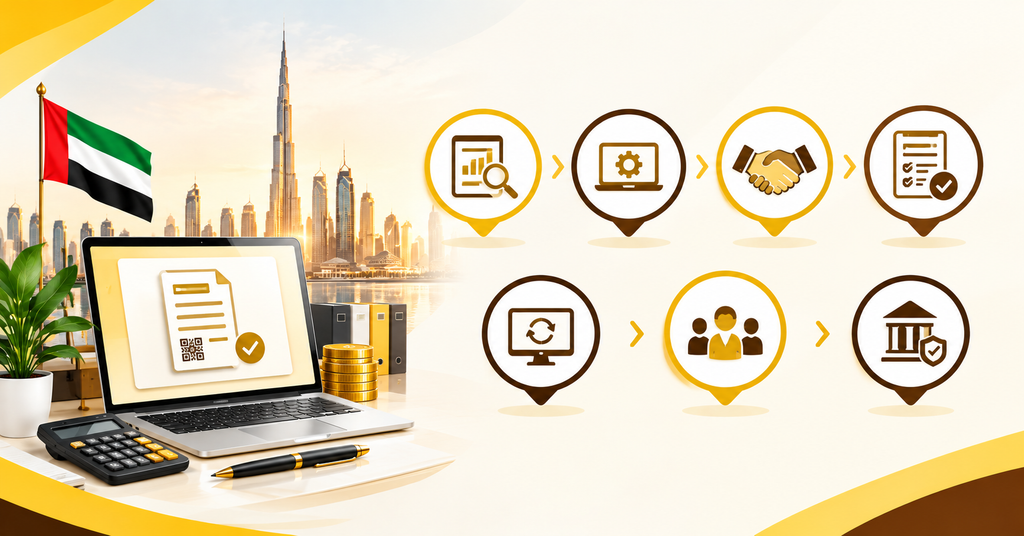
Companies with annual revenue of AED 50 million or more should prepare early for UAE e-Invoicing implementation before their mandatory deadline.
Step 1: Review revenue eligibility.
Examine financial statements to determine the applicable phase under the UAE eInvoicing AED 50 Million Threshold Explained guidelines.
Step 2: Evaluate accounting systems
Review accounting software, ERP platforms, invoice approval workflows, and customer and supplier records to identify gaps in UAE e-Invoicing compliance.
Step 3: Appoint an Accredited Service Provider
Compare ASPs based on system compatibility, integration costs, data security, and technical support.
Step 4: Validate invoice data
Check invoice numbering, customer details, supplier information, tax data, and required fields for structured electronic invoices.
Step 5: Test the invoicing workflow
Test invoice generation, electronic exchange, validation, reporting, and credit note processing.
Step 6: Train employees.
Ensure finance, accounting, IT, and billing teams understand the new electronic invoicing requirements in the UAE.
Step 7: Monitor regulatory updates
Follow Ministry of Finance and FTA announcements regarding UAE e-Invoicing deadlines, technical standards, and applicable exclusions.
Following the UAE eInvoicing AED 50 Million Threshold Explained guidance can help businesses plan their implementation and prepare for regulatory compliance.
What Happens If a Business Is Not Ready for eInvoicing?
The UAE eInvoicing AED 50 Million Threshold Explained highlights the importance of early preparation for businesses transitioning to the UAE e-Invoicing framework. Delays may cause invoice processing interruptions, integration challenges, inaccurate data, and difficulties exchanging invoices with customers.
Businesses should prioritize UAE e-invoicing compliance requirements by appointing an Accredited Service Provider (ASP), reviewing accounting systems, validating invoice data, and training employees. Appointing an ASP alone does not fulfill every compliance obligation. A structured implementation plan can help reduce operational risks and support a smoother transition.
Benefits of Early UAE eInvoicing Preparation
Although implementing electronic invoicing requires planning, it can provide several operational advantages.
- Improved invoice accuracy: Structured data can reduce manual entry and common processing errors.
- Faster invoice processing: Automated workflows can improve the efficiency of finance teams.
- Better record management: Digital invoice information can make financial records easier to organize and retrieve.
- Improved reconciliation: Standardized data can support invoice matching and financial reporting procedures.
- Stronger compliance processes: Defined workflows can help businesses monitor invoicing obligations.
- Operational efficiency: Integration with accounting and ERP systems can reduce repetitive administrative tasks.
The benefits depend on appropriate software, reliable data, and effective internal controls.
How Singiri & Co Can Support UAE eInvoicing Readiness
Preparing for electronic invoicing involves more than selecting software. The UAE eInvoicing AED 50 Million Threshold Explained guidance helps businesses assess applicable deadlines, review accounting procedures, organise invoice data, and coordinate with an Accredited Service Provider (ASP).
Singiri & Co – Accounting & Bookkeeping LLC provides accounting, bookkeeping, VAT, corporate tax, auditing, and business advisory services across the UAE. Our team can help businesses review accounting procedures, organise financial records, identify compliance gaps, and prepare for discussions with an ASP.
With professional guidance, companies can develop a practical implementation plan, improve financial record management, and prepare their finance teams for UAE e-Invoicing regulatory compliance.
Conclusion
The AED 50 million revenue threshold is an important milestone in the UAE’s transition towards structured electronic invoicing. Businesses that meet or exceed this threshold should review their eligibility, appoint an appropriate Accredited Service Provider by the applicable deadline, and prepare their accounting systems for implementation from 1 January 2027.
Early planning can help businesses improve invoice data quality, test technology integrations, train employees, and reduce operational disruption. Better financial record management and a more structured approach to compliance are also supported by an understanding of the pertinent requirements.
The UAE eInvoicing AED 50 Million Threshold Explained topic is essential for companies preparing for the country’s digital invoicing transition. Businesses that begin preparation early can make more informed technology decisions and establish processes that support future growth.
Singiri & Co is ready to support your business with accounting, bookkeeping, VAT, corporate tax, auditing, and business advisory services. Contact our team to discuss your accounting requirements and prepare for the UAE’s evolving regulatory landscape.
FAQS
1. What does the AED 50 million threshold mean for UAE e-Invoicing?
It is a revenue criterion used to determine the mandatory implementation phase for businesses covered by the UAE eInvoicing framework. Companies with annual revenue of AED 50 million or more fall under the first mandatory phase.
2. What is the ASP appointment deadline for businesses above AED 50 million?
The announced deadline is 30 October 2026 for businesses with annual revenue of AED 50 million or more.
3. When must businesses above AED 50 million implement UAE eInvoicing?
The mandatory implementation date for this category is 1 January 2027.
4. Are businesses below AED 50 million exempt from UAE eInvoicing?
No. Businesses below the threshold generally fall into a later implementation phase, subject to the applicable scope and exclusions. Their scheduled implementation date is 1 July 2027.
5. Is a PDF invoice considered a compliant eInvoice?
No. A PDF or scanned document alone does not meet the structured electronic invoicing requirements. Businesses must follow the prescribed data and electronic exchange specifications.
6. Do businesses need to appoint an accredited service provider?
Businesses within the mandatory scope must appoint an appropriate ASP according to their applicable implementation schedule. They should verify the provider’s accreditation and technical suitability.
7. Can businesses prepare before their mandatory implementation date?
Yes. Early preparation allows companies to review accounting software, validate invoice data, compare providers, test integrations, and train employees.