
When Do Businesses Need to Register for Corporate Tax in the UAE?
The introduction of corporate tax in the United Arab Emirates has changed the way businesses approach tax compliance and financial reporting. Companies, partnerships, and individuals conducting business activities need to understand whether they fall within the corporate tax rules and when registration with the Federal Tax Authority (FTA) is required.
One of the most common questions businesses have is, “Who Should Register for Corporate Tax in the UAE?” The answer depends on the type of person or business, its activities, legal structure, and applicable corporate tax rules.
The UAE corporate tax system generally applies to taxable persons, while certain persons may qualify for exemptions subject to the relevant conditions. According to the FTA, taxable persons may need to register and obtain a Corporate Tax Registration Number. Understanding Who Should Register for Corporate Tax in the UAE can help businesses identify their registration obligations and maintain proper tax compliance. UAE Corporate Tax Registration Requirements should also be considered when determining the applicable registration obligations.
Table of Contents
Understanding UAE Corporate Tax Registration
A taxable individual can obtain a Corporate Tax Registration Number by registering with the FTA through the Corporate Tax Registration process. Who Should Register for Corporate Tax in the UAE depends on whether the person or business falls within the applicable registration rules.
Companies shouldn’t think that registration is just necessary if they need to pay corporate tax. Registration and tax payment are separate compliance matters. A business may have a registration obligation even where the final corporate tax payable is low or zero.
Corporate tax registration is made possible by the FTA via the EmaraTax platform. The service is currently available online and does not have a registration fee. UAE Corporate Tax Registration Process provides the steps businesses and taxable persons should follow to complete registration.
Who Needs to Register for Corporate Tax in the UAE?
For corporate tax in the United Arab Emirates, Who Should Register for Corporate Tax in the UAE?
Who must thus register for corporate tax in the United Arab Emirates? All individuals who are liable to UAE corporate tax are generally required to register with the FTA.
This can include UAE-resident juridical persons, certain non-resident persons with UAE taxable activities, and natural persons conducting business activities that meet the applicable revenue threshold.
According to the FTA, some exempt individuals could have to register if the Authority requests it. UAE Corporate Tax Registration Eligibility also helps determine which taxable persons are required to register.
UAE Resident Companies
A corporation registered or founded in the United Arab Emirates is considered a UAE-resident juridical entity under the corporate tax registration structure. Who Should Register for Corporate Tax in the UAE includes UAE-resident businesses that fall within the applicable Corporate Tax rules.
This includes businesses established in different UAE jurisdictions, including free zones. Being located in a free zone does not automatically mean that a business is outside the corporate tax registration requirements. Corporate tax registration for UAE free zone companies should therefore be assessed based on the business’s status and applicable rules.
Free Zone businesses should therefore assess their status carefully and determine whether they are subject to corporate tax and whether they qualify for any specific treatment available under the law.
Non-Resident Businesses
Certain non-resident persons may also have corporate tax obligations in the UAE. Who Should Register for Corporate Tax in the UAE includes certain non-resident businesses that fall within the scope of UAE Corporate Tax rules.
For example, a non-resident business may become subject to UAE Corporate Tax where it has a Permanent Establishment or otherwise derives income that falls within the scope of UAE Corporate Tax rules. UAE Corporate Tax Registration for Non-Resident Businesses should therefore be assessed based on the business’s UAE activities and applicable rules.
The timeframe for registration is contingent upon the situation and the relevant regulations. The FTA has specifically published registration timelines covering both resident and non-resident persons.
Natural Persons Conducting Business
People who conduct business or engage in business operations in the United Arab Emirates may also need to register for corporate tax. Understanding Who Should Register for Corporate Tax in the UAE can help natural persons identify whether they fall within the applicable tax registration rules.
According to the FTA, natural individuals must register if their revenue from business or business-related activities exceeds AED 1 million in a Gregorian calendar year. Salary, private investment income, and real estate investment income are excluded from this calculation under the FTA’s Corporate Tax registration guidance.
Natural persons who meet the registration conditions need to follow the applicable registration deadline. UAE Corporate Tax Registration Requirements for Individuals are therefore an important consideration when determining tax registration obligations.
When Must New Businesses in the UAE Register?
For UAE resident juridical persons incorporated, established, or recognized on or after 1 March 2024, the FTA’s published guidance states that the Corporate Tax registration application must generally be submitted within three months following the date of recognition, incorporation, or establishment. Who Should Register for Corporate Tax in the UAE should therefore be assessed as soon as a new entity is established.
This means a newly established company should not wait until its first corporate tax return is due before considering registration.
Businesses should review their registration obligation as soon as they receive their license or establish the legal entity. Early preparation can also help ensure that the required documents and EmaraTax information are ready before the applicable deadline. Corporate Tax Registration Rules for New UAE Companies should be reviewed to determine the relevant registration timeline.
What About Existing Companies?
The FTA defined registration deadlines for businesses founded prior to March 1, 2024, based on the month the business license was initially granted. Who Should Register for Corporate Tax in the UAE is closely linked to understanding the applicable registration timeline.
The original schedule required companies with licenses issued in different months to register according to specified deadlines during 2024. For example, companies with January or February license issuance dates had a deadline of 31 May 2024, while companies with December license issuance dates had a deadline of 31 December 2024.
Businesses that were subject to those earlier deadlines should therefore not assume that the original registration period is still open simply because they have not yet registered. UAE Corporate Tax Registration Deadlines should be checked based on the latest applicable rules.
The FTA currently lists FTA Decision No. 12 of 2026 on Registration and Deregistration Timelines, issued in July 2026 and published in August 2026, among its corporate tax legislation. Businesses should therefore check the latest Corporate Tax Registration Timeline in the UAE when determining their current registration position.
Corporate Tax Registration for Free Zone Businesses
Free Zone companies are another area where businesses often have questions. Who Should Register for Corporate Tax in the UAE is particularly relevant for Free Zone businesses assessing their tax obligations.
If a free zone business meets the requirements to be a qualifying free zone person, it may be eligible for special corporate tax treatment. This does not, however, imply that all Free Zone companies are inherently exempt from the corporate tax registration system.
The FTA’s registration guidance expressly includes free zone persons within the resident juridical-person registration framework. UAE Corporate Tax Rules for Free Zone Companies should therefore be reviewed carefully.
Therefore, free zone companies should assess their activities, income, legal structure, and eligibility before deciding how the corporate tax rules apply to them.
What Happens If a Business Registers Late?
There may be an administrative penalty for late registration.
According to the FTA, late corporate tax registration is currently subject to an administrative fine of AED 10,000.
The FTA has also introduced a penalty-waiver initiative subject to specific conditions. A taxable person may be eligible for a waiver of the late-registration penalty under the initiative if their first corporate tax return is filed within seven months of the end of the first tax period. Specific conditions apply, so businesses should review their circumstances carefully rather than assuming that every late registration automatically qualifies.
Documents Needed for Corporate Tax Registration
In most cases, businesses must present supporting documentation with their EmaraTax registration application.
The FTA lists documents such as:
- Certificate of Incorporation or Memorandum of Association, where applicable
- Commercial Registration Certificate or other official licensing documentation
- A valid trade license, including any applicable branch licenses
- Details about Emirates IDs and passports for the appropriate owners and authorized signatories
- Proof of authorization for the person submitting the application
Depending on the conditions or type of entity, more documents can be needed.
Keeping these documents updated can make the registration process more straightforward.
How Businesses Can Prepare for Corporate Tax Registration
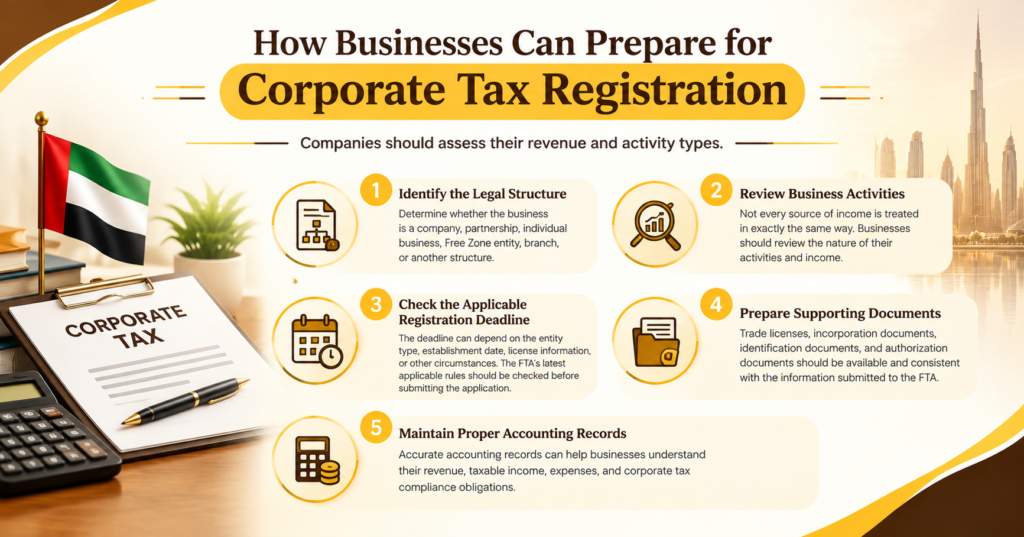
Companies should assess their revenue and activity types.
1. Identify the Legal Structure
Determine whether the business is a company, partnership, individual business, Free Zone entity, branch, or another structure.
2. Review Business Activities
Not every source of income is treated in exactly the same way. Businesses should review the nature of their activities and income.
3. Check the Applicable Registration Deadline
The deadline can depend on the entity type, establishment date, license information, or other circumstances. The FTA’s latest applicable rules should be checked before submitting the application.
4. Prepare Supporting Documents
Trade licenses, incorporation documents, identification documents, and authorization documents should be available and consistent with the information submitted to the FTA.
5. Maintain Proper Accounting Records
Accurate accounting records can help businesses understand their revenue, taxable income, expenses, and corporate tax compliance obligations.
Why Timely Registration Matters
In the UAE, corporate tax registration is just one aspect of tax compliance. After registration, businesses may also have responsibilities relating to tax returns, payments, financial records, supporting documentation, and other applicable requirements.
The FTA states that corporate tax returns and related amounts are generally due within the prescribed statutory timeframe, with the FTA currently reminding taxable persons that the period should not surpass nine months following the conclusion of the applicable tax period.
Businesses should therefore treat registration as the beginning of an ongoing compliance process rather than a one-time administrative task.
Conclusion
Understanding Who Should Register for Corporate Tax in the UAE and when registration is required is an important part of maintaining proper tax compliance. UAE companies, Free Zone businesses, non-resident persons with relevant UAE activities, and natural persons meeting the applicable business-revenue threshold should review their obligations carefully.
Because registration deadlines can depend on the entity structure, establishment date, license details, and applicable FTA decisions, businesses should keep their information and supporting documents up to date and check the latest requirements before submitting an application. UAE Corporate Tax Registration Rules can help businesses determine their applicable obligations.
For businesses that need assistance with corporate tax registration, accounting records, tax compliance, and related financial requirements, Singiri & Co in Dubai, UAE, provides accounting, tax, auditing, and business advisory services to support businesses with their financial and compliance needs.
FAQS
1. For corporate tax in the United Arab Emirates, who must register?
Generally speaking, all taxable individuals subject to UAE corporate tax must register with the FTA and receive a Corporate Tax Registration Number. If the FTA requests it, some exempt individuals might also have to register.
2. Does corporate tax registration apply to all UAE companies?
Juridical people who live in the UAE are typically covered by the corporate tax registration structure. However, specific exemptions and special rules can apply depending on the entity and its activities.
3. Do businesses in the Free Zone have to register for corporate tax?
The framework for corporate tax registration includes Free Zone businesses. Whether they satisfy the pertinent requirements—including those that apply to Qualifying Free Zone Persons—determines their particular corporate tax treatment.
4. When is it necessary for a new UAE company to register?
According to the FTA, resident juridical persons who are incorporated, established, or recognized on or after March 1, 2024, must register within three months of such events.
5. What is the natural person’s corporate tax registration threshold?
When a natural person’s yearly revenue from business activities surpasses AED 1 million in a Gregorian calendar year, they are usually required to register.
6. Does filing corporate taxes after the deadline result in a penalty?
Yes. According to the FTA, late corporate tax registration is subject to an administrative penalty of AED 10,000. A penalty-waiver initiative may apply when its specific conditions are satisfied.