
Mandatory E-Invoicing Implementation Requirements in UAE
The UAE is moving toward a structured and digitally connected invoicing environment. Businesses across the country need to understand the UAE e-Invoicing Mandatory Implementation 2026 requirements and prepare their accounting systems before their applicable compliance deadline.
The UAE Ministry of Finance has introduced a phased Electronic Invoicing System to standardize invoice exchange, improve data accuracy, support tax reporting, and reduce manual processes. The framework is based on the OpenPeppol standard and uses structured electronic invoice data rather than ordinary digital documents.
For businesses, e-invoicing is not simply a matter of converting paper invoices into PDF files. PDF files, Word documents, scanned invoices, images, and invoices sent only through email are not considered structured eInvoices under the UAE framework.
Understanding the UAE e-Invoicing Mandatory Implementation 2026 timeline, accredited service provider requirements, technical standards, invoice data, VAT considerations, and record-keeping obligations is therefore important for businesses preparing for the transition.
Table of Contents
What Is UAE E-Invoicing?
An electronic invoice, or eInvoice, is a structured form of invoice data that can be electronically processed, exchanged, and reported. It is designed to allow invoice information to move between businesses and relevant authorities in a standardized digital format.
The UAE e-invoicing system follows an electronic exchange model in which sellers and buyers use accredited service providers to exchange invoice information. Relevant tax information is also reported through the required channels to the Federal Tax Authority.
The UAE e-invoicing framework aims to support:
- Faster invoice processing
- Automated invoice exchange
- Better data accuracy
- Reduced manual data entry
- Improved tax reporting
- Greater financial visibility
- More efficient B2B transactions
- Improved compliance processes
Businesses should therefore view e-invoicing as a change to their overall invoicing and accounting process rather than simply as new invoicing software.
UAE e-Invoicing Mandatory Implementation 2026 Timeline
The UAE e-Invoicing Mandatory Implementation 2026 program is being introduced in phases based mainly on business revenue and entity type.
The current timeline is:
| Business or Entity | ASP Appointment Deadline | Mandatory Implementation |
|---|---|---|
| Businesses with annual revenue of AED 50 million or more | 30 October 2026 | 1 January 2027 |
| Businesses with annual revenue below AED 50 million | 31 March 2027 | 1 July 2027 |
| In-scope government entities | 31 March 2027 | 1 October 2027 |
The Ministry of Finance extended the Accredited Service Provider appointment deadline for businesses with annual revenue exceeding AED 50 million from 31 July 2026 to 30 October 2026. For these companies, the mandatory implementation date is still January 1, 2027.
A pilot phase began in July 2026, allowing selected participants and service providers to test technical integration and operational processes before mandatory implementation.
Businesses can also voluntarily adopt e-invoicing before their mandatory deadline, subject to the applicable requirements.
Who Needs to Follow UAE E-Invoicing Requirements?
The UAE e-invoicing framework generally applies to persons conducting business in the UAE for transactions within scope, subject to specified exclusions.
The framework covers business-to-business and business-to-government transactions, with the UAE’s broader rollout also supporting government-related electronic invoice exchanges.
Businesses should not assume that e-invoicing applies only to VAT-registered entities. The scope is based on the relevant UAE e-invoicing legislation and guidance, so each business should review its circumstances and applicable exclusions.
Understanding the UAE e-Invoicing Mandatory Implementation 2026 requirements early can help businesses determine whether their transactions, accounting systems, and business structure fall within the applicable requirements.
Accredited Service Provider UAE Requirements
An accredited service provider, commonly called an ASP, is a key part of the UAE e-invoicing framework.
Under the UAE model, the seller submits structured eInvoice information through its ASP. The ASP validates and exchanges the invoice with the buyer’s ASP, while relevant tax information is reported through the required reporting channel. The UAE system uses a decentralized five-corner model.
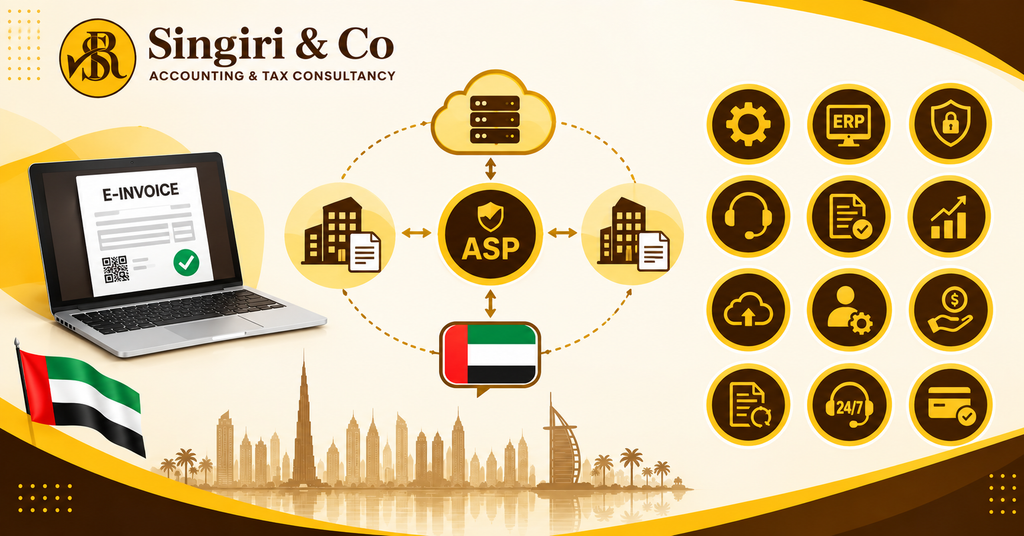
When selecting an accredited service provider, UAE businesses should consider:
- Accounting software compatibility
- ERP integration
- Data security
- PINT-AE support
- Invoice validation
- Reporting functionality
- Scalability
- Implementation assistance
- Technical support
- Pricing
- Credit note handling
The Ministry of Finance has also developed an ASP accreditation framework and provides guidance for businesses considering their service provider options.
UAE E-Invoice Format and PINT-AE
One of the most important UAE e-invoicing requirements is the use of structured invoice data.
The UAE framework uses the PINT-AE specification within the OpenPeppol environment. Electronic invoices are structured for machine processing rather than being simple documents that are manually read or emailed.
Depending on the transaction and document type, invoice information can include:
- Unique invoice number
- Invoice issue date
- Invoice type
- Currency
- Supplier information
- Buyer information
- Tax information
- Invoice line details
- Amounts and totals
- VAT information
Businesses should review their customer, supplier, product, tax, and accounting master data before implementation. Incorrect information can cause validation issues or create problems during invoice exchange.
UAE E-Invoicing and VAT Compliance
The UAE e-Invoicing Mandatory Implementation 2026 program is closely connected with tax administration and VAT compliance.
Businesses should ensure that their accounting systems correctly handle relevant VAT categories and transaction types. These may include standard-rated supplies, zero-rated supplies, exempt transactions, reverse-charge transactions, credit notes, refunds, and adjustments.
The Ministry of Finance states that e-invoicing can support tax reporting to the FTA and facilitate processes such as automatic pre-population of certain VAT return fields and faster VAT refund processing.
However, automation does not replace accounting controls. Businesses still need accurate VAT classification, proper documentation, reconciliation, and review procedures.
E-Invoicing Record-Keeping Requirements
Record keeping is another important part of UAE e-invoice compliance.
Businesses should ensure that electronic invoice data relating to issuance, transmission, and receipt is securely retained for the applicable statutory period. Accounting and document-management systems should allow businesses to retrieve records when required.
A proper backup and recovery process is also important. Businesses should consider how invoices will be handled if accounting software, ERP systems, internet connectivity, or ASP services experience technical interruptions.
Good record management can also help businesses maintain consistency between their invoicing, accounting, VAT reporting, and financial records.
UAE E-Invoicing Penalties
The UAE has established an administrative penalty framework for specified e-invoicing violations.
Cabinet Decision No. 106 of 2025 includes penalties such as AED 5,000 per month or part thereof for certain failures relating to implementation or ASP appointment. It also provides penalties for certain invoice and credit-note failures and specified notification obligations.
Because of these requirements, businesses should not leave system integration and compliance preparation until the final deadline.
Practical UAE E-Invoicing Implementation Checklist
Businesses preparing for the UAE e-Invoicing Mandatory Implementation 2026 should consider the following steps:
1. Identify Your Deadline
Review annual revenue and entity type to determine the applicable ASP appointment and implementation deadlines.
2. Review Current Invoicing Processes
Document how invoices are created, approved, issued, received, recorded, and stored.
3. Check Accounting Software
Confirm that your ERP or accounting system can support the required UAE e-invoicing specifications and integrate with an ASP.
4. Select an ASP.
Evaluate accredited service providers based on integration, security, support, scalability, functionality, and pricing.
5. Clean Master Data
Check customer names, supplier information, TRNs or relevant tax information, addresses, product codes, VAT classifications, and tax rates.
6. Map Transactions
Identify standard-rated, zero-rated, exempt, reverse-charge, credit-note, refund, and other transaction types.
7. Test the System
Test invoice creation, validation, transmission, rejection, correction, and credit-note processes.
8. Train Employees
Finance, sales, procurement, IT, and management teams should understand their responsibilities under the new process.
9. Establish Controls
Create procedures for approvals, errors, system failures, data changes, backups, and record retention.
10. Monitor Official Updates
The UAE e-invoicing program continues to develop. Businesses should monitor the Ministry of Finance and Federal Tax Authority for official updates.
Common UAE E-Invoicing Mistakes to Avoid
Businesses preparing for UAE e-invoicing mandatory implementation in 2026 should avoid several common mistakes.
Treating PDF invoices as eInvoices: A PDF alone does not satisfy the structured eInvoice requirement.
Waiting until the deadline: Integration and testing require preparation.
Selecting an ASP only on price: Businesses should also assess technical capabilities and support.
Ignoring master data: Incorrect customer or tax information can cause validation problems.
Forgetting credit notes: Relevant electronic credit notes also need to follow the applicable requirements.
Ignoring system failures: Businesses should establish procedures for technical interruptions.
Assuming automation replaces accounting controls: E-invoicing can reduce manual processes but does not eliminate the need for financial review.
How Singiri & Co Can Help
The UAE e-Invoicing Mandatory Implementation 2026 transition affects accounting, VAT, technology, data management, internal controls, and day-to-day invoicing.
Singiri & Co. provides accounting and bookkeeping, VAT and tax consulting, auditing, accounting software integration, and associated financial services to companies in Dubai and the UAE.
Professional accounting support can help businesses review their existing invoicing process, identify potential gaps, prepare accounting data, coordinate with technology providers, and strengthen internal controls.
Starting early gives businesses more time to understand their requirements, test their systems, train employees, and address potential technical issues before mandatory implementation.
Conclusion
The UAE e-Invoicing Mandatory Implementation 2026 programme represents a major change in how businesses issue, exchange, report, and retain invoice information.
Successful implementation requires more than installing invoicing software. Businesses need to understand their applicable deadline, review their accounting processes, select an appropriate ASP, prepare accurate master data, test integrations, train employees, and establish effective controls.
With mandatory implementation beginning in January 2027 for enterprises with yearly revenue of AED 50 million or more, preparedness during 2026 is vital. Businesses should use the remaining preparation period to assess their systems and work toward technical and operational readiness.
The UAE Ministry of Finance remains the primary official source for e-invoicing requirements and programme updates.
FAQS
1. Is e-invoicing mandatory in the UAE?
Yes. UAE e-invoicing is being introduced through a phased mandatory framework for persons conducting business in the UAE, subject to applicable exclusions and requirements.
2. Are PDF invoices considered UAE eInvoices?
No. PDF, Word, image, scanned, and email-only invoices are not structured eInvoices under the UAE framework.
3. When does mandatory e-invoicing start?
Businesses with annual revenue of AED 50 million or more are scheduled to implement e-invoicing from 1 January 2027. Businesses below AED 50 million are scheduled for 1 July 2027, while in-scope government entities are scheduled for 1 October 2027.
4.What is the ASP appointment deadline for large businesses?
Businesses must designate an Accredited Service Provider by October 30, 2026, if their yearly sales exceeds AED 50 million.
5.What standard does the UAE use?
The UAE e-invoicing framework uses the OpenPeppol standard and PINT-AE specifications for structured electronic invoices.
6. Map your transaction types
Identify standard-rated, zero-rated, exempt, reverse-charge, credit-note, refund, and other relevant transactions.
7. Monitor regulatory updates
The UAE eInvoicing programme is continuing to evolve. Businesses should regularly check the Ministry of Finance and FTA information for updated technical and regulatory guidance.