
UAE E-Invoicing Requirements & Implementation Timeline 2026–2027
The UAE is introducing a nationwide electronic invoicing framework as part of its digital transformation and efforts to modernize business and tax processes. The new system will change how businesses create, exchange, process, and maintain invoice information.
Understanding the UAE E-Invoicing Implementation Timeline 2026–2027 is important for companies of different sizes because implementation dates depend on factors such as annual revenue and whether the entity is an in-scope government organization.
Businesses should not wait until their mandatory deadline to begin preparation. Accounting software, financial data, customer and supplier information, invoice processes, internal controls, and employee workflows may all need to be reviewed before implementation.
Table of Contents
UAE E-Invoicing Timeline 2026-2027 Key Deadlines
The UAE e-invoicing system follows a phased implementation approach. Businesses are expected to prepare their systems and work with an Accredited Service Provider (ASP) where applicable.
The key deadlines are:
| Business Category | ASP Appointment Deadline | E-Invoicing Implementation Deadline |
|---|---|---|
| Businesses with annual revenue of AED 50 million or more | 30 October 2026 | 1 January 2027 |
| Businesses with annual revenue below AED 50 million | 31 March 2027 | 1 July 2027 |
| In-scope government entities | 31 March 2027 | 1 October 2027 |
| Voluntary implementation | From 1 July 2026 | Subject to applicable requirements |
Businesses with annual revenue of AED 50 million or more should pay particular attention to the 30 October 2026 ASP appointment deadline and the 1 January 2027 mandatory implementation date.
Companies below the AED 50 million threshold have additional preparation time, but they should still begin reviewing their accounting and invoicing systems well before their 2027 deadline.
Understanding the UAE E-Invoicing Implementation Timeline 2026–2027
The UAE’s e-invoicing rollout is designed to move businesses away from traditional paper-based and unstructured electronic invoicing toward structured electronic invoice data.
An e-invoice is not simply a PDF invoice sent by email. PDF files, scanned invoices, Word documents, images, and similar formats do not automatically qualify as structured e-invoices under the UAE framework.
The system is based on a Peppol-based four-corner model, which enables electronic invoice information to move between businesses and relevant service providers through standardized processes.
For businesses, this means e-invoicing should be viewed as a change to the overall invoicing and accounting process rather than simply a change in invoice design.
Key Requirements Under the UAE E-Invoicing Timeline 2026-2027 Key Deadlines
Businesses preparing for implementation should consider several important areas.
1. Accredited Service Provider
Businesses required to implement e-invoicing will need to work with an Accredited Service Provider (ASP) in accordance with the applicable UAE framework.
When selecting an ASP, businesses should consider:
- Accounting and ERP compatibility
- Integration capabilities
- Data security
- Technical support
- Implementation requirements
- Scalability
- Commercial costs
- Ability to handle required invoice data
Choosing a suitable provider early can give the business sufficient time for configuration and testing.
2. Structured Electronic Invoices
Businesses need to be prepared to generate and exchange structured electronic invoice information.
This means companies should check whether their existing accounting or ERP software can support the relevant UAE e-invoicing requirements and integrate with the selected service provider.
3. Accurate Financial and Customer Data
Good-quality data is essential for successful e-invoicing implementation.
Businesses should review:
- Customer legal names
- Supplier information
- Tax registration details
- Addresses
- Product and service descriptions
- Invoice numbers
- Tax information
- Payment details
- Accounting records
Incorrect or incomplete information can cause validation, processing, reconciliation, or reporting problems.
How to Prepare for the UAE E-Invoicing Timeline 2026-2027 Key Deadlines
Preparing for the requires more than installing new software. Businesses should evaluate their complete invoice-to-accounting workflow.
Review Your Accounting Software
Start by checking whether the existing accounting software or ERP system can support UAE e-invoicing requirements.
Businesses should discuss integration capabilities with their software provider and determine whether additional configuration, upgrades, or third-party integration will be required.
Select an Accredited Service Provider
Businesses should review the officially available accredited service providers and select one that fits their operational and technical requirements.
The provider should be capable of connecting the company’s accounting environment with the required electronic invoicing framework.
Clean Financial Data
Before implementation, businesses should review customer, supplier, tax, product, and service records.
Removing duplicate records and correcting incomplete or inaccurate information can help create a smoother transition.
Map Current Invoice Processes
Companies should document how invoices are currently:
- Created
- Reviewed
- Approved
- Sent
- Received
- Recorded
- Reconciled
- Archived
This process mapping can help identify areas that need to be changed for electronic invoicing.
Test the System
Testing should be completed before the mandatory implementation date.
Businesses can test invoice creation, transmission, validation, error handling, credit notes, accounting integration, and reconciliation processes.
Train Employees
Employees involved in accounting, finance, sales, procurement, and administration should understand the new procedures.
Training can reduce processing errors and help employees understand what to do when an invoice fails validation or requires correction.
UAE E-Invoicing Timeline 2026-2027: Key Deadlines and Tax Compliance
The should be considered alongside existing accounting and VAT compliance responsibilities.
Businesses need to maintain accurate financial records and ensure that invoice information is properly reflected in their accounting systems.
For VAT-registered businesses, companies should pay particular attention to consistency between invoices, accounting records, VAT information, credit notes, payments, and supporting documentation.
E-invoicing should therefore be integrated into the company’s wider financial-control and tax-compliance processes rather than being treated as a standalone technology project.
Why Businesses Should Start Preparing Early
The process provides businesses with defined dates, but successful implementation can involve multiple stages.
A company may need to:
- Select an ASP
- Upgrade accounting software
- Configure system integrations
- Review customer and supplier data
- Update invoice workflows
- Test electronic invoice transmission
- Establish error-handling procedures
- Train employees
- Coordinate with customers and suppliers
Starting early gives businesses more time to identify technical or accounting issues before the mandatory implementation date.
Businesses with an implementation deadline in 2027 should not assume that preparation can be completed immediately before the deadline. Software integration, data cleaning, testing, and employee training can require coordination across multiple departments.
Benefits of Preparing for UAE Electronic Invoicing
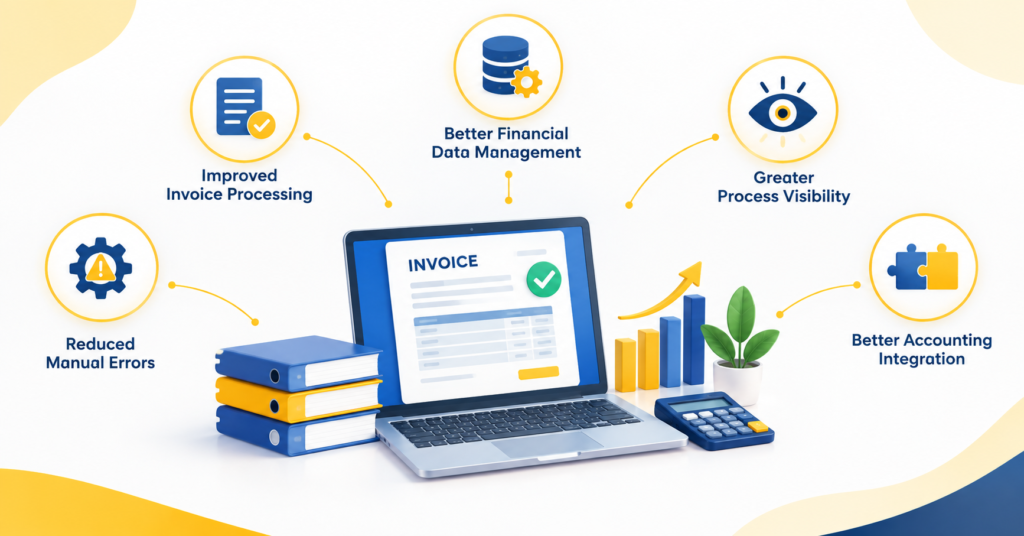
Proper preparation can help businesses improve several aspects of their accounting operations.
Improved Invoice Processing
Electronic processes can reduce dependence on manual invoice entry and document handling.
Better Financial Data Management
Structured invoice information can make it easier to maintain consistent financial records and support reconciliation.
Greater Process Visibility
Digital invoice workflows can provide businesses with better visibility into invoice status, approvals, and processing.
Reduced Manual Errors
Automation and standardized data can help reduce certain manual data-entry and processing errors.
Better Accounting Integration
When properly configured, e-invoicing can connect invoice processes more closely with accounting and financial reporting systems.
Role of Accounting Professionals in E-Invoicing Preparation
The implementation of electronic invoicing involves both technology and accounting processes. Professional accounting support can help businesses review their existing financial procedures and identify areas that need improvement.
Accounting professionals can assist with bookkeeping, financial data organization, invoice processes, VAT-related records, reconciliations, and coordination with technology providers.
For small and medium-sized businesses, professional assistance can also help management understand how e-invoicing may affect existing accounting workflows.
Preparing for the UAE E-Invoicing Timeline 2026-2027 Key Deadlines With Singiriandco
Preparing for the can be easier when businesses have organized accounting records and clearly documented financial processes.
Singiriandco provides accounting, bookkeeping, payroll, tax consultancy, and business support services for businesses in Dubai and the UAE. Professional accounting support can help businesses maintain accurate financial records, review bookkeeping processes, organize invoice information, and prepare their finance functions for evolving UAE compliance requirements.
Businesses can also benefit from reviewing their accounting workflows before connecting them with their selected e-invoicing technology provider.
Conclusion
This represents an important change in the UAE’s digital accounting environment. Businesses should identify their applicable deadline, review their accounting software, prepare financial data, select an accredited service provider where required, test their systems, and train relevant employees.
Companies with annual revenue of AED 50 million or more should pay close attention to the 30 October 2026 ASP appointment deadline and 1 January 2027 implementation deadline. Businesses below AED 50 million should also begin preparing for their 1 July 2027 implementation date.
With accounting and bookkeeping support from Singiriandco, businesses can organize their financial records, review accounting workflows, and prepare their finance operations.
Businesses should continue monitoring official UAE Ministry of Finance guidance for updates to e-invoicing requirements, technical specifications, accredited service providers, and implementation procedures.
FAQS
1. What is the UAE e-invoicing implementation deadline?
The deadline depends on the applicable business category. Businesses with annual revenue of AED 50 million or more have a mandatory implementation date of 1 January 2027. Businesses below AED 50 million have an implementation deadline of 1 July 2027, while in-scope government entities have a deadline of 1 October 2027.
2. When must businesses appoint an accredited service provider?
Businesses with annual revenue of AED 50 million or more must appoint an ASP by 30 October 2026. Businesses below AED 50 million and applicable government entities have an ASP appointment deadline of 31 March 2027
3. Is a PDF invoice considered an e-invoice?
No. A PDF, scanned document, image, or Word file does not automatically qualify as a structured electronic invoice under the UAE e-invoicing framework.
4. Can businesses voluntarily implement e-invoicing?
Yes. Businesses can voluntarily implement e-invoicing from 1 July 2026, subject to the applicable requirements.
5. Does every UAE business have the same e-invoicing deadline?
No. The rollout is phased. The applicable deadline depends on factors including annual revenue and the type of entity.
6. What is an Accredited Service Provider?
An accredited service provider is an approved provider that supports businesses with electronic invoicing services in accordance with the UAE’s applicable technical and regulatory framework.
7. Does e-invoicing replace accounting records?
No. E-invoicing forms part of the invoice and reporting process. Businesses still need to maintain appropriate accounting records and supporting financial documentation.