

Corporate Tax On Income from Qualifying Intellectual Property (IP) Rights by Free Zone Companies
The United Arab Emirates (UAE) has become one of the most attractive business destinations in the world. Many companies choose UAE Free Zones because of their tax benefits, easy business setup process, and global business opportunities. Recently, the UAE introduced corporate tax rules for businesses, including Free Zone companies.
One important topic under the new tax system is corporate tax on intellectual property in free zones. Many businesses earn income from intellectual property such as trademarks, patents, copyrights, software, and designs. Understanding how this income is taxed is very important for companies operating in UAE Free Zones.
Table of Contents
What is Intellectual Property (IP)?
Intellectual Property (IP) means creations of the mind that have commercial value. Businesses pay corporate tax on intellectual property in free zones to protect their products, services, inventions, and brand identity.
Common examples of intellectual property include:
- Trademarks
- Patents
- Copyrights
- Software programs
- Brand names
- Logos
- Industrial designs
- Trade secrets
Many businesses generate huge profits from their IP rights. For example, softwa
What is corporate tax in the UAE?
The UAE introduced corporate tax on intellectual property in free zones to create an internationally recognized tax system and support economic growth. Corporate tax generally applies to business profits.
The standard corporate tax rate in the UAE is:
- 0% on taxable income up to AED 375,000
- 9% on taxable income above AED 375,000
However, Free Zone businesses may enjoy special tax benefits if they meet certain conditions.
Understanding Free Zone Companies
Free Zones are special business areas in the UAE that offer benefits to investors and companies. These benefits may include:
- 100% foreign ownership
- Easy company registration
- Customs benefits
- International business opportunities
- Tax advantages
Popular free zones in the UAE include:
- Dubai Multi Commodities Centre (DMCC)
- Dubai Internet City
- Dubai Media City
- Jebel Ali Free Zone (JAFZA)
- Abu Dhabi Global Market (ADGM)
What is a Qualifying Free Zone Person (QFZP)?
A Qualifying Free Zone Person (QFZP) is a free zone company that meets specific conditions under UAE corporate tax law. Corporate tax on intellectual property in free zones may qualify for the 0% rate when the income meets the requirements for qualifying income.
A QFZP must:
- Derive qualifying income
- Maintain adequate substance in the Free Zone
- Follow relevant transfer pricing provisions
- Prepare audited financial statements
- Meet de minimis requirements
- Not elect to be taxed under the UAE Corporate Tax regime
A QFZP can enjoy a 0% corporate tax rate on qualifying income, subject to meeting all applicable conditions.
What is Qualifying Intellectual Property (QIP)?
Qualifying intellectual property generally includes
- Patents
- Copyrighted software
- Utility models
- Other legal rights that are functionally equivalent
However, some intellectual property assets do not qualify.
- Trademarks
- Brand names
- Marketing-related intellectual property assets
What is Qualifying Income for Free Zone Companies?
A Free Zone company may become a “Qualifying Free Zone Person” if it satisfies certain conditions under UAE corporate tax law.
Qualifying income may receive a 0% corporate tax rate. However, businesses must follow all required rules and maintain proper compliance.
- Transactions with other Free Zone businesses
- Certain international business activities
- Income from qualifying intellectual property rights
Corporate Tax Effect on IP Income
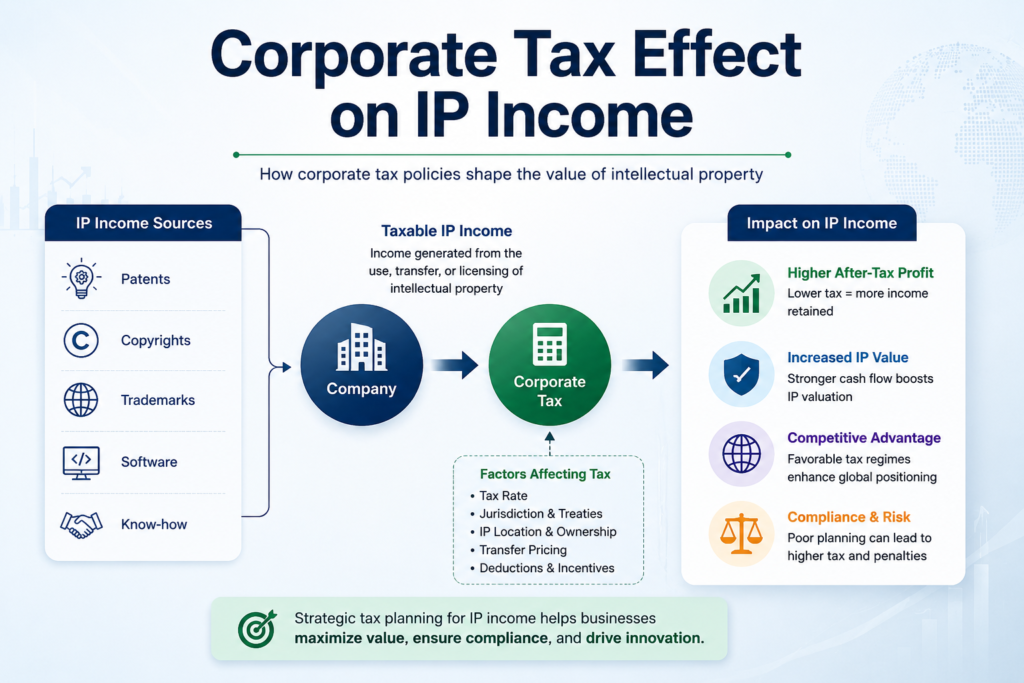
Many businesses believe all intellectual property income automatically qualifies for the 0% tax rate. However, this is not correct.
Under UAE corporate tax rules:
- A QFZP cannot automatically treat all IP income as eligible for the 0% corporate tax rate.
- Only the portion calculated under the prescribed formula qualifies as “Qualifying Income.”
- The balance of non-qualifying income will be subject to corporate tax at the rate of 9%.
This is one of the most important rules under corporate tax on intellectual property in free zones.
Nexus Approach for Intellectual Property Income
The UAE follows the OECD Nexus Approach, which links tax benefits to genuine R&D activities. Companies must demonstrate real IP development activities to qualify for tax benefits.
- A software company developing applications in a UAE Free Zone may qualify.
- A company only holding IP without active development may not qualify.
The Nexus approach ensures fairness and transparency in corporate tax on intellectual property in free zones.
Formula for Calculating Qualifying Income
The UAE Corporate Tax law provides a specific formula to calculate qualifying income from intellectual property.
Formula
(Qualifying Expenditure + Uplift Expenditure) × Overall Income ÷ Overall Expenditure
Understanding the Formula Components
1. Qualifying Expenditure
- R&D expenses incurred directly by the Free Zone company
- R&D outsourced to unrelated parties for developing the IP
2. Overall Expenditure
- Total R&D costs
- Acquisition costs related to the IP
3. Overall Income
- Royalty income
- Licensing fees
- Other income generated from the intellectual property
4. Uplift Expenditure
An additional 30% uplift expenditure is allowed on qualifying expenditures.
Important Note About R&D Activities
Qualifying IP income must come from the company’s own R&D activities or supervised outsourcing to non-related parties. These requirements are essential for obtaining tax benefits in free zones.
Example Calculation
A DMCC Free Zone software company has:
- Direct in-house R&D cost: AED 1,000,000
- Outsourced R&D to related party: AED 400,000
- Purchased IP cost: AED 200,000
- Royalty income: AED 3,000,000
Step 1: Calculate Qualifying Income
(1,000,000 + 300,000) ÷ (1,000,000 + 400,000 + 200,000) × 3,000,000
= AED 2,437,500
Step 2: Calculate Non-Qualifying Income
AED 3,000,000 – AED 2,437,500
= AED 562,500
Step 3: Calculate Corporate Tax Liability
- AED 2,437,500 × 0% = AED 0
- AED 562,500 × 9% = AED 50,625
Total Corporate Tax Liability
AED 50,625
This example clearly explains how corporate tax on intellectual property in free zones works in practice.
Types of Income from Intellectual Property
IP income may come from different sources, including:
1. Royalty Income
Companies may earn royalties from licensing their intellectual property to others.
2. Software Licensing Fees
Software companies often generate revenue through software subscriptions and licenses.
3. Patent Income
Manufacturing and technology businesses may earn income from patented products.
4. Franchise Fees
Businesses may earn franchise income linked to trademarks and brand names.
5. Copyright Revenue
Media and entertainment companies may earn from copyrighted content.
These income streams may fall under corporate tax on intellectual property in free zones depending on eligibility conditions.
Conditions to Qualify for Free Zone Tax Benefits
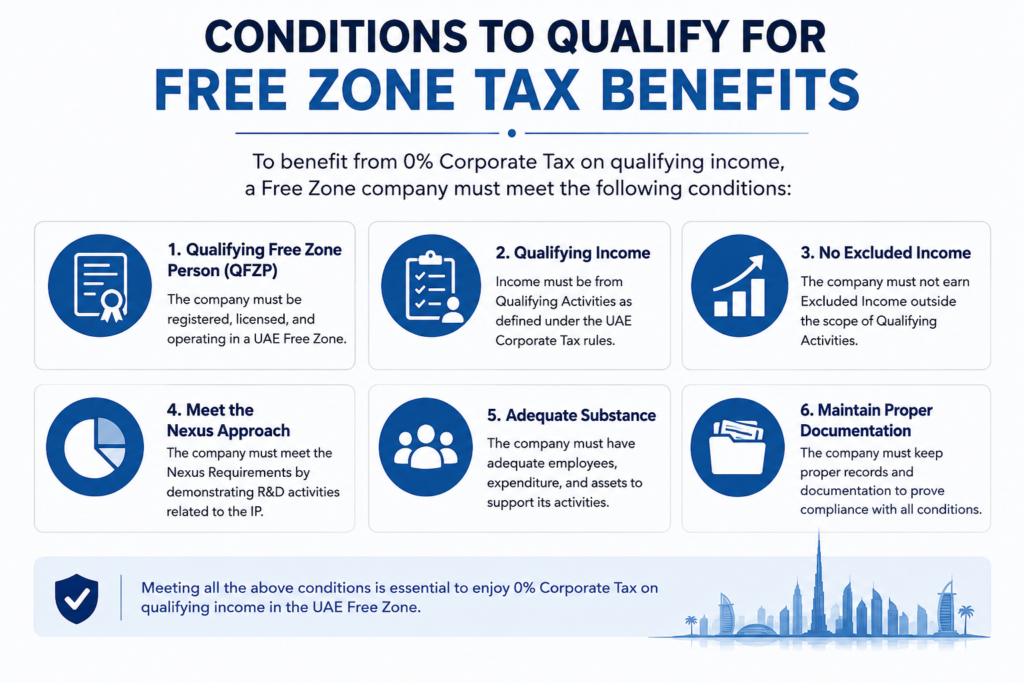
To enjoy tax advantages, Free Zone companies must meet several conditions:
Maintain Adequate Substance
The business must have real operations in the UAE.
Generate Qualifying Income
Income should meet the definition under UAE corporate tax law.
Maintain Proper Documentation
Companies must keep records related to IP development and income generation.
Comply with Transfer Pricing Rules
Transactions between related companies must follow market pricing rules.
Prepare Audited Financial Statements
Many Free Zone businesses are required to maintain audited accounts.
Failure to comply may result in losing the 0% corporate tax benefit.
Transfer Pricing and Intellectual Property
Related-party transactions involving intellectual property must follow fair market value rules. Businesses should also consider corporate tax on intellectual property in free zones, as incorrect pricing may result in tax adjustments and penalties under UAE corporate tax regulations.
Record Keeping Requirements
Proper documentation is necessary for compliance.
- IP registration certificates
- R&D expense records
- Licensing agreements
- Royalty contracts
- Financial statements
- Transfer pricing documents
Good record keeping helps companies defend their tax position during audits.
Benefits of Proper Tax Planning
Businesses that plan properly can enjoy several advantages:
- Better tax efficiency
- Reduced compliance risks
- Improved business reputation
- Financial transparency
- Stronger investor confidence
Professional tax planning also helps businesses avoid costly mistakes.
Conclusion
The introduction of corporate tax on intellectual property in free zones has made IP income compliance more important for free zone companies. Businesses earning income from patents, software, copyrights, and licensing must understand the rules on qualifying income, nexus requirements, transfer pricing, and proper documentation
FAQS
1. What is corporate tax on intellectual property in Free Zones?
UAE corporate tax rules for income earned from intellectual property by Free Zone companies.
2. What qualifies as intellectual property?
Patents, copyrighted software, utility models, and protected inventions.
3. Can Free Zone companies get 0% corporate tax?
Yes, if they meet the conditions for qualifying income.
4. What is the Nexus Approach?
It links tax benefits to genuine R&D activities.
5. Why is transfer pricing important?
It ensures related-party transactions are conducted at fair market value.