

VAT Return in UAE: Complete Guide to Filing and Compliance in 2026
The Value Added Tax (VAT) system has become an important part of business operations in the United Arab Emirates. Since VAT was introduced in 2018, all eligible businesses have been required to register, maintain records, and submit tax returns regularly. Understanding the process of filing a VAT Return in UAE is essential for staying compliant and avoiding penalties.
Whether you run a small business, startup, trading company, or large enterprise, filing VAT returns correctly helps maintain financial transparency and ensures compliance with the Federal Tax Authority (FTA). In this guide, we will explain everything you need to know about VAT returns, filing procedures, deadlines, common mistakes, and how professional tax consultants can help.
Table of Contents
What is a VAT Return?
A VAT return is a document submitted to the UAE Federal Tax Authority (FTA) that summarizes a business’s taxable sales, purchases, output VAT, and input VAT during a specific tax period.
The purpose of a VAT return is to calculate the VAT payable to the government or the amount that can be reclaimed by the business.
A VAT return generally includes:
- Total sales and revenue
- VAT collected on sales (Output VAT)
- VAT paid on purchases (Input VAT)
- Imports and exports
- VAT payable or refundable
Every VAT-registered business must submit a VAT Return in UAE according to the filing schedule assigned by the FTA.
Who Needs to File VAT Returns in UAE?
Businesses registered for VAT must file VAT returns regularly.
Mandatory VAT registration applies when taxable supplies exceed AED 375,000 annually.
Voluntary registration is available when taxable supplies exceed AED 187,500 annually.
Entities required to file VAT returns include:
- Trading companies
- Manufacturing businesses
- E-commerce businesses
- Service providers
- Construction companies
- Hospitality businesses
- Importers and exporters
Once registered, businesses must submit returns even if there was no business activity during the tax period.
VAT Return Filing Periods
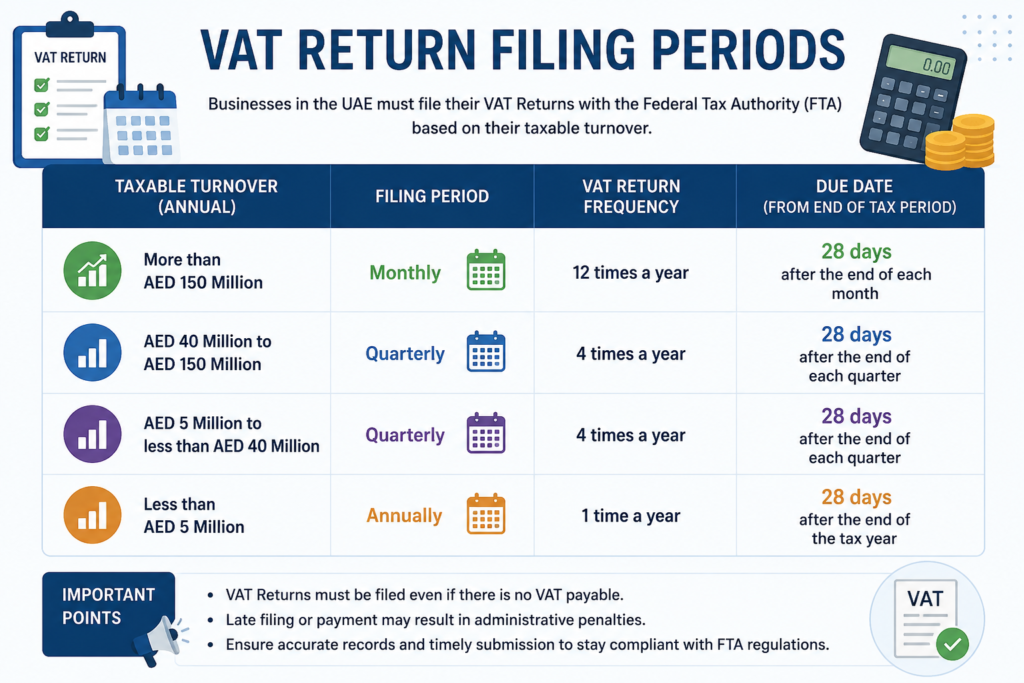
The Federal Tax Authority assigns filing periods based on business size and turnover.
Monthly Filing
Some large businesses may be required to submit VAT returns every month.
Quarterly Filing
Most SMEs and medium-sized businesses file VAT returns every quarter.
The FTA informs businesses about their filing period through their tax registration profile.
Information Required for VAT Return Filing
Before submitting a VAT return, businesses should gather all relevant financial records.
These records include:
Sales Invoices
All taxable sales made during the period should be documented properly.
Purchase Invoices
Businesses can claim eligible VAT paid on purchases and expenses.
Credit Notes
Adjustments made to invoices should be included.
Import Documents
Import VAT details must be reported accurately.
Accounting Records
Financial statements and bookkeeping records should match the figures reported in the VAT return.
Accurate documentation ensures a smooth VAT Return in UAE filing process.
Steps to File VAT Return in UAE
The filing process is completed online through the FTA portal.
Step 1: Log in to the FTA Portal
Access your registered account using your credentials.
Step 2: Select VAT Return Form
Choose the appropriate tax period.
Step 3: Enter Sales Details
Report taxable supplies, exempt supplies, and zero-rated supplies.
Step 4: Enter Purchase Details
Provide details of purchases and expenses eligible for VAT recovery.
Step 5: Calculate VAT
The system calculates:
- Output VAT
- Input VAT
- Net VAT payable
Step 6: Review Information
Verify all figures carefully before submission.
Step 7: Submit Return
Submit the VAT return electronically through the portal.
Step 8: Pay VAT Liability
Any VAT due must be paid before the deadline.
Following these steps helps businesses complete their VAT Return in UAE efficiently.
VAT Return Deadlines
VAT returns must be filed within 28 days after the end of the tax period.
For example:
If the tax period ends on March 31, the VAT return must be filed by April 28.
Missing deadlines can result in financial penalties and compliance issues.
Businesses should maintain a compliance calendar to track filing obligations.
Common VAT Return Mistakes
Many businesses face challenges due to incorrect reporting.
Some common errors include:
Incorrect Tax Calculations
Errors in VAT calculations can lead to underpayment or overpayment.
Missing Invoices
Incomplete documentation may result in rejected VAT claims.
Late Filing
Missing deadlines can trigger penalties from the FTA.
Wrong Tax Treatment
Incorrect classification of taxable and exempt supplies can create compliance issues.
Failure to Maintain Records
Businesses must retain records for at least five years.
Avoiding these mistakes ensures a smooth VAT Return in UAE process.
Penalties for Non-Compliance
The UAE government has established strict penalties for VAT violations.
Penalties may apply for:
- Late VAT registration
- Failure to submit returns
- Late payment of VAT
- Incorrect VAT reporting
- Failure to maintain records
Repeated violations can lead to increased penalties and additional scrutiny from tax authorities.
Therefore, businesses should prioritize timely compliance.
Benefits of Proper VAT Return Filing
Accurate VAT compliance offers several advantages.
Avoid Penalties
Timely filing helps businesses avoid unnecessary fines.
Better Financial Management
VAT reporting provides insights into company finances.
Improved Credibility
Proper compliance improves trust among investors, clients, and regulators.
Easier Audits
Well-maintained records simplify tax audits.
Business Growth
Compliance allows businesses to focus on expansion without tax-related concerns.
A properly managed VAT Return in UAE system supports long-term business success.
VAT Record Keeping Requirements
The Federal Tax Authority requires businesses to maintain proper records.
Important records include:
- Tax invoices
- Credit notes
- Debit notes
- Import documents
- Bank statements
- Accounting records
- VAT calculations
Businesses should store records securely and ensure easy access during audits.
Digital record-keeping systems can significantly improve compliance efficiency.
How Technology Helps VAT Compliance
Modern accounting software has simplified VAT management.
Popular accounting solutions can:
- Generate VAT reports
- Track invoices
- Calculate VAT automatically
- Store records securely
- Reduce human errors
Businesses using technology often experience smoother VAT filing processes and better financial control.
Why Professional VAT Consultants Are Important
VAT regulations can be complex, especially for growing businesses.
Professional consultants help by:
- Reviewing financial records
- Preparing VAT returns
- Ensuring compliance
- Identifying VAT risks
- Handling FTA communications
- Supporting audits
Expert assistance minimizes errors and allows businesses to focus on core operations.
VAT Return in UAE: Future Outlook
The UAE continues to strengthen its tax framework to align with international standards.
Businesses should expect:
- Increased digital compliance requirements
- Enhanced reporting standards
- Greater regulatory monitoring
- Improved tax administration systems
Staying updated with changing regulations is essential for maintaining compliance.
Companies that adopt strong tax practices today will be better prepared for future regulatory developments.
Conclusion
Filing a VAT Return in UAE is a critical responsibility for every VAT-registered business. Accurate reporting, proper documentation, and timely submission help businesses avoid penalties and maintain compliance with Federal Tax Authority regulations.
As VAT requirements continue to evolve, professional guidance can make a significant difference in ensuring smooth and error-free tax management.
Choose Singiri & Co for Expert VAT Services
If your business needs assistance with VAT Return in UAE filing, VAT registration, bookkeeping, tax compliance, or FTA support, Singiri & Co is here to help.
Our experienced tax professionals provide:
- VAT Registration Services
- VAT Return Filing
- Tax Compliance Support
- Bookkeeping Services
- Corporate Tax Advisory
- Financial Reporting Assistance
- Audit Support
At Singiri & Co, we help businesses stay compliant, reduce risks, and focus on growth. Contact our team today for reliable and professional VAT solutions tailored to your business needs.
FAQS
1. What is a VAT return in UAE?
A VAT return is a tax report submitted to the Federal Tax Authority showing sales, purchases, output VAT, and input VAT for a specific tax period.
2. How often should VAT returns be filed in UAE?
Most businesses file quarterly, while some larger businesses may be required to file monthly.
3. What is the deadline for filing VAT returns?
VAT returns must generally be submitted within 28 days after the end of the tax period.
4. Can a business submit a VAT return with no transactions?
Yes. VAT-registered businesses must submit returns even if no transactions occurred during the tax period.
5. What happens if a VAT return is filed late?
Late filing may result in penalties imposed by the federal tax authority.
6. Can businesses recover VAT on purchases?
Yes, eligible businesses can recover VAT paid on qualifying business expenses.
7. How long should VAT records be maintained?
Businesses must generally keep VAT-related records for at least five years.
8. Why should businesses hire VAT consultants?
VAT consultants help ensure compliance, reduce errors, avoid penalties, and manage tax obligations efficiently.