
Corporate Tax Return Filing UAE
The introduction of corporate tax has transformed the UAE business landscape, making tax compliance an essential responsibility for companies operating across the Emirates. Whether you own a mainland company, free zone entity, or branch office, understanding UAE corporate tax return filing UAE requirements is crucial to avoid penalties and maintain compliance with the Federal Tax Authority (FTA).
Every taxable business must prepare and submit an accurate corporate tax return within the prescribed deadline. Proper filing not only ensures legal compliance but also demonstrates transparency, strengthens financial management, and builds trust with investors, financial institutions, and government authorities.
In this comprehensive guide, we explain everything businesses need to know about Corporate Tax Return Filing UAE, including eligibility, deadlines, required documents, filing procedures, penalties, and best practices.
Table of Contents
What is Corporate Tax Return Filing UAE?
Corporate Tax Return Filing UAE is the process of submitting a company’s taxable income, financial information, allowable deductions, and tax liability to the UAE Federal Tax Authority (FTA).
The corporate tax return is an official declaration that enables the FTA to determine the amount of tax payable by a business.
Businesses are required to:
- Calculate taxable income
- Claim eligible deductions
- Declare exempt income where applicable
- Report tax liability accurately
- Submit the return before the deadline
- Maintain supporting financial records
Who Needs Corporate Tax Return Filing UAE?
Most businesses operating in the UAE are required to file corporate tax returns, including:
- Mainland companies
- Limited Liability Companies (LLCs)
- Sole establishments (where applicable)
- Foreign companies with UAE taxable income
- Branch offices
- Professional firms
- Certain Free Zone businesses
Even if no corporate tax is payable, many businesses are still required to submit a corporate tax return.
Corporate Tax Rates in the UAE
The UAE corporate tax system is straightforward.
0% Tax Rate
Applicable on taxable income up to AED 375,000.
9% Tax Rate
Applicable on taxable income exceeding AED 375,000.
Certain multinational enterprises may be subject to different international tax rules under OECD Pillar Two regulations.
Why Corporate Tax Return Filing UAE is important.
Timely filing provides several benefits:
- Compliance with UAE tax regulations
- Avoidance of administrative penalties
- Accurate financial reporting
- Improved business credibility
- Better financial planning
- Easier bank financing
- Increased investor confidence
- Reduced risk of FTA audits
Ignoring filing requirements can lead to unnecessary financial losses and compliance issues.
Documents Required for Corporate Tax Return Filing UAE
Businesses should prepare the following documents before filing:
- Audited financial statements (if applicable)
- Profit and Loss Statement
- Balance Sheet
- Trial Balance
- General Ledger
- Corporate Tax Registration Number
- Trade License
- Expense records
- Revenue reports
- Payroll records
- Bank statements
- Fixed asset register
- Previous tax records (if applicable)
Maintaining accurate bookkeeping throughout the year simplifies the filing process significantly.
Steps for Corporate Tax Return Filing UAE
1. Maintain Proper Accounting Records
Accurate bookkeeping is the foundation of tax compliance. Every business transaction should be recorded correctly.
2. Prepare Financial Statements
Generate complete financial statements that comply with applicable accounting standards.
3. Calculate Taxable Income
Determine taxable income after adjusting for allowable deductions and exempt income.
4. Verify Tax Adjustments
Ensure all tax adjustments are correctly calculated according to UAE corporate tax law.
5. Complete the Corporate Tax Return
Enter financial information accurately through the FTA online portal.
6. Review Before Submission
Double-check figures, supporting documents, and calculations before submitting.
7. Submit Before Deadline
Submit your return before the due date to avoid penalties.
8. Pay Corporate Tax
If tax is payable, make payment before the specified deadline.
Common Mistakes During Corporate Tax Return Filing UAE
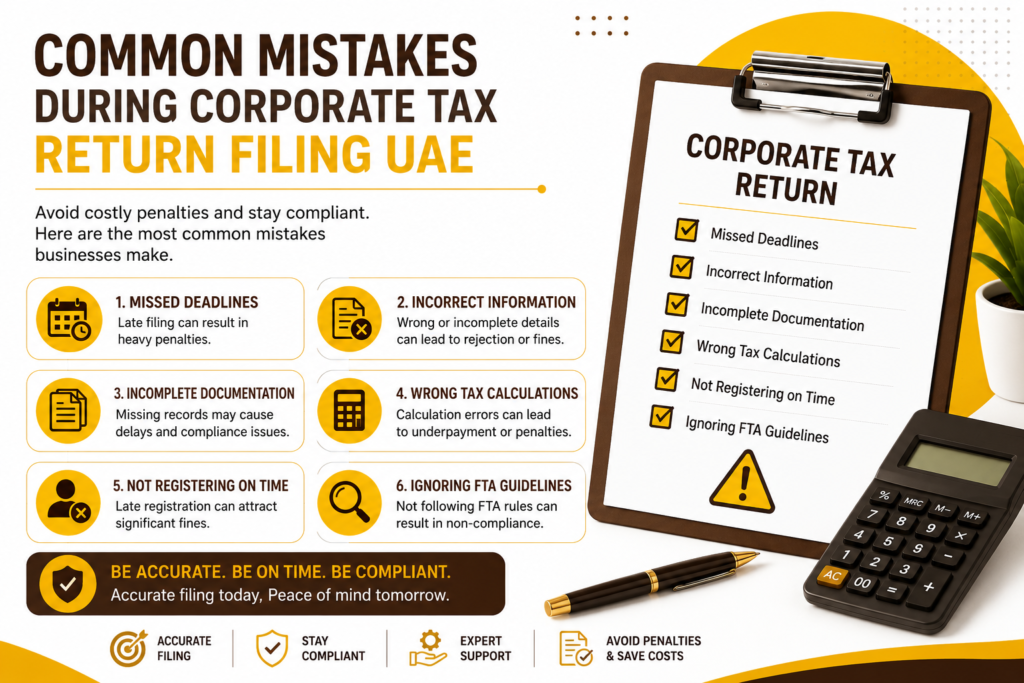
Many businesses face compliance issues because of avoidable mistakes.
These include:
- Incorrect taxable income calculation
- Missing filing deadlines
- Incomplete documentation
- Claiming non-allowable expenses
- Errors in financial statements
- Failure to maintain accounting records
- Incorrect tax adjustments
- Not reviewing the return before submission
Professional tax advisors help businesses avoid these costly errors.
Benefits of Professional Corporate Tax Filing Services
Working with experienced tax consultants provides numerous advantages:
- Accurate tax calculations
- Timely return submission
- Reduced compliance risks
- Expert tax planning
- Proper documentation
- Assistance during FTA audits
- Ongoing compliance support
- Peace of mind
Professional support allows business owners to focus on growth while ensuring tax obligations are fulfilled.
Corporate Tax Return Filing Deadlines
The filing deadline generally depends on the company’s financial year-end.
Businesses should:
- Monitor filing deadlines carefully
- Prepare accounts early
- Complete tax calculations in advance
- Avoid last-minute submissions
Late filing may result in administrative penalties imposed by the FTA.
Record Keeping Requirements
The UAE Corporate Tax Law requires businesses to maintain financial records for the prescribed period.
Records should include:
- Sales invoices
- Purchase invoices
- Accounting books
- Payroll records
- Contracts
- Bank statements
- Tax calculations
- Financial reports
Proper record keeping supports accurate tax filing and simplifies future audits.
How to Reduce Corporate Tax Risks
Businesses can improve compliance by:
- Maintaining proper bookkeeping
- Conducting regular financial reviews
- Reconciling accounts monthly
- Keeping supporting documents
- Monitoring tax law updates
- Working with experienced tax advisors
- Filing returns on time
Proactive tax management minimizes compliance risks and financial penalties.
Why Businesses Choose Professional Tax Consultants
Corporate taxation involves more than simply submitting a return.
Professional consultants assist with:
- Tax registration
- Tax planning
- Financial statement preparation
- Corporate tax advisory
- Compliance reviews
- Tax return preparation
- FTA communication
- Audit support
Their expertise ensures businesses remain compliant while optimizing tax efficiency.
Conclusion
Navigating Corporate Tax Return Filing UAE can be challenging, especially with evolving tax regulations and strict compliance requirements. Accurate bookkeeping, proper documentation, timely filing, and professional tax planning are essential for avoiding penalties and maintaining smooth business operations.
If you’re looking for reliable experts to handle your corporate tax obligations, Singiri & Co is your trusted partner in the UAE. With extensive experience in accounting, auditing, bookkeeping, VAT, and corporate tax services, Singiri & Co helps businesses file accurate corporate tax returns while ensuring full compliance with UAE Federal Tax Authority regulations.
Whether you’re a startup, SME, or large enterprise, the experienced professionals at Singiri & Co provide personalized tax solutions that save time, reduce compliance risks, and support long-term business growth. Partner with Singiri & Co for hassle-free corporate tax return filing UAE services and focus on growing your business with confidence.
FAQS
1. What is Corporate Tax Return Filing UAE?
It is the process of submitting a company’s taxable income and corporate tax details to the UAE Federal Tax Authority.
2. Who must file a corporate tax return in the UAE?
Most mainland companies, eligible free zone businesses, branches, and taxable entities operating in the UAE must file a corporate tax return.
3. What is the corporate tax rate in the UAE?
A 0% rate applies to taxable income up to AED 375,000, and a 9% rate applies to taxable income exceeding AED 375,000, subject to applicable laws.
4. What documents are required for corporate tax return filing?
Common documents include financial statements, accounting records, trade license, bank statements, payroll records, and supporting invoices.
5. What happens if I file my corporate tax return late?
Late filing may result in administrative penalties and additional compliance issues with the Federal Tax Authority.
6. Can I file my corporate tax return myself?
Yes, but many businesses choose professional tax consultants to ensure accuracy, compliance, and timely submission.
7. Why should I hire Singiri & Co for corporate tax filing?
Singiri & Co offers expert corporate tax advisory, accurate return preparation, compliance support, and end-to-end filing services to help businesses meet UAE tax requirements efficiently.
8. How can proper bookkeeping help with corporate tax return filing?
Accurate bookkeeping ensures reliable financial records, simplifies tax calculations, supports compliance, and reduces the risk of filing errors.