VAT compliance is an important responsibility for businesses registered for Value Added Tax in the United Arab Emirates. Filing VAT returns accurately and within the required deadline helps businesses maintain proper tax records and avoid unnecessary administrative penalties. Understanding the UAE VAT return filing rules and payment deadlines is also essential for maintaining accurate and timely tax compliance.
One common compliance issue is delayed VAT return submission. Businesses may miss deadlines because of incomplete accounting records, errors in sales and purchase data, lack of proper documentation, or insufficient preparation time.
For businesses trying to understand late VAT filing penalties in the UAE, it is important to distinguish between the penalty for submitting a VAT return late and penalties that may apply when VAT payable is not paid on time. The Federal Tax Authority (FTA) requires registered businesses to submit their VAT returns and settle any VAT payable within the applicable deadline.
Table of Contents
What Is VAT Return Filing in the UAE?
A VAT return is a periodic tax declaration submitted to the FTA by a VAT-registered business. It provides information about taxable sales, output VAT, purchases, input VAT, and the resulting VAT payable or refundable. Understanding late VAT filing penalties in the UAE helps businesses maintain timely VAT return filing compliance and follow UAE VAT return filing rules and payment deadlines.
The FTA states that VAT returns and related VAT payments are generally due within 28 days from the end of the relevant tax period, unless another deadline has been specified by the Authority.
Businesses should therefore monitor their tax periods carefully and prepare their accounting records before the filing deadline.
The process normally involves:
- Reviewing sales and purchase transactions
- Calculating output VAT
- Checking eligible input VAT
- Reconciling accounting records
- Reviewing VAT invoices and supporting documents
- Preparing the VAT return
- Submitting the return through the FTA’s electronic system
- Paying any VAT due within the applicable deadline
Following these UAE VAT compliance requirements can help businesses reduce the risk of errors, delayed filing, and unnecessary penalties.
What Are the Penalties for Late VAT Filing in the UAE?
One of the most important compliance considerations for VAT-registered businesses is understanding late VAT filing penalties in the UAE and following UAE VAT return filing rules and payment deadlines. Businesses should also be aware of UAE VAT penalty rules when managing their tax obligations.
According to the FTA’s VAT Returns User Guide, a late VAT return submission can result in an administrative penalty of AED 1,000 for the first occurrence. If the same non-compliance is repeated within 24 months, the penalty increases to AED 2,000 for each repeated offense.
This means businesses should not assume that a short delay will have no financial consequences. Even if the delay is caused by an internal accounting issue, the business may still face the applicable administrative penalty.
The FTA has also stated that administrative penalties relating to VAT legislation have been amended under Cabinet Decision No. 129 of 2025, which entered into force on 14 April 2026. Businesses should therefore check the latest FTA guidance and applicable legislation when determining the penalty for a particular violation.
What Happens If a VAT Return Is Not Submitted?
Late submission can create consequences beyond the initial administrative penalty. Understanding Late VAT Filing Penalties in the UAE is important for businesses that want to maintain VAT filing compliance in the UAE and follow UAE VAT return filing rules and payment deadlines.
If a VAT return is not submitted by the required deadline, the FTA may issue a tax assessment estimating the amount of tax payable. According to the FTA’s VAT Returns User Guide, the business may then be required to settle the assessed tax together with applicable penalties.
This can make the situation more complicated than simply submitting a delayed return.
A business may need to review its accounting records, determine the correct VAT position, respond to FTA requirements, and ensure that any outstanding tax and penalties are dealt with properly.
Late VAT Filing and Late VAT Payment Are Different
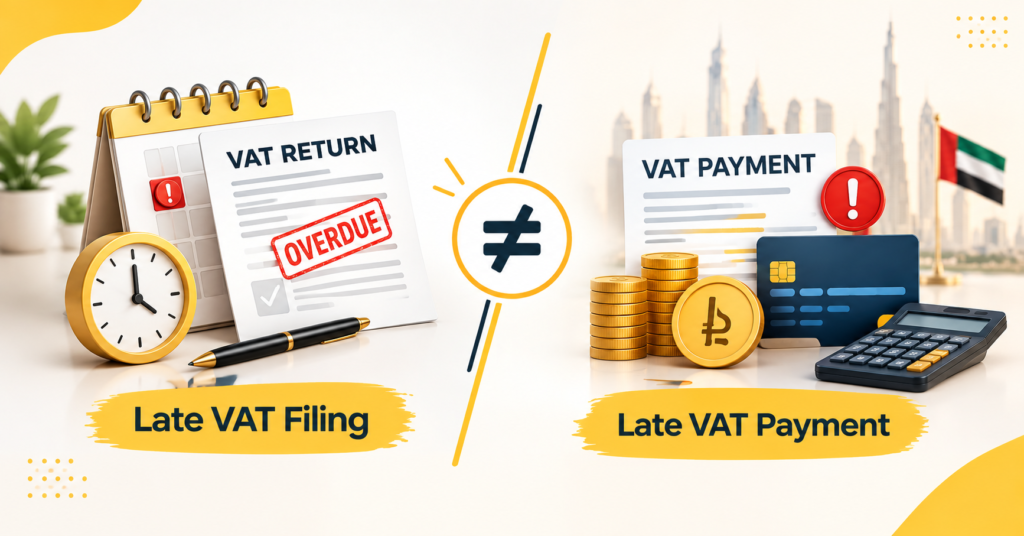
It is important to understand that late VAT filing penalties in the UAE involve distinguishing between late filing and late payment, as these are separate compliance issues. Businesses should also follow UAE VAT return filing rules and payment deadlines to avoid compliance problems.
A business may submit its VAT return late, or it may submit the return on time but fail to pay the VAT due by the deadline. In some circumstances, both filing and payment penalties can apply.
The FTA’s VAT Returns User Guide explains that late payment of VAT payable can result in:
- 2% of the unpaid tax being imposed immediately when payment becomes late.
- 4% being imposed on the amount still unpaid on the seventh day following the payment deadline.
- A 1% daily penalty on unpaid tax one calendar month after the payment deadline, subject to an overall ceiling of 300%.
Businesses should therefore understand the UAE VAT late payment rules and meet both filing and payment deadlines.
Why Do Businesses Miss VAT Filing Deadlines?
Late VAT filing can happen for several practical reasons. Some common causes include:
Incomplete Accounting Records
If sales invoices, purchase invoices, expense records, credit notes, or other documents are missing, the business may struggle to prepare an accurate VAT return.
Poor Bank and Ledger Reconciliation
Unreconciled transactions can result in incorrect VAT calculations and delays in preparing the return.
Incorrect Input VAT Claims
Businesses need to ensure that input VAT claimed in a return is supported by appropriate documentation and meets the relevant recovery requirements.
Lack of Internal Deadlines
Waiting until the final day to prepare a VAT return can create unnecessary pressure, particularly when the business has a large number of transactions.
Accounting Software Issues
Incorrect VAT settings, duplicate transactions, or improperly recorded invoices can affect the information used to prepare the VAT return.
How Can Businesses Avoid Late VAT Filing Penalties?
Understanding what are the penalties for late VAT filing in the UAE is useful, but preventing late filing is even more important. Following UAE VAT return filing rules and payment deadlines can help businesses maintain timely tax compliance.
Businesses can establish a regular VAT compliance process instead of preparing everything immediately before the deadline.
1. Maintain Updated Accounting Records
Record sales, purchases, expenses, credit notes, and other relevant transactions regularly.
2. Reconcile Transactions
Regular reconciliation helps identify missing or duplicated transactions before the VAT return is prepared.
3. Review VAT Invoices
Check that invoices and supporting documents contain the information required for VAT purposes. This supports VAT record-keeping requirements in the UAE.
4. Prepare Before the Deadline
Businesses should complete their VAT review several days before the actual filing deadline. This leaves time to correct errors or collect missing documents.
5. Monitor the FTA Account
Businesses should regularly check their FTA account for filing obligations, notifications, assessments, and outstanding amounts.
6. Keep Supporting Records
Proper documentation makes it easier to verify the figures reported in the VAT return and respond to questions from the FTA if required. Maintaining UAE VAT compliance records can also support accurate and timely filing.
What Should a Business Do After Missing the VAT Deadline?
If a business has already missed its VAT filing deadline, it should avoid delaying further and review the UAE VAT return filing rules and payment deadlines.
The first step is to determine why the return was not submitted and prepare the outstanding return as accurately as possible. The business should review its sales, purchases, output VAT, input VAT, and supporting documentation before submission.
It should also check its FTA account to identify any penalties, assessments, or outstanding VAT payments. Understanding late VAT return filing requirements in the UAE can help businesses take appropriate corrective steps.
Where professional assistance is needed, a qualified tax or accounting professional can help review the records, prepare the VAT return, and address compliance issues.
The FTA provides electronic VAT return filing through its tax services, and businesses should follow the applicable instructions and deadlines provided by the Authority.
Importance of Accurate VAT Return Filing
Timely filing alone is not enough. A VAT return should also be accurate and supported by appropriate records. Following UAE VAT return filing rules and payment deadlines helps businesses maintain proper tax compliance.
Submitting incorrect figures can create additional compliance issues. Businesses should therefore review the information carefully before filing rather than rushing to meet the deadline. Understanding VAT return accuracy requirements in the UAE can also help reduce filing errors.
A structured monthly accounting review can make quarterly VAT preparation easier. Even where the VAT return is filed quarterly, reviewing transactions throughout the period helps identify potential problems early.
Conclusion
Understanding Late VAT Filing Penalties in the UAE can help businesses take VAT compliance deadlines more seriously. Late filing may result in administrative penalties, while late payment of VAT can create additional financial consequences. Following UAE VAT return filing rules and payment deadlines can help businesses manage their tax obligations effectively.
Businesses can reduce compliance risks by maintaining accurate accounting records, reconciling transactions regularly, keeping proper VAT documentation, and preparing returns well before the filing deadline. They should also monitor updates from the Federal Tax Authority because UAE tax legislation and administrative penalty rules can change.
For businesses that need support with VAT return preparation, accounting records, VAT compliance, and tax-related requirements, Singiri & Co in Dubai, UAE, provides accounting, VAT, corporate tax, auditing, and business advisory services. Professional support can help businesses organize their financial records and maintain a more structured approach to ongoing tax compliance.
FAQS
1. What are the penalties for late VAT filing in the UAE?
According to the FTA VAT Returns User Guide, the penalty for late submission is AED 1,000 for the first occurrence and AED 2,000 for each repeated occurrence within 24 months. Businesses should also check the latest applicable FTA legislation because penalty rules have been amended. Understanding UAE VAT return filing rules and payment deadlines can help businesses manage their filing obligations.
2. When is a UAE VAT return due?
VAT returns are generally required to be submitted within 28 days from the end of the relevant tax period, unless the FTA specifies another deadline. Businesses should follow UAE VAT return filing rules and payment deadlines to maintain timely compliance.
3. Is late VAT filing the same as late VAT payment?
No. Filing a VAT return after the deadline and failing to pay VAT due on time are separate compliance matters. Applicable penalties can arise for each issue.
4. Can a business receive a penalty even if no VAT is payable?
Late filing can still result in an administrative penalty. The filing obligation applies regardless of whether the return ultimately shows VAT payable or another position.
5. How can businesses avoid VAT filing penalties?
Businesses can reduce the risk of penalties by maintaining accurate accounting records, reconciling transactions regularly, reviewing VAT documentation, monitoring filing deadlines, and preparing returns before the due date.
6. What happens if a business does not submit its VAT return?
The FTA may issue a tax assessment estimating the tax payable. The business may then have to settle the assessed amount and applicable penalties.