VAT registration is an important compliance requirement for businesses operating in the United Arab Emirates. Before applying for VAT registration with the Federal Tax Authority (FTA), businesses should prepare the necessary documents and financial information to avoid delays or requests for additional evidence.
Understanding the documents required for VAT registration in UAE can make the registration process smoother and help businesses submit an accurate application through the EmaraTax platform.
For UAE-resident businesses, VAT registration becomes mandatory when taxable supplies and imports exceed AED 375,000 over the previous 12 months or are expected to exceed this threshold within the next 30 days. Businesses may also apply voluntarily when taxable supplies, imports, or taxable expenses exceed AED 187,500, subject to the applicable rules.
Table of Contents
What Is VAT Registration in the UAE?
Value Added Tax (VAT) is a consumption tax applied to taxable goods and services in the UAE. Businesses that meet the applicable registration criteria must register with the FTA and obtain a Tax Registration Number (TRN).
VAT registration allows a business to legally charge VAT on taxable supplies, issue VAT-compliant tax invoices, submit VAT returns, and account for VAT payable or recoverable. Understanding UAE VAT registration requirements is important before starting the application.
The FTA currently processes VAT registration applications through the EmaraTax platform. The VAT registration service itself is free, and the FTA states that a completed application may take up to 20 business days to process.
What Documents Do You Need for VAT Registration in UAE?
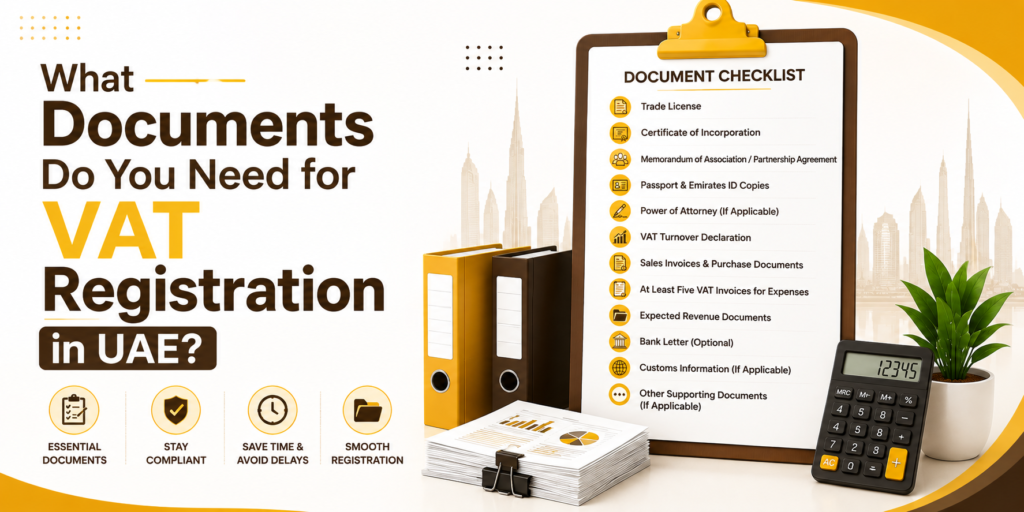
Preparing your paperwork before starting the application can save considerable time. The exact requirements can vary depending on whether the applicant is a natural person, legal person, government entity, charity, or another type of organization.
Here are the major documents required for VAT registration in UAE.
1. Valid Trade License
A valid UAE trade license or business license is one of the key documents required for VAT registration.
Businesses should provide the current license issued by the relevant licensing authority. If the company has branches, applicable branch licenses may also need to be provided.
2. Certificate of Incorporation
Companies may need to submit their Certificate of Incorporation or another official incorporation document.
This helps establish the legal identity of the business and confirms that the company has been properly established.
3. Memorandum of Association or Partnership Agreement
The Memorandum of Association (MOA) or Partnership Agreement may be required depending on the legal structure of the business.
These documents can also help establish ownership, management, and authorized signatory information.
4. Commercial Registration Certificate
A commercial registration certificate or another official document issued by the relevant licensing authority may be required as part of the VAT application.
Businesses should ensure that the information matches the details provided in their EmaraTax profile and FTA VAT registration application.
5. Passport and Emirates ID Copies
Passport and Emirates ID copies of the business owners and authorized signatories are among the important supporting documents.
Verify the copies’ validity and clarity. Incorrect or outdated identification documents can result in additional clarification requests.
6. Power of Attorney, If Applicable
A Power of Attorney (POA) may be required where the person acting as an authorized signatory is not identified as the manager in the MOA or where additional individuals are being given permission to sign on the company’s behalf.
Businesses using VAT registration services in Dubai should ensure that all authorization documents are properly prepared.
7. VAT Turnover Declaration
Businesses should prepare an official declaration showing their taxable supplies and monthly sales from the date of establishment until the VAT registration application.
The FTA states that this declaration should be signed and stamped by the authorized signatory.
Businesses should also check the VAT registration threshold in UAE before submitting their application.
8. Sales Invoices and Purchase Documents
Supporting financial documents required for VAT registration in UAE, including trade license, Emirates ID, invoices, financial records, and FTA supporting documents. may be requested to demonstrate the nature and value of business activities.
Depending on the application, these can include:
- Sales invoices
- Purchase invoices
- Local purchase orders
- Contracts
- Lease agreements
- Ownership documents
- Completion certificates
These documents can help support the information declared in the VAT registration application and maintain proper VAT compliance in UAE.
9. At Least Five VAT Invoices for Expenses
For applications relying on taxable expenses, the FTA may require at least five VAT invoices with amounts exceeding the relevant registration threshold.
Businesses should therefore maintain properly issued invoices and supporting accounting records before submitting the application.
10. Expected Revenue Documents
If the business expects to cross the VAT registration threshold in the future, it may need documents supporting its expected revenue.
Examples include:
- Signed customer contracts
- Purchase orders
- Sales agreements
- Other commercial documents
The FTA specifies that expected revenues should be supported by valid documents duly signed and stamped by the relevant parties.
11. Bank Letter
A bank letter containing the business’s account information may be provided where applicable. The FTA identifies this as an optional document.
For legal entities, the bank account should be in the company’s name, while individuals may use a personal or sole-establishment account where applicable.
12. Customs Information
Businesses involved in imports or exports may need to provide relevant customs information.
This can be particularly important for companies whose VAT liability is connected with imported goods and VAT on imports and exports in UAE.
Additional Documents for Special Businesses
Some entities may have additional requirements. For example, clubs, charities, and associations may need to submit registration documents and supporting evidence.
Government entities may also be required to provide a copy of the relevant decree, depending on the type of government entity.
Therefore, the documents required for VAT registration in UAE can vary depending on the business structure and activities. Following the correct VAT registration process in UAE can help businesses complete their application accurately.
VAT Registration Process in the UAE
Once the necessary documents are ready, the business can begin the registration process through EmaraTax.
The general process includes:
- Create and activate an EmaraTax account.
- Create a new Taxable Person Profile.
- Access the Taxable Person Account.
- Select Register under Value Added Tax.
- Complete the VAT registration application.
- Upload the required supporting documents.
- Review the information carefully.
- Submit the application to the FTA.
The FTA states that the application should contain accurate and complete information.
Common Mistakes to Avoid During VAT Registration
Even when businesses have all the documents required for VAT registration in UAE, mistakes can delay the process.
Common issues include:
- Providing an expired trade license
- Uploading unclear documents
- Entering incorrect company information
- Providing inconsistent turnover figures
- Missing supporting contracts or invoices
- Using incorrect authorised signatory details
- Failing to support expected revenue
- Not maintaining proper accounting records
Businesses should cross-check every document against the information entered into the EmaraTax application before submission.
Why Professional VAT Registration Support Can Help
VAT registration involves more than simply uploading documents. Businesses must determine whether they are required to register, calculate taxable turnover correctly, identify applicable supplies, and provide supporting evidence.
Professional VAT registration services in UAE can help businesses prepare their documentation, review turnover calculations, and reduce the possibility of errors.
An experienced VAT consultant in Dubai can also assist businesses with VAT compliance after registration, including VAT return filing, tax invoice requirements, and record keeping.
Conclusion
Preparing the correct documents before starting the VAT registration application can make the process more efficient and reduce the risk of delays. From trade licenses and incorporation documents to turnover declarations, invoices, contracts, and identification documents, every piece of information should be accurate and consistent.
If you are unsure about the documents required for VAT registration in UAE or need assistance with your application, Singiri & Co can help businesses with VAT registration, accounting, bookkeeping, and tax compliance services in the UAE. Professional support can help you prepare the required documentation, understand your VAT obligations, and maintain better compliance after receiving your TRN.
For businesses looking for reliable documents required for VAT registration in UAE working with an experienced accounting and tax consultancy can provide valuable support throughout the registration and compliance process.
FAQS
1. What are the main documents required for VAT registration in UAE?
The main documents can include a valid trade license, incorporation documents, MOA or partnership agreement, commercial registration certificate, passport and Emirates ID copies, authorized signatory documents, turnover declaration, and relevant financial or commercial supporting documents.
2. What is the mandatory VAT registration threshold in the UAE?
For UAE-resident businesses, the mandatory VAT registration threshold is AED 375,000 in taxable supplies and imports over the previous 12 months or expected within the next 30 days.
3. Can a business register for VAT voluntarily?
Yes. A UAE-resident business may generally apply for voluntary VAT registration when the value of taxable supplies, imports, or taxable expenses meets the voluntary registration threshold of AED 187,500, subject to applicable requirements.
4. Is a bank letter mandatory for VAT registration?
The FTA lists a bank letter containing bank account information as optional for VAT registration, although it may be useful where applicable.
5. How long does VAT registration take?
The FTA currently states an estimated processing time of 20 business days from receipt of a completed application.
6. Where can businesses apply for VAT registration?
Businesses can apply through the FTA’s EmaraTax platform. The FTA provides the VAT registration service online