
Managing finances is an important part of running a small business in Dubai. As a company grows, invoices, expenses, customer payments, supplier transactions, and bank activities can increase quickly. Keeping financial records organized can become time-consuming for business owners
Choosing the right bookkeeping for small business in Dubai can help maintain accurate records, monitor cash flow, reduce administrative work, and provide useful information for business decisions
However, choosing a bookkeeping provider should not be based only on price. Experience, service quality, accounting technology, communication, data security, and knowledge of the UAE business environment should also be considered
Table of Contents
What Is Bookkeeping?
Bookkeeping is the process of recording, organizing, and maintaining a company’s financial transactions. These may include sales, purchases, expenses, customer payments, supplier invoices, receipts, and bank transactions
Depending on the provider, bookkeeping services may also include bank reconciliation, accounts payable, accounts receivable, invoice tracking, expense categorization, and financial reporting
The purpose of bookkeeping for small business in Dubai is to keep financial information accurate and updated. This allows business owners to understand how much the business earns, spends, receives, and owes
Why Is Bookkeeping Important for Small Businesses?
As a business grows, managing financial records manually can lead to errors and delays. Professional bookkeeping for small business in Dubai can provide several practical benefits
Accurate Financial Records
Regular bookkeeping helps ensure that income and expenses are recorded correctly. Organized records also make it easier to identify missing invoices, duplicate transactions, and unusual expenses
Better Cash-Flow Management
Cash flow is essential for small businesses. Updated records help owners track customer payments, outstanding invoices, supplier obligations, recurring expenses, and available funds
Saves Time
Business owners already manage customers, employees, sales, marketing, and daily operations. Outsourcing bookkeeping can reduce routine administrative work and allow owners to focus on business growth
Supports Better Decisions
Financial reports can show revenue, expenses, profitability, assets, liabilities, and cash flow. This information can help owners make decisions about hiring, pricing, expenses, equipment, and expansion
How to Choose the Right Bookkeeping Service
Choosing a bookkeeping provider requires careful consideration. Here are the main factors to review before making a decision
1. Check the Provider’s Experience
Look for a provider with experience working with small and medium-sized businesses. Industry knowledge can also be valuable because different businesses have different financial processes
For example, an online business may have numerous payment-gateway transactions, while a consultancy may mainly manage invoices and operating expenses
Ask whether the provider has worked with businesses similar to yours and understands your industry
2. Review the Services Included
Not every bookkeeping provider offers the same services. Make sure you know exactly what is covered before signing an agreement
Services may include:
- Sales and purchase recording
- Expense tracking
- Bank reconciliation
- Accounts payable
- Accounts receivable
- Invoice management
- Supplier reconciliation
- General ledger maintenance
- Financial reporting
- Payroll records
Ask whether VAT-related services, corporate tax support, payroll, year-end accounting, or historical bookkeeping are included or charged separately
3. Check UAE Accounting Knowledge
When selecting bookkeeping for small business in Dubai, consider whether the provider understands the UAE business environment and the accounting requirements relevant to your company
This can be particularly important for businesses dealing with VAT, corporate tax, international transactions, multiple currencies, or complex business structures
A provider with suitable UAE knowledge may also coordinate with accountants, auditors, or tax professionals when additional support is required
4. Consider Accounting Software
Accounting software can make bookkeeping for small business in Dubai faster and more organized. Ask which software the provider uses and whether it is suitable for your business
Useful features can include:
- Automated bank feeds
- Invoice management
- Expense tracking
- Financial reports
- Customer and supplier records
- Bank reconciliation
- Document storage
- Cloud access
If your business already uses accounting software, check whether the provider can work with your existing system
5. Compare Pricing Carefully
Price is important for small businesses, but the cheapest provider may not always offer the best value
Bookkeeping fees can depend on transaction volume, number of bank accounts, employees, payroll requirements, reporting frequency, accounting software, and business complexity
Ask for a written quotation and clarify whether additional fees apply to VAT services, tax support, payroll, year-end accounting, audit assistance, or historical bookkeeping
Understanding the bookkeeping for small business in Dubai pricing structure can help you plan your budget and avoid unexpected costs
6. Evaluate Communication
Good communication is essential for an effective bookkeeping relationship. Your provider may need invoices, receipts, bank statements, payment confirmations, or explanations about specific transactions
Before choosing a provider, ask:
- Who will manage my account?
- How often will reports be provided?
- How will documents be submitted?
- How quickly will queries be answered?
- Is there a dedicated contact person?
A clear communication process can prevent delays and misunderstandings
7. Check Data Security
Bookkeeping providers handle confidential financial information. They may have access to bank statements, invoices, customer details, supplier records, and payroll information
Ask how your information is protected. Look for secure accounting software, restricted access, strong passwords, regular backups, multi-factor authentication, and secure document-sharing systems
You should also understand who can access your records and how your information will be handled if the service agreement ends
8. Consider Future Business Growth
Your bookkeeping requirements may increase as your business grows. You may add employees, bank accounts, suppliers, branches, or international customers
Choose a provider that can scale its services according to your changing requirements. This can save you from having to change providers as your company expands
A scalable bookkeeping for small business in Dubai solution can continue to support your financial needs as transaction volumes and business activities increase
Outsourced Bookkeeping vs. Hiring an Employee
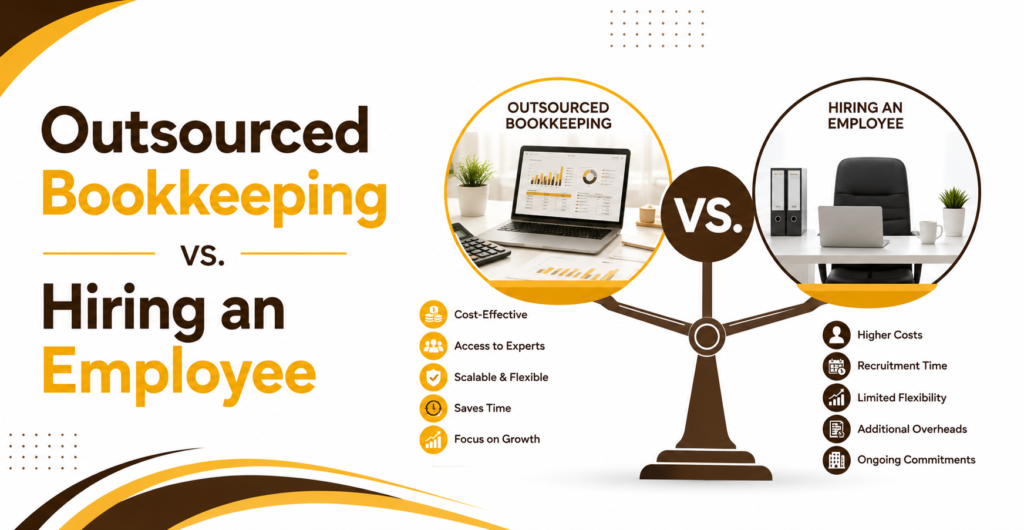
Small business owners often need to choose between hiring an in-house bookkeeper and outsourcing bookkeeping
An internal employee works directly with the business but can involve additional costs such as salary, recruitment, benefits, equipment, software, training, and leave coverage
Outsourcing can provide access to bookkeeping professionals without maintaining a full-time position. It may be suitable for startups, consultants, agencies, retailers, and other small businesses that need regular financial support
The right option depends on transaction volume, budget, business complexity, and future plans
Common Mistakes to Avoid
Avoid choosing a bookkeeping for small business in Dubai provider only because it offers a low monthly price. A low-cost service may not include everything your business requires.
Other warning signs include:
- Unclear pricing
- Poor communication
- No regular reporting
- Weak data-security practices
- No bank reconciliation
- Limited experience
- Unclear responsibilities
- No written agreement
A reliable provider should clearly explain its services, responsibilities, pricing, reporting process, and document requirements
How Often Should Bookkeeping Be Updated?
The ideal frequency depends on transaction volume and business complexity
A business with many daily transactions may benefit from daily or weekly bookkeeping. A smaller company with fewer transactions may only require monthly updates
Regular updates can help identify unpaid invoices, unexpected expenses, bank discrepancies, supplier balances, and changes in revenue or profitability.
Leaving financial records untouched for several months can make errors harder to identify and supporting documents more difficult to locate
How Bookkeeping Supports Business Decisions
Bookkeeping is not simply about recording transactions. Accurate financial information can help business owners understand how their company is performing
For example, increasing sales while profits decline could indicate rising operating expenses. Similarly, a growing number of unpaid invoices could create cash-flow pressure
Financial information can support decisions about hiring employees, controlling costs, marketing budgets, equipment purchases, pricing, supplier payments, and business expansion
This makes bookkeeping for small business in Dubai useful for both daily financial management and long-term business planning
Why Choose Singiri & Co?
For companies that want help preserving orderly financial records and comprehending their financial situation, Singiri & Co. offers accounting and bookkeeping for small business in Dubai
Depending on business requirements, services may include bookkeeping, accounting, bank reconciliation, expense recording, invoice management, and financial reporting
Businesses can discuss their transaction volume, accounting software, reporting requirements, and specific financial needs before selecting a suitable service package
Professional support can reduce routine administrative work while giving business owners better visibility into their financial information
Conclusion
Choosing the right bookkeeping for small business in Dubai is an important decision for any small business in Dubai. Business owners should consider experience, service scope, accounting technology, pricing, communication, data security, and the provider’s ability to support future growth
The right bookkeeping for small business in Dubai can help maintain accurate financial records, improve cash-flow visibility, reduce administrative work, and support better business decisions
Rather than choosing a provider based only on price, businesses should look for a reliable service that understands their requirements and can adapt as the company grows
FAQS
1. How do I choose a bookkeeping service in Dubai?
Compare providers based on experience, services, pricing, accounting software, communication, data security, and UAE accounting knowledge
2. How much does bookkeeping cost in Dubai?
Costs vary depending on transaction volume, number of bank accounts, payroll requirements, accounting software, reporting frequency, and business complexity
3. Is outsourced bookkeeping suitable for startups?
Yes. Outsourcing can provide professional financial recordkeeping without the cost of hiring a full-time employee
4. How often should bookkeeping be updated?
The frequency depends on transaction volume. High-volume businesses may need daily or weekly updates, while smaller companies may update their records monthly
5. Can bookkeeping help with cash flow?
Yes. Updated records help monitor customer payments, unpaid invoices, expenses, supplier obligations, and available funds
6. Why is bank reconciliation important?
Bank reconciliation compares accounting records with bank statements and helps identify missing transactions, duplicate entries, bank charges, and discrepancies
7. What should I ask a bookkeeping provider?
Ask about experience, services included, accounting software, reporting frequency, pricing, additional charges, data security, communication, and scalability
8. Can bookkeeping support business growth?
Yes. Accurate financial records can help owners understand performance, manage cash flow, control expenses, and make informed growth decisions