
The UAE’s corporate tax framework has made tax compliance an essential responsibility for businesses operating across the country. Companies must understand their registration obligations, maintain accurate financial records, calculate taxable income correctly, and submit their corporate tax returns within the prescribed deadlines. Preparing early can help businesses avoid penalties and maintain financial transparency.
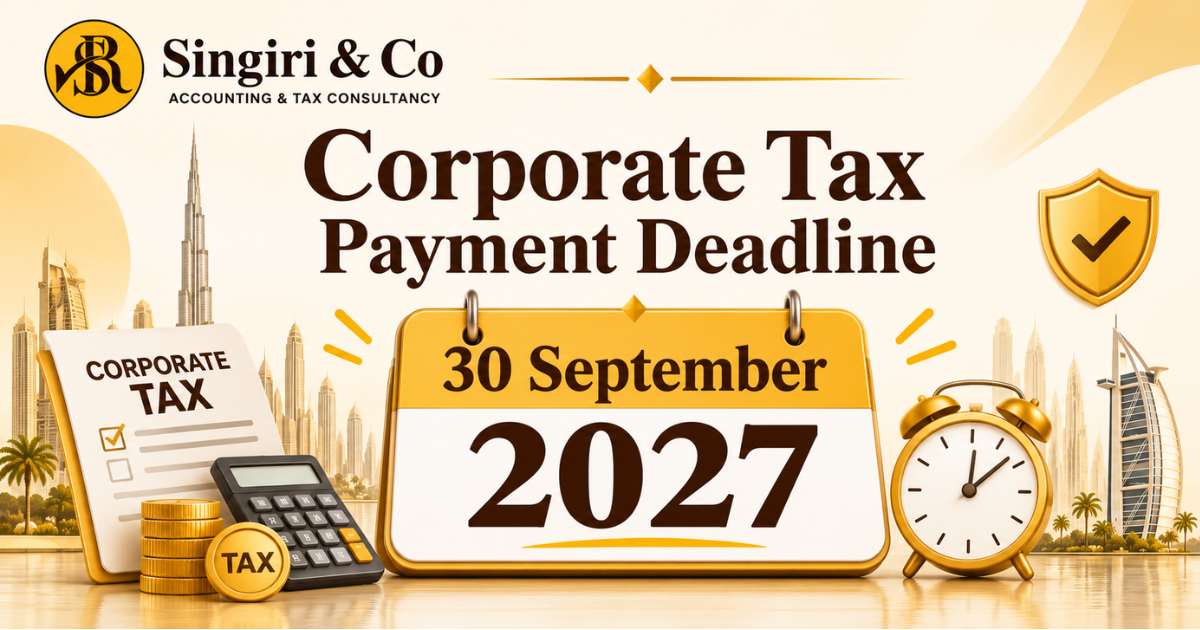
For businesses following a January-to-December financial year, 30 September 2027 is an important date. Companies with a tax period ending on 31 December 2026 must submit their corporate tax returns and settle any corporate tax payable within nine months after the end of that tax period.
Understanding the Corporate Tax Payment Deadline 30 September 2027 is particularly important for businesses that want to avoid last-minute filing issues and maintain compliance with Federal Tax Authority (FTA) requirements.
Table of Contents
1. Understand the UAE Corporate Tax Payment Deadline
Under the UAE Corporate Tax Law, taxable persons must submit their corporate tax returns and pay the applicable corporate tax within nine months from the end of their relevant tax period, unless another date is determined by the FTA.
For businesses following the calendar financial year, the Corporate Tax Payment Deadline 30 September 2027 applies to the financial year ending 31 December 2026.
Businesses should understand that the deadline depends on their financial year-end, and not every company will have the same filing date.
For example:
- Financial year ending 31 December 2026—deadline 30 September 2027.
- Financial year ending 31 March 2027—deadline 31 December 2027.
- Financial year ending 30 June 2027—deadline 31 March 2028.
Companies should confirm their applicable tax period and calculate the filing deadline accordingly.
2. Complete Corporate Tax Registration
Corporate tax registration is one of the first compliance responsibilities for businesses operating in the UAE.
All taxable persons, including mainland companies and free zone businesses, must register with the Federal Tax Authority and obtain a Corporate Tax Registration Number.
Businesses should:
- Verify their corporate tax registration status.
- Check the accuracy of their company information.
- Maintain their corporate tax registration number.
- Update relevant business information when required.
- Review applicable registration deadlines.
Late registration can result in an administrative penalty of AED 10,000.
Companies that have recently established their businesses should check the registration timelines applicable to their category and incorporation date.
3. Maintain Accurate Financial Records
Maintaining proper financial records is essential for calculating taxable income and preparing accurate corporate tax returns.
Businesses should regularly update their accounting records rather than waiting until the filing deadline approaches.
Important financial documents include:
- Sales and purchase invoices.
- Bank statements and reconciliation reports.
- General ledger and trial balance.
- Profit and loss statements.
- Balance sheets.
- Expense records and supporting receipts.
- Fixed asset registers.
- Loan and liability statements.
- Payroll and employee-related records.
Under UAE corporate tax requirements, relevant tax records generally need to be maintained for at least seven years following the end of the relevant tax period.
Proper bookkeeping helps businesses identify errors, support deductions, and respond to FTA queries when necessary.
4. Calculate Taxable Income Correctly
Corporate tax is calculated based on taxable income rather than simply applying the tax rate to total business revenue.
Businesses generally start with their accounting profit or loss and make the adjustments required under the UAE Corporate Tax Law.
The standard UAE corporate tax rates are
- 0% on taxable income up to AED 375,000.
- 9% on taxable income exceeding AED 375,000.
Companies should review exempt income, deductible business expenses, non-deductible expenditure, and applicable tax reliefs before calculating their final liability.
Accurate tax calculations are important for avoiding underpayment, incorrect declarations, and potential penalties.
5. Review Small Business Relief Eligibility
Small Business Relief is an important provision for eligible UAE businesses under the UAE Corporate Tax Payment Deadline 30 September 2027 compliance requirements.
Under applicable rules, a resident taxable person may elect for Small Business Relief if its revenue does not exceed AED 3 million in the relevant and previous tax periods, subject to applicable conditions.
The Ministry of Finance extended Small Business Relief to tax periods ending on or before 31 December 2029.
Eligible businesses should understand the following requirements:
- Annual revenue must not exceed AED 3 million.
- Relevant eligibility conditions must be satisfied.
- The required election must be made in the corporate tax return.
- Supporting financial records must be maintained.
- Certain categories, including qualifying free zone persons and specified multinational enterprise groups, are excluded.
Small businesses should review their eligibility before submitting their tax returns.
6. Understand Free Zone Corporate Tax Requirements
Free zone companies are also subject to UAE Corporate Tax registration and filing requirements. Businesses should understand the UAE Corporate Tax Payment Deadline 30 September 2027 and comply with applicable tax regulations.
A qualifying Free Zone Person may benefit from a 0% tax rate on qualifying income, while non-qualifying income may be subject to the standard 9% rate.
Businesses should review:
- Adequate substance requirements.
- Qualifying income conditions.
- Permitted and excluded activities.
- Transfer pricing compliance.
- De minimis requirements.
- Audited financial statement obligations.
Operating in a free zone does not automatically provide complete corporate tax exemption.
7. Review Transfer Pricing Requirements
Transfer pricing compliance is another important responsibility for UAE businesses under the UAE Corporate Tax Payment Deadline 30 September 2027 that conduct transactions with related parties and connected persons.
Companies must ensure transactions follow the arm’s length principle and maintain proper documentation for FTA reviews.
Businesses should identify related-party transactions involving:
- Management fees.
- Intercompany loans.
- Shared business expenses.
- Service agreements.
- Goods and product transfers.
- Payments to connected persons.
Proper documentation helps businesses support their pricing arrangements and meet UAE Corporate Tax compliance requirements.
8. Prepare Audited Financial Statements Where Required
Financial statements provide the foundation for calculating taxable income and supporting corporate tax declarations. Businesses should understand the UAE Corporate Tax Payment Deadline 30 September 2027 and complete their financial reporting and audit preparation on time.
Under applicable UAE requirements, businesses generating revenue exceeding AED 50 million during a relevant tax period must prepare and maintain audited financial statements. Qualifying Free Zone Persons must also maintain audited financial statements regardless of their revenue.
Businesses should arrange audit preparation early and ensure financial statements are supported by accurate accounting records. This helps identify discrepancies and resolve reporting issues before corporate tax filing.
9. Reconcile Accounting Records Before Filing

Before submitting a corporate tax return, businesses should reconcile their accounting records and verify that financial information is complete.
Important reconciliation activities include:
- Comparing bank statements with accounting records.
- Checking customer and supplier balances.
- Reviewing outstanding receivables and payables.
- Verifying fixed asset additions and disposals.
- Checking employee expenses and payroll entries.
- Reviewing related-party transactions.
- Identifying non-deductible expenses.
- Verifying tax adjustments.
A proper reconciliation process improves the accuracy of corporate tax calculations and reduces the possibility of filing errors.
10. File Corporate Tax Returns Through EmaraTax
The Federal Tax Authority provides the EmaraTax platform for corporate tax registration, return submission, and payment.
Businesses should prepare the required information before accessing the platform.
The filing process generally involves:
- Logging into the EmaraTax account.
- Selecting the relevant corporate tax registration.
- Reviewing the applicable tax period.
- Entering financial and taxable income information.
- Applying relevant tax adjustments and reliefs.
- Reviewing the calculated tax liability.
- Submitting the corporate tax return.
- Paying the outstanding corporate tax amount.
Companies should retain the return submission confirmation and payment records for future reference.
For calendar-year businesses, completing these steps before the Corporate Tax Payment Deadline 30 September 2027 can help avoid unnecessary last-minute complications.
11. Avoid Late Filing and Payment Penalties
Failure to comply with UAE Corporate Tax obligations can result in administrative penalties and additional financial liabilities. Businesses should follow the UAE Corporate Tax Payment Deadline 30 September 2027 and avoid common compliance mistakes, including:
- Missing corporate tax registration deadlines.
- Submitting incorrect tax returns.
- Failing to maintain supporting financial documents.
- Missing corporate tax payment deadlines.
- Incorrectly claiming tax reliefs.
- Failing to maintain required transfer pricing documentation.
Businesses should establish an internal compliance calendar and review accounting records, tax calculations, and supporting documents well before September 2027.
Corporate Tax Compliance Checklist Before September 2027
Businesses can use the following checklist to prepare for their corporate tax obligations:
| Compliance Requirement | Recommended Action |
| Corporate Tax Registration | Verify registration status. |
| Financial Records | Update bookkeeping regularly. |
| Taxable Income | Calculate tax adjustments. |
| Small Business Relief | Verify eligibility. |
| Free Zone Compliance | Review qualifying conditions. |
| Transfer Pricing | Maintain supporting documents. |
| Financial Statements | Arrange audits where required |
| Account Reconciliation | Review all financial balances. |
| Tax Return | Prepare and review the return. |
| Tax Payment | Arrange funds before the deadline. |
Completing these activities early can help businesses maintain compliance and improve their financial management.
Conclusion:
Preparing for UAE Corporate Tax compliance requires proper bookkeeping, accurate financial reporting, timely registration, and correct tax calculations. Businesses should not wait until the final filing month to organise their financial documents and review their tax obligations.
For companies following a calendar financial year, the Corporate Tax Payment Deadline 30 September 2027 is an important compliance milestone that requires advance preparation.
Singiri & Co. provides professional accounting, bookkeeping, auditing, and UAE Corporate Tax services to help businesses manage their financial responsibilities efficiently.
FAQS
1. What is the UAE Corporate Tax Payment Deadline for 2027?
For businesses whose financial year ended on 31 December 2026, the Corporate Tax return filing and payment deadline is 30 September 2027.
2. What is the standard UAE corporate tax rate?
The standard rate is 0% on taxable income up to AED 375,000 and 9% on taxable income exceeding AED 375,000.
3. Are free zone companies required to register for corporate tax?
Yes. Free zone companies are generally required to register for corporate tax, even when they qualify for the 0% rate on qualifying income.
4. What is the revenue threshold for Small Business Relief?
Eligible resident taxable persons may claim Small Business Relief when their revenue does not exceed AED 3 million in the relevant and previous tax periods, subject to applicable conditions.
5. How many years should UAE businesses maintain corporate tax records?
Businesses generally need to maintain relevant corporate tax records and supporting documents for at least seven years following the end of the relevant tax period.
6. Can businesses submit corporate tax returns through EmaraTax?
Yes. Businesses can complete corporate tax registration, submit returns, and make payments through the FTA’s EmaraTax platform.
7. What happens if a company misses the corporate tax filing deadline?
Late filing and payment can result in administrative penalties. Businesses should submit their returns and settle outstanding tax liabilities within the applicable statutory timeframe.