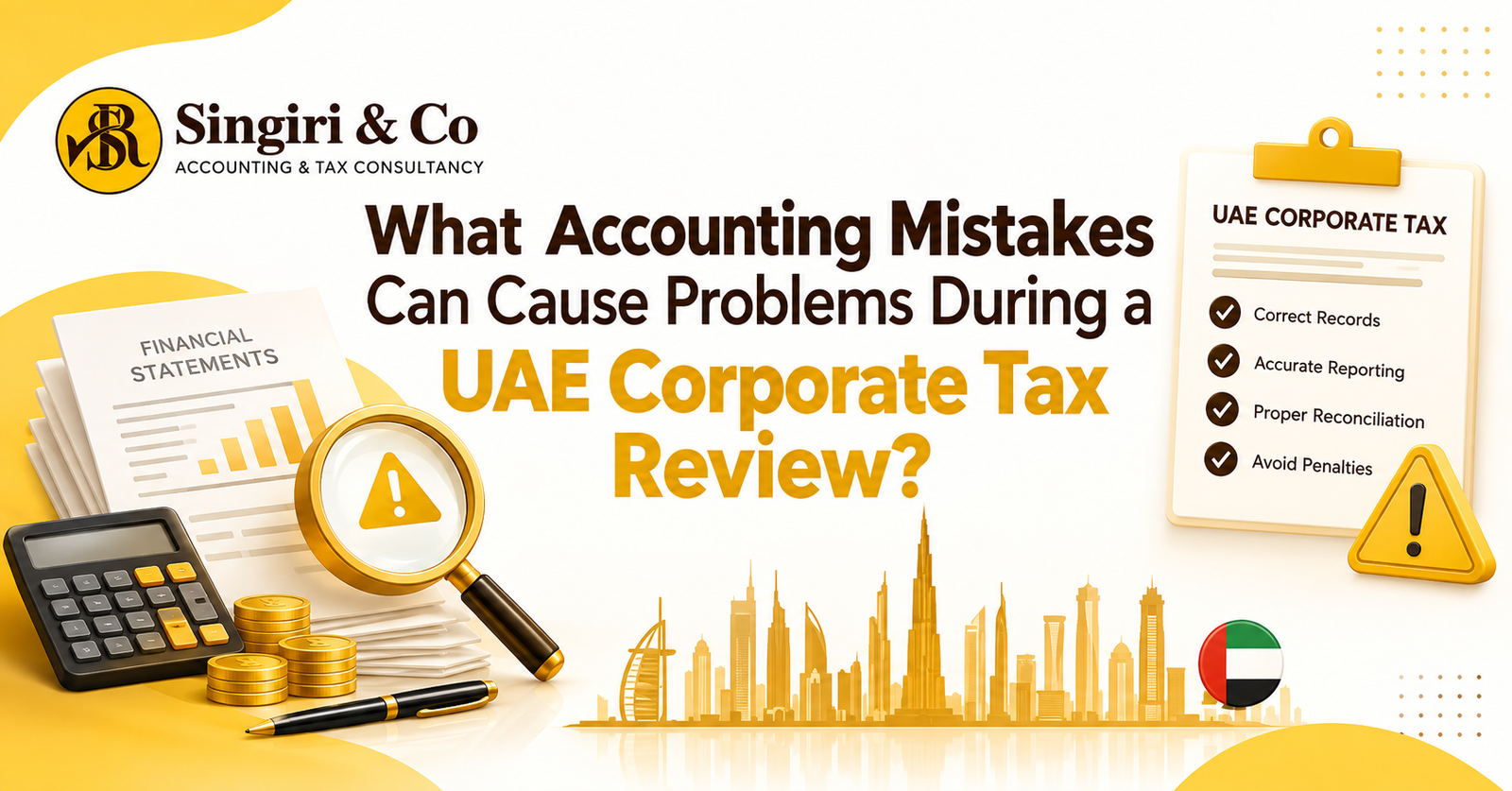
What Accounting Mistakes Can Cause Problems During a UAE Corporate Tax Review?
A UAE corporate tax review can become challenging when a business’s accounting records contain errors, missing information, or inconsistent financial data. Although many businesses focus on filing their corporate tax returns before the deadline, the quality of the underlying accounting records is equally important. Incorrect revenue figures, unsupported expenses, poor documentation, and reconciliation issues can create questions during a tax review.
Understanding the common mistakes to avoid in UAE corporate tax can help businesses strengthen their financial records and reduce unnecessary compliance risks. Proper bookkeeping, accurate reporting, and organized supporting documents can make it easier to determine taxable income and respond to requests for clarification.
Table of Contents
Why Accurate Accounting Matters for UAE Corporate Tax
Corporate Tax calculations depend heavily on reliable financial information. Businesses generally begin with accounting records and financial statements before applying the relevant UAE corporate tax rules.
When accounting information is incomplete or incorrectly classified, the resulting tax calculation may also be inaccurate. A small bookkeeping error can sometimes affect revenue recognition, deductible expenses, provisions, related-party transactions, or other tax-related calculations.
The common mistakes to avoid in UAE corporate tax are not limited to large numerical errors. Even inconsistencies between invoices, bank statements, ledgers, contracts, and financial statements can make the records difficult to verify.
Maintaining a clear accounting trail therefore plays an important role in corporate tax compliance.
1. Incorrect Revenue Recording
One of the most important accounting areas is revenue. Businesses may accidentally record sales in the wrong accounting period, omit transactions, duplicate invoices, or incorrectly treat advances and other receipts.
Revenue should be recorded consistently and supported by appropriate documentation. Differences between sales records, invoices, bank receipts, and financial statements can raise questions about the accuracy of taxable income.
Regular reconciliation can help identify discrepancies before they affect the corporate tax return.
2. Poor Expense Classification
Another common issue is incorrectly classifying business expenses. Some companies record personal, capital, or non-business costs as ordinary operating expenses without considering their appropriate accounting and tax treatment.
An expense appearing in the accounting ledger does not automatically mean that the full amount will be deductible for corporate tax purposes.
Understanding the common mistakes to avoid in UAE corporate tax requires businesses to distinguish between accounting treatment and tax treatment. A cost may be legitimate from a business perspective but require a specific adjustment when calculating taxable income.
3. Missing Supporting Documents
A transaction without adequate supporting documentation can become difficult to explain during a review.
Businesses should maintain relevant invoices, contracts, payment records, receipts, agreements, bank statements, and other documents supporting accounting entries. Documentation should be organized so that individual transactions can be traced back to their source.
Missing records may make it difficult to demonstrate why an income item was recorded or why an expense was included in the accounts.
4. Bank Reconciliation Errors
Bank reconciliation is a basic but important accounting control. When bank statements do not match the accounting system, unexplained differences may remain in the books.
Common issues include unrecorded bank charges, duplicate entries, missing customer receipts, incorrect payment dates, and transactions posted to the wrong account.
Regular bank reconciliation helps businesses detect these problems early rather than discovering them while preparing the corporate tax return.
5. Mixing Personal and Business Transactions
Small and growing businesses sometimes use business bank accounts or accounting records for transactions that are personal in nature. This can make the financial records unclear and complicate the identification of genuine business expenses.
Maintaining separate records for business and personal transactions can improve transparency. Clear descriptions and proper supporting documentation can also help accountants determine the appropriate accounting treatment.
6. Incorrect Treatment of Fixed Assets
Businesses may purchase equipment, vehicles, technology, furniture, machinery, or other long-term assets. Recording such purchases incorrectly as ordinary expenses can distort the financial statements.
Fixed assets should be properly recorded and supported by purchase invoices and relevant documentation. Depreciation and other accounting adjustments should also be recorded consistently.
Incorrect asset accounting is among the common mistakes to avoid in UAE corporate tax, particularly when financial records are used as the starting point for tax calculations.
7. Ignoring Related-Party Transactions
Transactions involving related parties require careful accounting and documentation. Examples can include management charges, loans, service arrangements, payments between group companies, or transactions involving owners and connected businesses.
Businesses should maintain appropriate agreements, invoices, supporting records, and accounting entries for such transactions.
Where UAE corporate tax rules require specific consideration of related-party or connected-person transactions, incomplete records can create additional compliance difficulties.
8. Errors in VAT and Other Tax-Related Records
VAT accounting and corporate tax accounting are separate areas, but inconsistencies between them can create questions.
For example, sales recorded in the accounting system should generally be capable of being reconciled with relevant VAT records. Differences in turnover, invoices, credit notes, or tax-related entries should be investigated.
Businesses should regularly compare accounting records with their tax records rather than waiting until the corporate tax return is being prepared.
9. Failing to Reconcile Financial Statements
Financial statements should be supported by the underlying accounting records. If the general ledger, trial balance, balance sheet, profit and loss statement, and supporting schedules contain unexplained differences, the business may struggle to demonstrate how its taxable income was calculated.
A pre-filing review can identify unusual balances, duplicate transactions, incorrect classifications, and missing entries.
Recognizing the common mistakes to avoid in UAE corporate tax before filing gives businesses an opportunity to correct their accounting records and maintain a stronger compliance position.
10. Poor Record-Keeping for Adjustments
Corporate tax calculations may require businesses to consider adjustments between accounting profit and taxable income. These adjustments should be supported by clear working papers and relevant documentation.
Simply changing figures in a spreadsheet without maintaining an explanation can make the calculation difficult to follow.
Businesses should retain a clear record showing the starting accounting profit, relevant adjustments, and final taxable income calculation.
How Businesses Can Prevent Accounting Problems
Preventing accounting errors is usually easier than correcting them after a tax review. Businesses can establish a regular accounting control process that includes:
- Monthly bank and ledger reconciliation
- Review of sales and purchase records
- Proper invoice and receipt management
- Separate business and personal transactions
- Regular review of expense classifications
- Maintenance of fixed-asset records
- Documentation of related-party transactions
- Reconciliation between accounting and tax records
- Review of financial statements before tax filing
- Proper retention of supporting documents
The common mistakes to avoid in UAE corporate tax can often be reduced through consistent bookkeeping procedures and periodic professional reviews.
What Happens When Accounting Errors Are Discovered?
Discovering an accounting error does not necessarily mean that a business has failed its compliance responsibilities. The important step is to identify the issue, understand its impact, correct the accounting records where appropriate, and assess whether the tax position is also affected.
Businesses should avoid making unexplained changes simply to make figures appear consistent. Corrections should be properly documented and supported by accounting evidence.
A professional review can help identify whether an accounting error affects financial statements, taxable income, or corporate tax reporting.
Why a Pre-Tax Accounting Review Is Useful
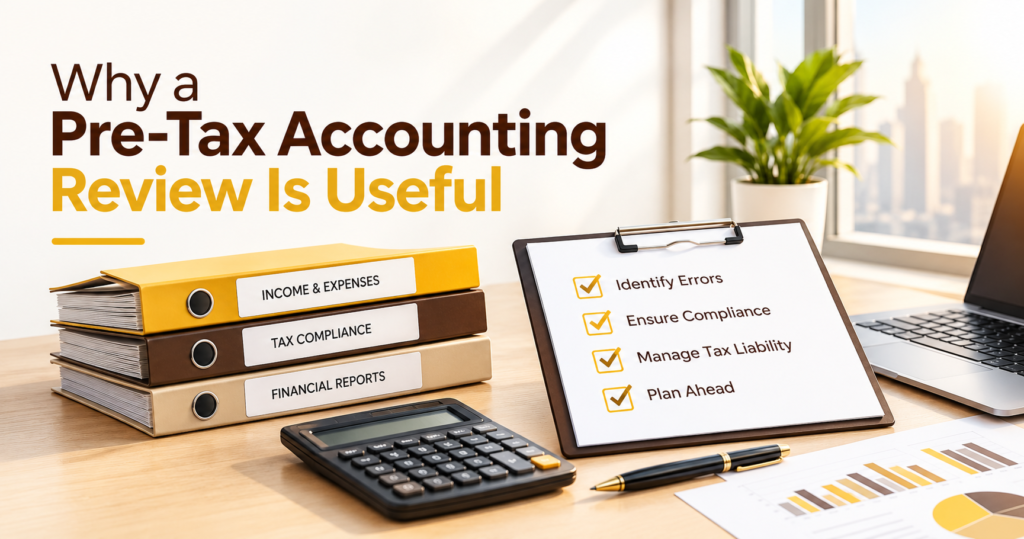
A pre-tax review provides an opportunity to examine accounting records before the corporate tax return is finalized. It can reveal discrepancies that might otherwise remain unnoticed.
For example, an accountant may identify unusual expense balances, missing invoices, inconsistent revenue figures, unreconciled bank accounts, or incorrect journal entries.
Reviewing these areas early can make the final tax preparation process more organized and transparent.
For businesses operating in Dubai and across the UAE, understanding the common mistakes to avoid in UAE corporate taxis therefore an important part of maintaining reliable financial records.
Conclusion
Accurate accounting is the foundation of reliable corporate tax compliance. Businesses that maintain complete records, reconcile their accounts regularly, classify transactions correctly, and retain proper supporting documents are better prepared for tax reporting and potential reviews.
Understanding the common mistakes to avoid in UAE corporate tax can help companies identify weak areas before they become bigger compliance concerns. From revenue recording and expense classification to bank reconciliation and documentation, every part of the accounting process can contribute to the accuracy of corporate tax reporting.
For businesses looking for professional support, Singiri & Co. in Dubai, UAE, provides accounting, bookkeeping, VAT, corporate tax, auditing, and business advisory support for businesses. With structured accounting processes and professional guidance, businesses can improve financial record accuracy and approach UAE tax compliance with greater confidence.
If your business needs help reviewing accounting records, preparing for corporate tax compliance, or identifying the common mistakes to avoid in UAE corporate tax, Singiri & Co can assist with practical accounting and tax support tailored to your business requirements.
FAQS
1. What are common accounting mistakes affecting UAE corporate tax?
Common mistakes include incorrect revenue recording, poor expense classification, missing supporting documents, bank reconciliation errors, incorrect fixed-asset treatment, and inconsistent financial records.
2. Can accounting errors affect UAE corporate tax calculations?
Yes. Accounting errors can affect the figures used to determine taxable income and may result in incorrect corporate tax calculations or additional clarification requirements.
3. Why are supporting documents important for corporate tax?
Supporting documents help demonstrate the nature, amount, and business purpose of transactions recorded in the accounts. They also make financial information easier to verify.
4. How can businesses identify accounting mistakes before filing corporate tax?
Businesses can conduct monthly reconciliations, review expense classifications, compare accounting and tax records, verify supporting documents, and perform a pre-filing accounting review.
5. Should businesses review related-party transactions?
Yes. Related-party transactions should be properly recorded and supported with appropriate agreements, invoices, and other relevant documentation, while considering applicable UAE corporate tax requirements.
6. What is the biggest accounting risk during a corporate tax review?
There is no single universal risk. However, inaccurate revenue, unsupported expenses, incomplete records, unexplained differences, and poor documentation can make a corporate tax review more difficult.
7. How can professional accounting support UAE corporate tax compliance?
Professional accounting support can help businesses maintain organized books, reconcile financial records, identify accounting inconsistencies, prepare financial information, and improve the overall quality of corporate tax reporting.