Maintaining accurate financial records is an essential part of running a successful business in Dubai. Documents to keep for VAT compliance in UAE should be organized properly to support accurate tax returns and financial reporting.
Many businesses focus on record keeping only during tax filing periods. However, businesses should maintain invoices, VAT returns, credit notes, receipts, and other financial audit records consistently throughout the year. Proper documentation helps identify errors, monitor cash flow, and stay prepared for VAT obligations.
For better financial control, professional bookkeeping services in Dubai can help businesses maintain accurate records and ensure that the documents to keep for VAT compliance in UAE are properly organized.
Table of Contents
Documents to Keep for VAT Compliance in UAE
Why Is Monthly Bookkeeping Important for Dubai Businesses?
Monthly bookkeeping gives business owners a clear picture of their income, expenses, assets, liabilities, and overall financial performance. Instead of waiting until the end of the financial year, businesses can review their finances regularly.
Maintaining bookkeeping records to maintain every month in Dubai can help businesses:
- Track revenue and business expenses
- Monitor cash flow
- Identify accounting errors
- Prepare financial reports
- Support VAT compliance
- Organize records for corporate tax requirements
- Monitor outstanding customer payments
- Control unnecessary expenses
- Make better business decisions
Consistent bookkeeping also reduces the stress of collecting missing invoices and financial documents at the last minute.
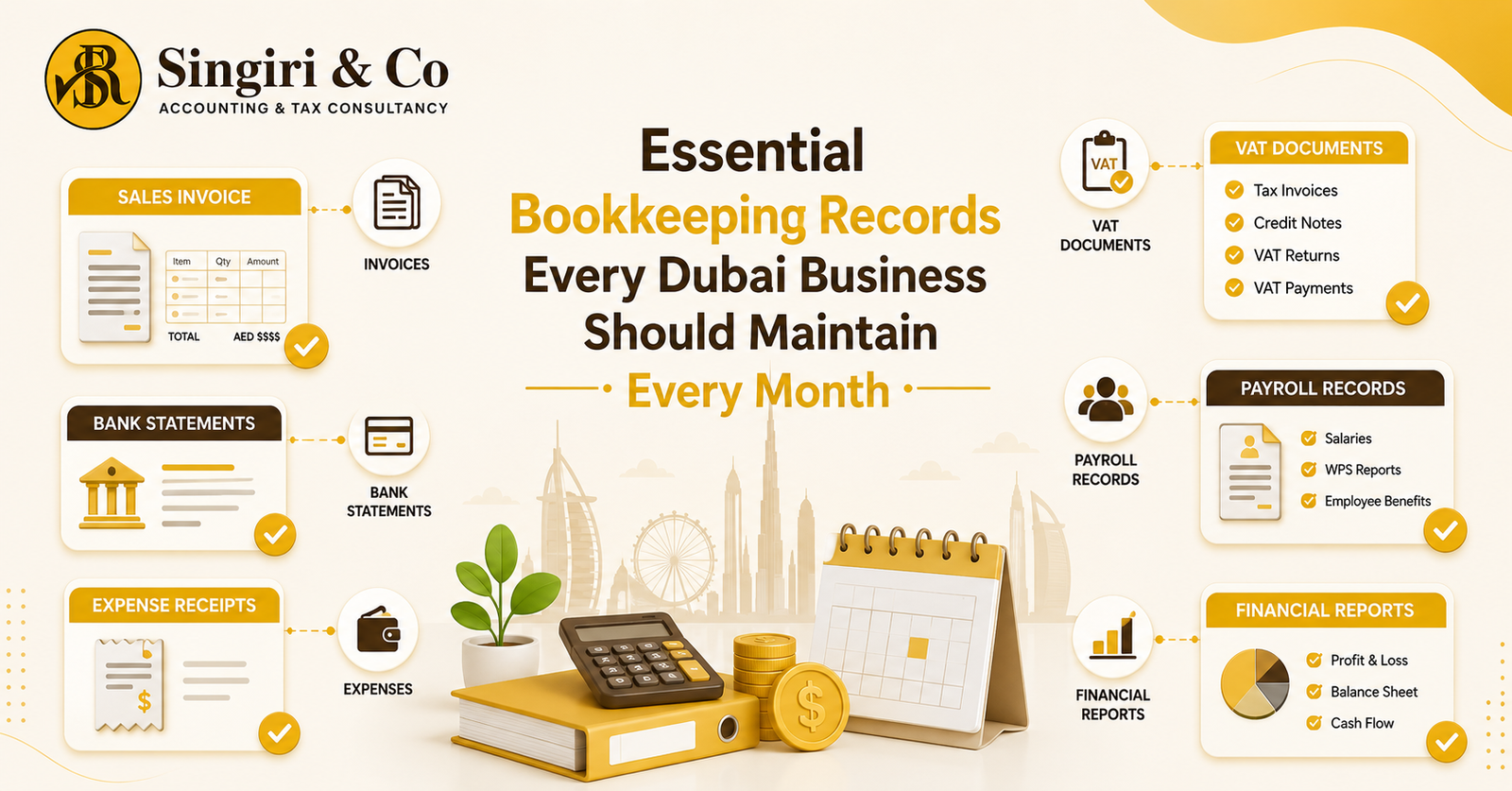
1. Sales and Revenue Records

Businesses should maintain complete records of all sales and income generated during the month. These records should include invoices issued to customers, sales receipts, credit notes, and other relevant revenue documents.
A proper sales record should generally show:
- Invoice number and date
- Customer details
- Description of products or services
- Amount charged
- VAT, where applicable
- Payment status
Keeping sales records organized makes it easier to reconcile revenue with bank transactions and prepare financial reports.
2. Purchase and Expense Records
Another important category among bookkeeping records to maintain every month in Dubai is business expense documentation. Businesses should also organize the documents to keep for VAT compliance in UAE, including invoices, receipts, bills, and supporting records for expenses such as:
- Office rent
- Utilities
- Advertising
- Professional fees
- Business travel
- Office supplies
- Software subscriptions
- Equipment purchases
- Transportation expenses
Separating business expenses from personal spending improves accounting accuracy and makes VAT compliance in the UAE easier to manage.
3. Bank Statements and Bank Reconciliation
Monthly bank statements should be collected and reviewed against the accounting records.
Bank reconciliation involves comparing transactions recorded in the books with transactions appearing on the company’s bank statement. This process can identify:
- Missing transactions
- Duplicate entries
- Bank charges
- Incorrect payments
- Unrecorded deposits
- Outstanding transactions
Regular reconciliation is one of the most important monthly bookkeeping requirements for businesses in Dubai because it helps maintain accurate financial information.
4. Accounts Receivable Records
Businesses that sell products or services on credit should maintain detailed accounts receivable records.
These records help track:
- Customer invoices
- Amounts received
- Outstanding balances
- Overdue invoices
- Credit notes
- Payment dates
Reviewing receivables every month helps businesses identify customers with overdue payments and take appropriate collection action.
Strong receivables management can also improve business cash flow.
5. Accounts Payable Records
Accounts payable records show the amounts a business owes to suppliers and service providers.
Monthly records should include supplier invoices, payment dates, outstanding balances, and credit notes.
Maintaining accurate accounts payable records helps prevent missed payments and allows businesses to plan their cash requirements more effectively.
6. Payroll and Employee Records
Businesses with employees should maintain monthly payroll documentation.
Depending on the company’s circumstances, records may include:
- Employee salary details
- Payroll calculations
- Allowances and deductions
- Leave records
- Salary payments
- Employee benefits
- End-of-service-related records
Accurate payroll bookkeeping helps businesses monitor employee-related costs and maintain organized financial records.
7. VAT Records and Tax Documents
VAT-registered businesses in the UAE should maintain appropriate VAT-related documentation.
This may include:
- Tax invoices
- Tax credit notes
- Purchase invoices
- Sales records
- VAT calculations
- Import and export documentation where applicable
- VAT return working papers
Keeping these documents updated every month can make VAT return filing in Dubai more organized and reduce the risk of errors.
Businesses should also maintain records relevant to their UAE corporate tax obligations and keep their accounting information properly organized.
8. Petty Cash Records
Small cash transactions should also be included in the documents to keep for VAT compliance in UAE. Businesses using petty cash should maintain a register with the date, purpose, amount, and supporting receipts.
Regular reviews help prevent cash differences and ensure all small expenses are accurately recorded.
9. Fixed Asset Records
Businesses that own equipment, computers, vehicles, furniture, machinery, or other long-term assets should maintain a fixed asset register. This is also one of the documents to keep for VAT compliance in UAE.
The register can include:
- Asset description
- Purchase date
- Purchase cost
- Location
- Useful life
- Depreciation information
- Disposal details
A well-maintained asset register helps businesses track investments, support VAT compliance in UAE, and prepare accurate financial statements.
10. Monthly Financial Reports
Recording transactions is only one part of effective bookkeeping. Business owners should also review financial reports every month.
Important reports may include:
- Profit and Loss Statement: Shows revenue, expenses, and profit or loss during a particular period.
- Balance Sheet: Provides information about assets, liabilities, and equity.
- Cash Flow Report: Shows how money moves into and out of the business.
- Accounts Receivable Report: Highlights unpaid customer invoices.
- Accounts Payable Report: Shows outstanding amounts owed to suppliers.
Reviewing these reports helps management understand business performance and identify areas requiring attention.
How to Organize Bookkeeping Records Efficiently
Businesses can make monthly bookkeeping easier by following a consistent process. Keep invoices, receipts, bank statements, payroll documents, and tax records in properly organized digital folders.
Accounting software can also help automate transaction recording, invoicing, reconciliation, and reporting.
For businesses with limited internal accounting resources, Accounting Outsourcing in Dubai can provide ongoing support while allowing business owners to focus on their core operations.
The key is consistency. Waiting several months before updating records can make errors harder to find and increase the workload during tax and audit periods.
Common Mistakes Businesses Make With Monthly Bookkeeping
Some common bookkeeping mistakes include:
- Failing to record transactions promptly
- Losing purchase invoices and receipts
- Mixing personal and business expenses
- Not reconciling bank accounts
- Ignoring unpaid customer invoices
- Delaying payroll records
- Incorrectly recording VAT
- Not maintaining supporting documentation
- Relying entirely on spreadsheets without proper controls
Avoiding these mistakes can significantly improve financial visibility and business control.
Benefits of Maintaining Monthly Bookkeeping Records
Maintaining bookkeeping records to maintain every month in Dubai provides several long-term benefits. It also helps businesses organize the documents to keep for VAT compliance in UAE and stay financially prepared.
Businesses can gain:
- Better Financial Visibility: Understand income, expenses, and profitability.
- Improved Cash-Flow Management: Track payments, expenses, and outstanding receivables.
- Tax Readiness: Keep accurate records for VAT calculations and tax filings.
- Audit Preparation: Maintain supporting documents for financial reviews and audits.
- Better Decision-Making: Use reliable financial reports to make informed business decisions.
- Reduced Accounting Errors: Identify and correct mistakes through regular monthly reviews.
Conclusion
Maintaining accurate financial information should be a monthly business routine rather than a year-end activity. From sales invoices and expenses to bank statements, payroll, VAT documentation, receivables, and financial reports, keeping the right records improves financial control and helps businesses stay prepared for tax and reporting responsibilities.
Following a structured approach to bookkeeping records to maintain every month in Dubai also helps businesses organize the documents to keep for VAT compliance in UAE, reduce accounting errors, improve cash-flow visibility, and support better business decisions.
For professional support, Singiri & Co provides accounting and bookkeeping solutions to help Dubai businesses maintain accurate, organized financial records. Their team can assist with ongoing bookkeeping, accounting, tax support, and financial reporting.
Looking for reliable bookkeeping support in Dubai? Singiri & Co can help you keep your books accurate, organized, and up-to-date.
FAQS
1. What documents to keep for VAT compliance in UAE?
Businesses should generally retain tax invoices issued and received, tax credit notes, records of supplies and imports, export records, VAT adjustment records, accounting records and other supporting documents.
2. How long should VAT invoices be kept in the UAE?
VAT invoices issued and received by a taxable person generally need to be retained for at least five years.
3. Do businesses need to keep supplier invoices?
Yes. Supplier tax invoices are important supporting documents, particularly when a business claims recoverable input VAT.
4. Should businesses keep VAT returns?
Yes. Businesses should retain copies of submitted VAT returns together with the records and calculations supporting the amounts reported.
5. Are electronic VAT records acceptable?
Businesses can maintain electronic records provided they are properly preserved, legible, accessible, and capable of supporting the relevant tax information and audit trail.
6. What records are required for imported goods?
Businesses importing goods should retain relevant customs, import, shipping, invoice, and VAT documentation supporting the transactions.
7. Why are credit notes important for VAT compliance?
Credit notes document reductions or adjustments to previously recorded taxable supplies and VAT. They provide evidence for changes made to accounting and VAT records.
8. What happens if VAT records are incomplete?
Incomplete records can make it difficult to substantiate VAT calculations, input VAT claims and transactions during an FTA review. Businesses should maintain complete and accessible supporting documentation.