

VAT Registration and Filing in Dubai
Dubai is one of the world’s leading business destinations, attracting entrepreneurs, startups, and multinational companies due to its strategic location and business-friendly environment. However, businesses operating in the emirate must comply with UAE tax regulations, including VAT registration and filing in Dubai. Since the introduction of VAT in 2018, understanding registration and filing requirements has become essential for ensuring compliance, avoiding penalties, and supporting long-term business growth.
Table of Contents
What Is VAT in Dubai?
Value Added Tax (VAT) is an indirect tax levied on the consumption of goods and services. Businesses registered under the VAT system collect tax from customers on taxable supplies and remit the collected amount to the Federal Tax Authority.
In the UAE, VAT is generally charged at a standard rate of 5% on most goods and services. While the end consumer ultimately bears the cost of VAT, businesses act as intermediaries responsible for collecting, reporting, and paying the tax to the government.
The introduction of VAT has enabled the UAE to diversify its revenue sources while continuing to maintain a highly competitive business environment. Consequently, businesses operating in Dubai must ensure that their accounting systems, invoicing procedures, and financial reporting processes align with the applicable VAT regulations.
Why Is VAT Registration Important in Dubai?
VAT registration and filing in Dubai is not merely a regulatory requirement; it is also an essential component of sound financial management and corporate governance. Businesses that register for VAT on time and comply with filing obligations can avoid penalties while strengthening their credibility in the marketplace.
One of the primary benefits of VAT registration is the ability to recover input VAT paid on eligible business expenses. This can significantly improve cash flow, particularly for businesses that incur substantial operational costs.
Furthermore, VAT registration demonstrates transparency and professionalism, which can enhance relationships with clients, suppliers, and investors. Many organizations prefer to work with VAT-registered entities because it reflects compliance and financial accountability.
To ensure accurate registration and ongoing compliance, many businesses seek professional support from experienced firms such as Singiri & Co, which assist organizations in managing their VAT obligations effectively.
Who Must Register for VAT in Dubai?
The UAE VAT legislation establishes specific thresholds that determine whether VAT registration is mandatory or voluntary.
Mandatory VAT Registration
A business is required to register for VAT if:
- The total value of taxable supplies and imports exceeds AED 375,000 during the previous twelve months.
- The business expects its taxable supplies and imports to exceed AED 375,000 within the next thirty days.
This requirement applies to a wide range of businesses, including:
- Trading companies
- Manufacturing firms
- E-commerce businesses
- Consultancy firms
- Construction companies
- Professional service providers
- Hospitality businesses
Businesses that fail to register despite exceeding the threshold may face administrative penalties imposed by the Federal Tax Authority.
Voluntary VAT Registration
Businesses may voluntarily register for VAT if their taxable supplies, imports, or taxable expenses exceed AED 187,500.
Voluntary registration can be advantageous for startups and small businesses because it allows them to recover input VAT on eligible expenses while establishing credibility in the market.
Documents Required for VAT Registration in Dubai
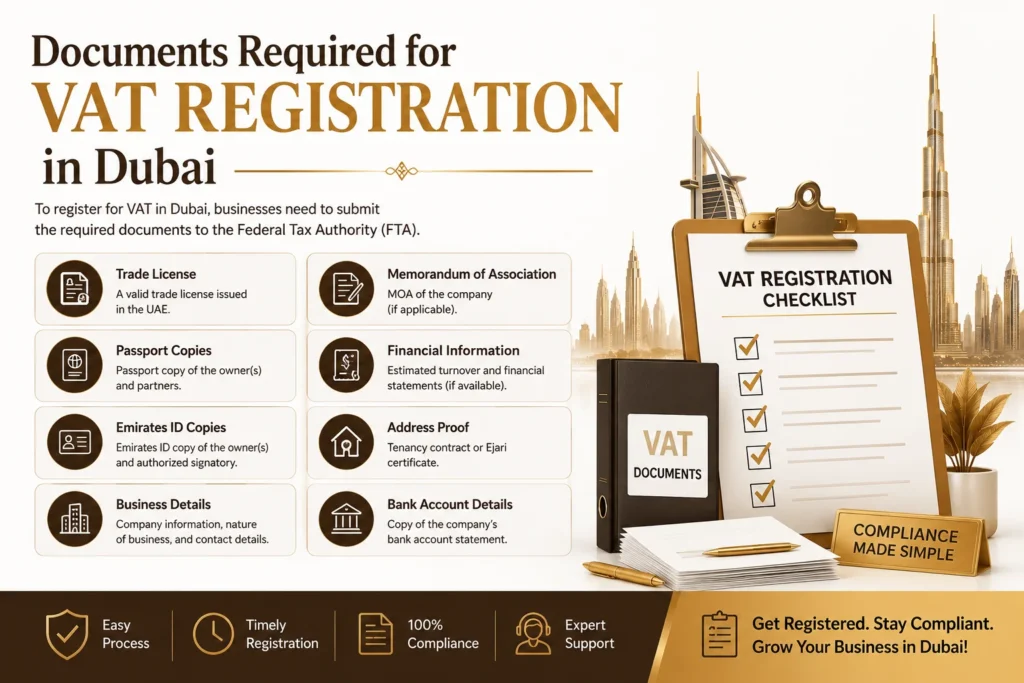
Before initiating the registration process, businesses should gather all necessary documentation to avoid delays.
Commonly required documents include:
- Valid trade license
- Passport copies of shareholders or partners
- Emirates ID copies
- Memorandum of Association (MOA)
- Financial statements
- Revenue records and sales invoices
- Corporate bank account details
- Customs registration details, if applicable
- Contact information and business address
Preparing complete and accurate documentation helps streamline the registration process and reduces the likelihood of application rejection.
Step-by-Step VAT Registration Process in Dubai
The VAT registration process is completed online through the Federal Tax Authority portal.
Step 1: Create an FTA Account
Businesses must first create an account on the official FTA portal. This account will be used for all future VAT-related activities, including filing returns and making tax payments.
Step 2: Complete the VAT Registration Application
The application requires detailed information about the business, including:
- Business activities
- Ownership details
- Annual turnover
- Contact information
- Banking details
- Import and export activities
Providing accurate information is essential because discrepancies may delay approval.
Step 3: Upload Supporting Documents
Applicants must upload all required documents in the prescribed format. Missing or incomplete documentation may result in additional information requests.
Step 4: Review and Submit the Application
Before submission, businesses should carefully review all information to ensure accuracy and completeness.
Step 5: Obtain the Tax Registration Number (TRN)
Once the application is approved, the Federal Tax Authority issues a Tax Registration Number (TRN). This number serves as the company’s official VAT identification and must appear on tax invoices and other relevant documents.
Understanding VAT Filing in Dubai
VAT filing refers to the process of submitting VAT returns to the Federal Tax Authority. Businesses that have completed their VAT registration and filing in Dubai are required to periodically report their taxable transactions and pay any outstanding VAT liabilities.
A VAT return typically includes information regarding:
- Taxable sales
- Output VAT collected
- Purchases and expenses
- Input VAT recoverable
- Imports and exports
- Net VAT payable
Accurate VAT registration and filing in Dubai are essential because errors may lead to penalties, compliance issues, and increased scrutiny from tax authorities. Proper VAT registration and filing in Dubai helps businesses maintain financial transparency and remain compliant with UAE tax regulations.
How Often Must VAT Returns Be Filed?
The frequency of VAT filing depends on the tax period assigned by the Federal Tax Authority.
- Quarterly Filing: Most small and medium-sized businesses are required to file VAT returns every three months.
- Monthly Filing: Certain larger businesses may be assigned monthly filing obligations based on their transaction volumes.
The applicable filing frequency is generally specified in the VAT Registration and Filing in Dubai certificate issued by the FTA.
VAT Filing Deadlines in Dubai
VAT returns are generally due within 28 days after the end of the relevant tax period.
For example:
| Tax Period Ends | Filing Deadline |
| 31 March | 28 April |
| 30 June | 28 July |
| 30 September | 28 October |
| 31 December | 28 January |
Businesses should maintain a compliance calendar to ensure that filing deadlines are not missed.
Common VAT Compliance Challenges
Despite the relatively straightforward VAT framework in the UAE, many businesses encounter challenges during the compliance process.
- Incorrect VAT Calculations: Errors in calculating output VAT or recoverable input VAT can result in inaccurate returns.
- Poor Record Keeping: Maintaining incomplete financial records can create significant compliance issues during audits.
- Late Filing: Missing VAT return deadlines may lead to financial penalties and administrative complications.
- Incorrect Invoice Formats: Tax invoices must contain specific information as prescribed by UAE VAT regulations. Failure to issue compliant invoices can lead to penalties.
- Improper Input VAT Claims: Businesses should only recover VAT on eligible expenses. Claiming VAT on non-allowable expenses may result in regulatory scrutiny.
Implementing robust accounting systems and internal controls can significantly reduce these challenges.
VAT Penalties in Dubai
The Federal Tax Authority imposes penalties for various forms of non-compliance to ensure adherence to tax regulations.
Common violations include:
- Late VAT Registration: Businesses that fail to register within the required timeframe may be subject to penalties.
- Late Filing of VAT Returns: Delays in filing VAT returns can result in administrative fines.
- Late Payment of VAT: Failure to pay outstanding VAT liabilities on time may lead to additional penalties.
- Submission of Incorrect Returns: Providing inaccurate information in VAT returns may trigger financial penalties and further investigations.
To avoid these risks, businesses should establish effective compliance procedures and conduct periodic reviews of their tax processes.
Importance of Maintaining VAT Records
Accurate record keeping is a fundamental requirement under UAE VAT law. Businesses are generally required to maintain records relating to their transactions for the prescribed retention period.
Important records include:
- Tax invoices
- Purchase invoices
- Accounting books
- Import and export documents
- Credit notes and debit notes
- Bank statements
- Contracts and agreements
Maintaining proper records enables businesses to substantiate their tax positions, prepare accurate returns, and remain audit-ready at all times.
Modern accounting software can significantly improve record management while minimizing manual errors.
Benefits of Professional VAT Services
Managing VAT obligations can be complex, particularly for businesses with high transaction volumes or cross-border activities. This is why many companies rely on professional VAT registration and filing services in Dubai to ensure full compliance with UAE tax regulations.
Professional VAT services offer several benefits, including:
✔ Improved accuracy in tax calculations
✔ Timely filing of VAT returns
✔ Reduced risk of penalties and fines
✔ Enhanced compliance with changing regulations
✔ Better financial transparency and reporting
✔ Significant time and cost savings
By outsourcing VAT registration and Filing in Dubai, businesses can focus on their core operations while ensuring that their tax obligations are managed accurately and efficiently in accordance with UAE tax laws.
How Singiri & Co Can Help
Navigating VAT regulations requires expertise, precision, and a thorough understanding of UAE tax legislation. Singiri & Co provides comprehensive support to businesses seeking assistance with VAT registration and filing in Dubai.
Services may include:
- VAT registration assistance
- Documentation review and preparation
- VAT return filing
- VAT compliance reviews
- Advisory and consultation services
- Audit support and representation
With professional guidance, businesses can confidently manage their VAT obligations while minimizing compliance risks and administrative burdens.
Conclusion
Understanding VAT registration and filing in Dubai is essential for businesses operating in the UAE. From determining registration eligibility and obtaining a tax registration number to filing accurate returns and maintaining proper records, every stage of the process requires careful attention and ongoing compliance.
Businesses that establish effective VAT systems not only avoid penalties but also strengthen financial governance and improve operational efficiency. Given the evolving regulatory landscape, seeking expert assistance from experienced professionals such as Singiri & Co can help ensure seamless compliance while allowing businesses to focus on growth and long-term success.
FAQS
1. What is the VAT rate in Dubai?
The standard VAT rate in Dubai and across the UAE is 5%.
2. When is VAT registration mandatory?
VAT registration becomes mandatory when taxable supplies and imports exceed AED 375,000 annually.
3. How often should VAT returns be filed?
Most businesses file quarterly, although some may be required to file monthly.
4. What is a TRN?
A Tax Registration Number (TRN) is the official VAT identification number issued by the Federal Tax Authority.
5. What happens if a business misses a VAT filing deadline?
Late filing may result in penalties and additional administrative charges.
6. Why should businesses seek professional VAT assistance?
Professional support helps improve accuracy, ensure compliance, and reduce the risk of penalties.