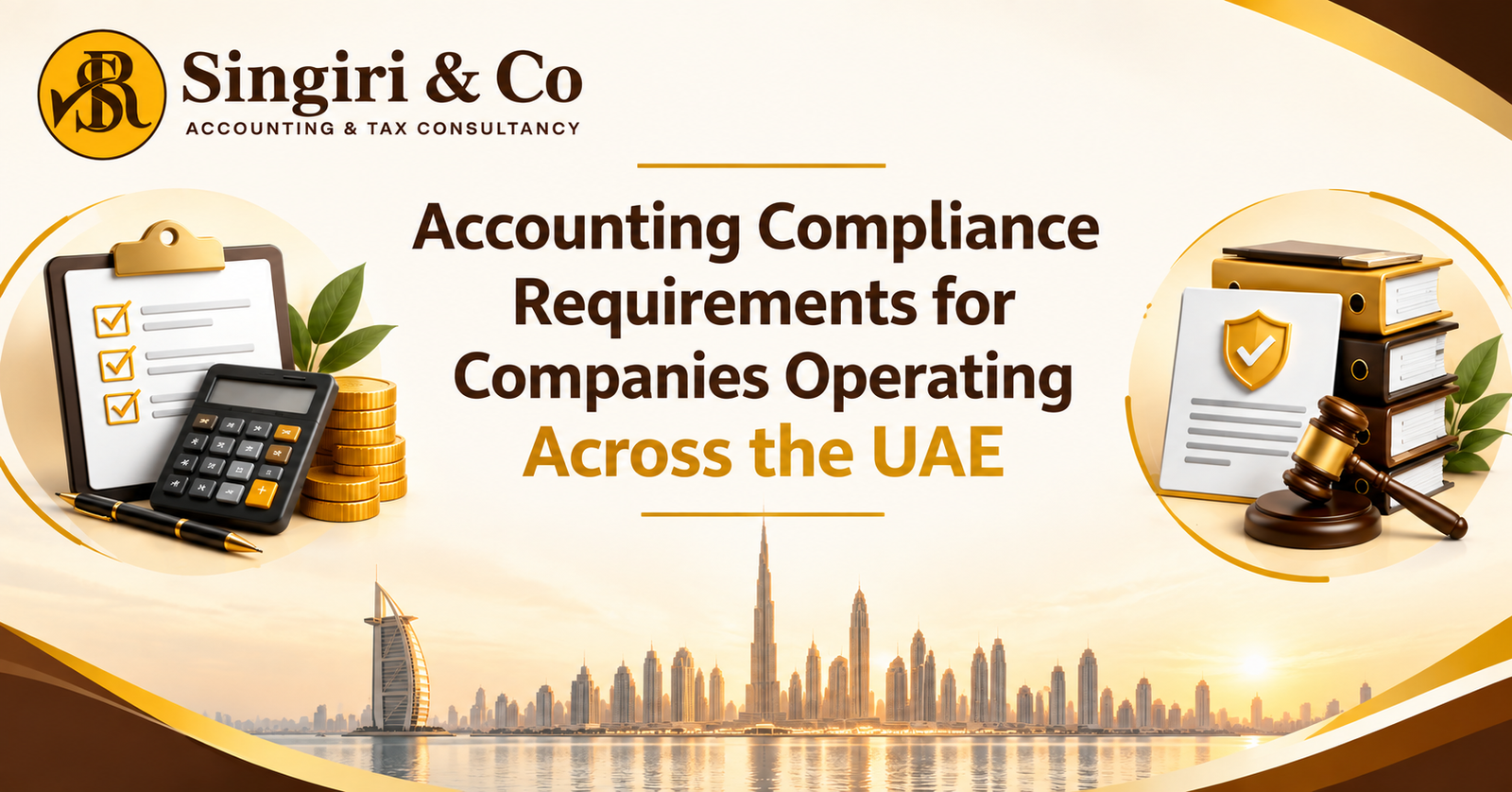
Accounting Compliance Requirements for Companies Operating Across the UAE
Running a business in the United Arab Emirates requires more than focusing on sales, customers, and daily operations. Companies must also maintain accurate financial records, prepare reliable financial statements, follow accounting standards applicable to UAE businesses, and meet relevant tax and regulatory obligations. Proper accounting compliance helps businesses maintain financial transparency while supporting better decision-making and long-term growth.
For companies seeking professional financial support, Singiri & Co Dubai, UAE, provides accounting, auditing, taxation, and business advisory services to help businesses manage their financial and compliance responsibilities.
Understanding Accounting Standards Applicability to UAE businesses is important because accounting records influence financial reporting, corporate tax calculations, audit procedures, and business decisions. Whether a company operates in mainland Dubai, another UAE emirate, or a free zone, maintaining an organized accounting system can help reduce errors and improve financial control.
Table of Contents
What Is Accounting Compliance in the UAE?
Accounting compliance refers to maintaining financial records and preparing financial information according to Accounting Standards Applicable to UAE Businesses, UAE regulations, tax requirements, and business practices.
The exact UAE accounting compliance requirements may vary according to the company’s legal structure, business activity, size, turnover, tax position, and regulatory environment. However, businesses should maintain complete, accurate, and properly supported financial records.
Key areas of accounting compliance include bookkeeping, financial reporting, VAT accounting, corporate tax accounting, record retention, account reconciliation, internal controls, and auditing where applicable.
A structured accounting system gives business owners a clearer understanding of revenue, expenses, assets, liabilities, profitability, and cash flow.
Key Accounting Compliance Requirements for UAE Businesses
| Compliance Area | Key Requirement | Why It Matters |
|---|---|---|
| Accounting Standards | Apply appropriate accounting standards consistently. | Supports reliable financial reporting |
| Bookkeeping | Record business transactions accurately. | Creates complete financial records |
| Financial Statements | Prepare accurate financial statements | Shows financial performance and position |
| VAT Accounting | Record taxable transactions and VAT correctly. | Supports VAT compliance |
| Corporate Tax | Maintain records supporting tax calculations. | Helps determine taxable income |
| Record Retention | Keep accounting and supporting documents. | Provides evidence for reviews |
| Reconciliation | Regularly reconcile financial accounts. | Helps identify errors |
| Related Parties | Properly document applicable transactions. | Supports transparency |
| Audit | Complete an audit where applicable. | Provides independent financial review |
| Internal Controls | Establish approval and review procedures. | Reduces financial errors |
1. Follow Appropriate Accounting Standards
One of the most important responsibilities of a UAE business is preparing financial information using appropriate accounting standards.
Accounting standards applicable to UAE businesses provide a framework for recording, measuring, presenting, and disclosing financial transactions.
International Financial Reporting Standards, commonly known as IFRS, are widely used by businesses in the UAE. Companies should establish accounting policies appropriate to their activities and apply them consistently.
Important accounting areas can include:
- Revenue recognition
- Inventory valuation
- Fixed assets
- Depreciation
- Leases
- Financial instruments
- Provisions
- Foreign currency transactions
- Related-party transactions
- Financial statement presentation
Businesses should maintain appropriate documentation for significant accounting judgments and estimates.
2. Maintain Accurate Bookkeeping Records
Bookkeeping forms the foundation of effective financial management. Businesses should record their income, purchases, expenses, assets, liabilities, payroll, bank transactions, and other financial activities throughout the year.
Delaying bookkeeping until the end of a financial period can create unnecessary complications. Missing invoices, duplicate transactions, incorrect classifications, and unreconciled balances can affect the reliability of financial information.
Regular bookkeeping helps businesses prepare for tax filings, financial reporting, management reviews, and audits.
Proper bookkeeping also makes it easier to apply accounting standards applicable to UAE businesses consistently because financial reporting depends on the accuracy of the underlying accounting records.
3. Prepare Reliable Financial Statements
Financial statements provide an organized picture of a company’s financial performance and position under Accounting Standards Applicable to UAE Businesses.
Depending on the business and applicable requirements, financial statements can include:
- Statement of financial position
- Statement of profit or loss
- Statement of cash flows
- Statement of changes in equity
- Notes to the financial statements
Reliable financial statements should be supported by reconciled accounting records and appropriate documentation.
Financial reporting also helps business owners evaluate profitability, assets, liabilities, cash flow, and overall financial performance.
Companies that are required to undergo an audit should ensure their financial statements are accurate and properly supported. Ensure their financial records and statements are properly prepared before the audit begins.
4. Maintain Proper VAT Accounting
VAT accounting is another important area for businesses that are registered for UAE VAT.
Companies should accurately record taxable sales, purchases, input VAT, output VAT, credit notes, and other relevant transactions.
Accounting records should support the information reported through VAT returns. Regular reconciliation between accounting records and VAT records can help identify discrepancies before filing.
Businesses should also maintain relevant invoices and supporting documentation according to applicable requirements.
Integrating VAT procedures with everyday bookkeeping can make the company’s overall UAE accounting compliance requirements easier to manage.
5. Connect Accounting Records With Corporate Tax
UAE Corporate Tax has made accurate accounting records increasingly important.
Corporate tax calculations generally begin with accounting profit or loss before considering the adjustments required under the corporate tax rules.
Businesses should therefore maintain reliable records for revenue, expenses, assets, liabilities, and other financial information.
Particular attention may be required for:
- Taxable income
- Deductible expenses
- Non-deductible expenses
- Exempt income
- Related-party transactions
- Transfer pricing considerations
- Accounting adjustments
- Supporting documentation
Applying Accounting Standards Applicable to UAE businesses correctly can provide a more reliable accounting foundation for corporate tax calculations.
6. Reconcile Accounts Regularly
Account reconciliation is an essential accounting control that helps businesses identify errors and inconsistencies.
Companies should regularly reconcile:
- Bank accounts
- Accounts receivable
- Accounts payable
- VAT balances
- Payroll
- Inventory
- Fixed assets
- Loans
- Intercompany balances
Bank reconciliation, for example, can identify transactions recorded incorrectly or transactions appearing on bank statements that have not yet been entered into the accounting system.
Regular reconciliation helps ensure that financial reports are based on accurate and complete information.
7. Properly Document Related-Party Transactions
Businesses that operate as part of a group or deal with related companies should maintain proper records of related-party transactions in line with Accounting Standards Applicable to UAE Businesses.
These transactions can include management fees, loans, shared expenses, service arrangements, asset transfers, and other financial dealings.
Companies should retain relevant agreements, invoices, payment records, and supporting documentation.
Proper documentation can support transparency and help businesses meet applicable accounting and tax obligations.
8. Maintain Accounting and Supporting Records

Record retention is an important component of financial compliance.
Businesses should maintain accounting books and supporting documentation for the applicable period required under UAE company, tax, and regulatory requirements.
Important records may include:
- Sales invoices
- Purchase invoices
- Bank statements
- Contracts
- Receipts
- Payroll records
- Tax documents
- Asset registers
- Financial statements
- Loan agreements
- Related-party documentation
A digital document management system can make it easier to organize and retrieve records when needed.
9. Establish Strong Internal Controls
Internal controls help companies reduce financial errors and improve accountability.
Useful controls can include:
- Separating payment and approval responsibilities
- Setting approval limits
- Reviewing accounting entries
- Performing regular reconciliations
- Restricting access to financial systems
- Maintaining supporting documentation
- Conducting periodic financial reviews
Strong internal controls become particularly useful as a business grows and the number of financial transactions increases.
Common Accounting Compliance Mistakes
Businesses can face accounting difficulties when financial processes are not reviewed regularly.
Common mistakes include:
- Delaying bookkeeping.
- Mixing personal and business transactions.
- Failing to reconcile bank accounts.
- Incorrectly classifying expenses.
- Losing supporting documents.
- Ignoring related-party transactions.
- Maintaining incomplete asset records.
- Preparing financial statements without proper reconciliations.
- Treating tax compliance separately from accounting.
- Failing to review accounting policies.
Avoiding these mistakes can improve financial reporting and make tax and audit procedures more efficient.
Accounting Compliance Checklist
Businesses can use this checklist to review their financial processes:
| Review Area | What Should Be Checked? |
|---|---|
| Bookkeeping | Are all transactions recorded accurately? |
| Accounting policies | Are appropriate accounting policies applied consistently? |
| Bank reconciliation | Are bank balances reconciled regularly? |
| VAT | Do VAT records agree with accounting records? |
| Corporate Tax | Are accounting records ready for tax calculations? |
| Documentation | Are invoices, contracts, and receipts available? |
| Fixed assets | Is the asset register updated? |
| Related parties | Are applicable transactions documented? |
| Financial statements | Are reports supported by reconciled records? |
| Audit | Have applicable audit requirements been reviewed? |
Why Professional Accounting Support Matters
Understanding Accounting Standards Applicable to UAE businesses can involve detailed accounting policies, reporting requirements, documentation procedures, and interactions with tax regulations.
Businesses with multiple entities, complex transactions, international operations, or significant related-party dealings may benefit from professional accounting assistance.
Professional accounting firms can support businesses with bookkeeping, financial reporting, account reconciliation, VAT accounting, corporate tax support, audit preparation, and financial analysis.
Professional support can also help business owners receive timely financial information for budgeting, cash-flow planning, profitability analysis, and strategic decisions.
Conclusion
Accounting compliance is an ongoing responsibility for companies operating across the UAE. Businesses need accurate bookkeeping, reliable financial statements, proper documentation, regular reconciliations, appropriate tax records, and effective internal controls.
Following accounting standards applicable to UAE businesses can help companies maintain consistent financial reporting and create more reliable information for management, tax, and audit purposes.
The UAE accounting compliance requirements can vary according to a company’s structure and activities, so businesses should regularly review the requirements relevant to their operations.
For professional assistance, Singiri & Co Dubai, UAE, provides accounting, auditing, taxation, and business advisory services to help businesses manage their financial responsibilities and build structured accounting processes.
With accurate records, consistent accounting practices, effective controls, and professional support, companies can strengthen their financial management and establish a solid foundation for sustainable business growth in the UAE.
FAQS
1. What accounting standards are commonly used in the UAE?
IFRS is widely used for financial reporting in the UAE. Businesses should determine the appropriate accounting framework based on their circumstances and applicable requirements.
2. Why are accounting standards important for UAE businesses?
Accounting standards applicable to UAE businesses provide a structured framework for recording and presenting financial information consistently.
3. How does bookkeeping support corporate tax compliance?
Accurate bookkeeping provides the financial information needed to determine accounting profit or loss and make applicable corporate tax adjustments.
4. Should businesses reconcile accounts regularly?
Yes. Regular reconciliation helps identify errors, missing transactions, duplicate entries, and unexplained differences before financial statements are finalized.
5. What accounting records should UAE businesses maintain?
Businesses should maintain relevant invoices, receipts, contracts, bank statements, payroll records, tax documentation, asset registers, and other supporting financial records.
6. Can accounting software guarantee compliance?
No. Accounting software can improve record-keeping and reporting, but compliance also depends on accurate data, appropriate policies, documentation, internal controls, and regular review.
7. How can a company improve its accounting compliance?
A company can improve compliance by maintaining accurate books, applying appropriate accounting standards, reconciling accounts regularly, retaining supporting documents, reviewing tax obligations, and obtaining professional accounting assistance where appropriate.