
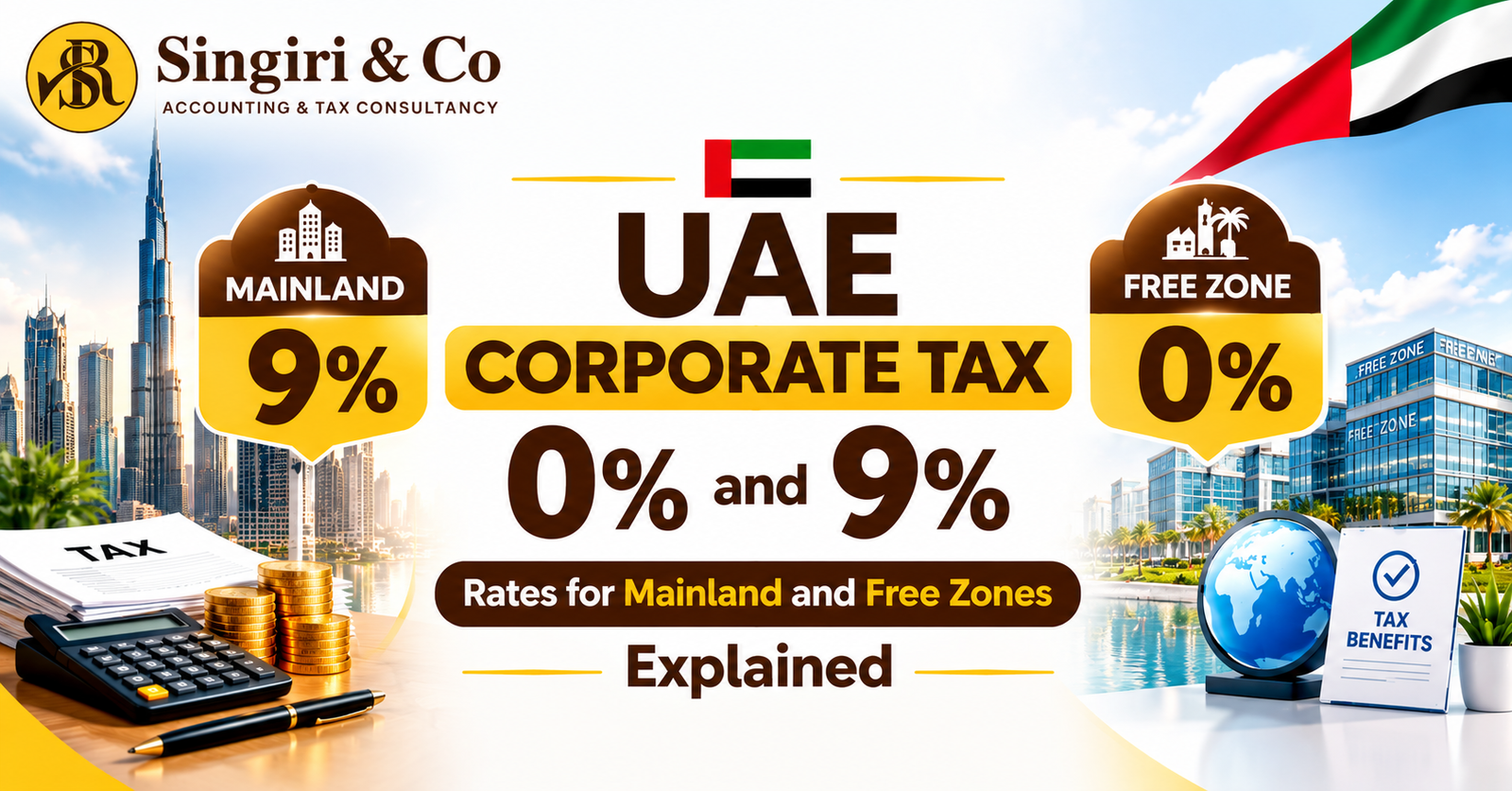
The United Arab Emirates has introduced a structured corporate tax system that influences how businesses calculate profits, manage financial records, and fulfill their tax responsibilities. In 2026, companies operating in Dubai and other Emirates must understand the applicable corporate tax rates to plan their finances and comply with federal regulations.
The standard UAE corporate tax framework applies a 0% rate to taxable income up to AED 375,000 and a 9% rate to taxable income exceeding that threshold. However, the final tax liability depends on the company’s taxable income, business activities, eligibility for reliefs, and applicable tax provisions.
Understanding UAE corporate tax 0% and 9% rates for businesses can help business owners distinguish between accounting profit, taxable income, and the amount payable to the Federal Tax Authority (FTA). Mainland businesses, free zone entities, professional service providers, and trading companies should review their individual circumstances before calculating their corporate tax obligations.
1. Understanding the UAE Corporate Tax Structure
UAE corporate tax is a federal tax imposed on the taxable income of businesses and other taxable persons covered by the legislation. The framework establishes a standard tax structure while providing specific treatments for qualifying free zone entities and eligible relief arrangements.
The standard corporate tax rates are
| Annual taxable income | Applicable rate |
| Up to AED 375,000 | 0% |
| Above AED 375,000 | 9% on the excess |
The threshold does not represent a company’s annual sales or total business revenue. Instead, it applies to taxable income determined under UAE corporate tax rules after relevant adjustments have been made.
For instance, a company with AED 500,000 in taxable income does not generally pay 9% on the entire amount. The first AED 375,000 is taxed at 0%, while the remaining AED 125,000 is taxed at 9%.
This structure is important for UAE corporate tax planning because businesses can estimate their potential liabilities more accurately when their financial records are complete and their taxable income is calculated correctly.
2. How the 0% Corporate Tax Rate Works
The UAE Corporate Tax 0% and 9% Rates for Businesses include a 0% corporate tax rate on the first AED 375,000 of taxable income under the standard tax regime. This provision can benefit small and medium-sized enterprises, startups, consultancies, and other businesses whose taxable income falls within the threshold.
However, a 0% rate does not automatically exempt businesses from all corporate tax responsibilities.
Example of the 0% tax bracket
Under the UAE Corporate Tax 0% and 9% Rates for Businesses, suppose a consulting business in Dubai records AED 350,000 in taxable income during its financial year.
Its tax calculation would be
- Taxable income: AED 350,000.
- Income covered by the 0% bracket: AED 350,000.
- Corporate tax payable under the standard rate structure: AED 0.
Although the company has no corporate tax payable under this calculation, it must still assess whether corporate tax registration, return filing, recordkeeping, and other compliance requirements apply.
Businesses should also monitor changes in profitability. If taxable income rises above AED 375,000, the standard 9% rate generally applies to the excess.
3. When the 9% UAE Corporate Tax Rate Applies
The UAE Corporate Tax 0% and 9% Rates for Businesses include the standard 9% corporate tax rate on taxable income exceeding AED 375,000. It can affect mainland companies, service providers, trading businesses, manufacturers, contractors, and other taxable businesses under the standard regime.
Taxable income is calculated according to relevant legislation. Accounting profit may require adjustments for deductible expenditure, exempt income, and other tax-specific provisions.
Corporate tax calculation example
Consider a UAE trading company with AED 950,000 in taxable income.
| Particulars | Amount |
| Total taxable income | AED 950,000 |
| Income taxed at 0% | AED 375,000 |
| Income subject to 9% | AED 575,000 |
| Tax at 9% | AED 51,750 |
Based on these assumptions, the company’s corporate tax liability would be AED 51,750.
This example demonstrates why businesses should calculate taxable income before applying the tax rate. Using gross revenue instead of taxable income can lead to incorrect estimates and unnecessary confusion.
Companies should maintain supporting documents for revenue, expenses, adjustments, and other transactions to substantiate the figures reported in their corporate tax returns.
4. UAE Free Zone Corporate Tax Rules in 2026
UAE Corporate Tax 0% and 9% Rates for Businesses apply differently to free zone companies depending on their eligibility. Incorporation in a UAE free zone does not automatically entitle a company to pay 0% corporate tax on all its income.
A Qualifying Free Zone Person (QFZP) may benefit from a 0% rate on qualifying income, while non-qualifying income is generally subject to 9%, subject to applicable provisions and de minimis rules.
Requirements for qualifying free zone companies
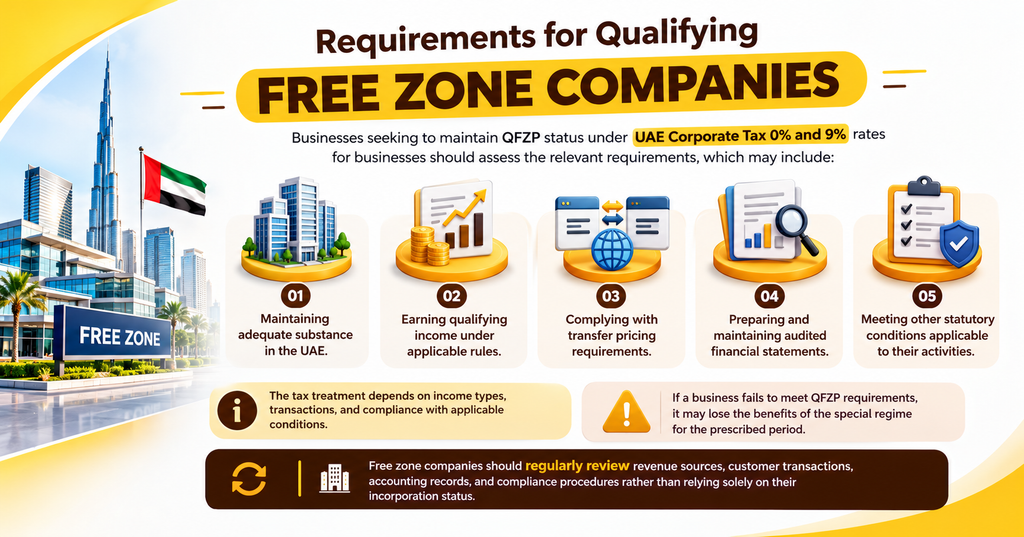
Businesses seeking to maintain QFZP status under UAE Corporate Tax 0% and 9% rates for businesses should assess the relevant requirements, which may include:
- Maintaining adequate substance in the UAE.
- Earning qualifying income under applicable rules.
- Complying with transfer pricing requirements.
- Preparing and maintaining audited financial statements.
- Meeting other statutory conditions applicable to their activities.
The tax treatment depends on income types, transactions, and compliance with applicable conditions.
If a business fails to meet QFZP requirements, it may lose the benefits of the special regime for the prescribed period.
Free zone companies should regularly review revenue sources, customer transactions, accounting records, and compliance procedures rather than relying solely on their incorporation status.
5. Mainland Companies Versus Free Zone Businesses
The applicable tax treatment may differ between mainland businesses and free zone entities. Understanding the distinction helps companies identify the correct rules for their operations.
| Business type | General corporate tax treatment |
| Mainland company | 0% on the first AED 375,000 of taxable income and 9% on the excess |
| Qualifying free zone company | 0% on qualifying income and generally 9% on non-qualifying income |
| The free zone company is not qualifying for the special regime. | Generally follows the standard 0% and 9% structure |
| Eligible business electing for Small Business Relief | May qualify for relief if all statutory conditions are met |
Under UAE Corporate Tax 0% and 9% Rates for Businesses, Small Business Relief is separate from the standard 0% tax bracket. Eligible resident taxable persons may elect for this relief when they meet the applicable revenue threshold and other conditions. The AED 3 million revenue threshold applies to eligible tax periods ending on or before 31 December 2026, subject to relevant legislation and exclusions.
Qualifying free zone persons and members of multinational enterprise groups meeting applicable criteria are among those excluded from small business relief.
Businesses should evaluate their eligibility before relying on a particular tax treatment.
6. Steps to Calculate UAE Corporate Tax Correctly
An organized calculation process helps businesses prepare accurate tax returns and minimize avoidable errors.
Step 1: Prepare financial statements.
For UAE Corporate Tax 0% and 9% Rates for Businesses, compile the company’s accounting records and prepare financial statements using the applicable accounting standards. Ensure that revenue, expenses, assets, liabilities, and other balances are properly reconciled.
Step 2: Review taxable and exempt income.
Identify income that is taxable and assess whether any income qualifies for an exemption or special treatment under UAE corporate tax legislation.
Step 3: Assess deductible expenses
Review business expenses and determine whether they meet the applicable deductibility requirements. Maintain invoices, contracts, payment evidence, and other supporting documents.
Step 4: Calculate taxable income
Make the required adjustments to accounting profit and apply the relevant tax rules to determine taxable income.
Step 5: Apply the appropriate tax treatment
Under the standard regime, apply 0% to the first AED 375,000 and 9% to the excess. Separately assess eligibility for QFZP treatment or Small Business Relief where relevant.
Step 6: Review the return and payment
Check the tax computation, reconcile it with the financial statements, and submit the return and any payment by the applicable deadline.
Following these steps supports accurate corporate tax reporting and better financial management.
7. Corporate Tax Registration and Filing Deadlines
UAE Corporate Tax 0% and 9% Rates for Businesses require registration where applicable, accurate reporting, timely return filing, tax payment, and record maintenance. Generally, returns and payments are due within nine months after the tax period ends. For example, companies with a tax year ending 31 December 2025 generally must file and pay by 30 September 2026. Businesses should follow FTA guidance and meet applicable deadlines to avoid penalties.
8. Common Corporate Tax Mistakes Businesses Should Avoid
Businesses can reduce compliance risks by addressing several common mistakes.
Applying 9% to total revenue: Corporate tax is calculated using taxable income, not simply the total sales recorded by the business.
Assuming that all free zone income is tax-free: The 0% rate depends on qualifying income and compliance with the applicable QFZP conditions.
Ignoring financial documentation: Incomplete invoices, expense records, or reconciliations can make tax calculations difficult to substantiate.
Overlooking filing responsibilities: A company with no tax payable may still have registration, filing, or recordkeeping obligations.
Failing to review relief eligibility: Small Business Relief and other special treatments have specific eligibility requirements that should be assessed carefully.
Waiting until the deadline to prepare: Delayed bookkeeping and incomplete financial statements can increase the risk of errors.
Businesses can address these issues by reviewing their accounts regularly and seeking professional advice when tax matters become complex.
9. Practical Corporate Tax Planning Tips for 2026
Effective tax planning begins with understanding the business’s financial position and the rules applicable to its activities.
Companies should maintain accurate accounting records, reconcile bank accounts, review expenses, and monitor changes in taxable income throughout the year. Free zone businesses should also assess their QFZP status and the treatment of income from different transactions.
Additional measures include keeping tax registration details updated, maintaining supporting documents, reviewing related-party transactions where relevant, and tracking regulatory updates.
Businesses should avoid making decisions based only on the headline 0% or 9% rates. The correct tax outcome depends on taxable income, the business structure, available reliefs, and compliance with statutory requirements.
The phrase UAE Corporate Tax 0% and 9% Rates for Businesses reflects an important consideration for companies in 2026: understanding the applicable rates is only one part of maintaining effective tax compliance.
Conclusion
Understanding UAE Corporate Tax 0% and 9% Rates for Businesses is important for companies that want to calculate their liabilities correctly, manage cash flow, and comply with UAE regulations in 2026. The standard tax structure offers a 0% rate on the first AED 375,000 of taxable income and 9% on the excess, while free zone tax treatment and relief provisions require a separate eligibility assessment.
Singiri & Co provides accounting and bookkeeping, corporate tax registration and return filing, VAT services, auditing, financial reporting, and business advisory support to businesses in Dubai and across the UAE.
With professional support, businesses can improve the accuracy of their financial records, assess relevant tax treatments, prepare corporate tax computations, and manage their compliance responsibilities more efficiently.
FAQS
1. What are the UAE corporate tax rates for 2026?
The standard rates are 0% on the first AED 375,000 of taxable income and 9% on the portion exceeding AED 375,000. Special rules may apply to qualifying free zone businesses and eligible relief arrangements.
2. Is the AED 375,000 threshold based on revenue or profit?
The threshold applies to taxable income, not total revenue. Taxable income is determined after applying the relevant adjustments and provisions under UAE corporate tax legislation.
3. Do all free zone companies qualify for 0% corporate tax?
No. A free zone company must satisfy the applicable requirements for qualifying as a free zone person and earn qualifying income to benefit from the 0% rate on that income.
4. How much corporate tax is payable on AED 700,000 of taxable income?
Under the standard regime, AED 375,000 is taxed at 0%, while AED 325,000 is taxed at 9%. The resulting tax liability is AED 29,250, assuming no other adjustments or reliefs apply.
5. What is the corporate tax filing deadline in the UAE?
Generally, the return and any tax payable are due within nine months of the end of the relevant tax period. Businesses should confirm their specific deadlines and obligations.
6. What is Small Business Relief in the UAE?
Small Business Relief is available to eligible resident businesses with revenue not exceeding AED 3 million for tax periods ending on or before 31 December 2026, subject to applicable conditions and exclusions.
7. Can a company have zero corporate tax but still need to file a return?
Yes. A zero tax liability does not automatically remove corporate tax registration, return filing, or recordkeeping requirements.