
Importance of Accounting in the UAE: A comprehensive guide on the importance of accounting in the UAE, including key benefits, regulatory standards, applications, and compliance steps for individuals and businesses.
Accounting is the process of recording, organizing, and analyzing financial transactions to understand a business’s financial health. The Importance of Accounting in the UAE has increased significantly due to strict corporate tax, VAT, and audit regulations. Accurate accounting helps businesses track income, expenses, assets, and liabilities while ensuring compliance with UAE financial laws. It also supports effective financial planning, risk management, and informed decision-making. Strong accounting practices promote transparency, build stakeholder trust, and support sustainable business growth.
Table of Contents
Role of Accounting in Business Growth
Accounting plays a strategic and value-driven role in business growth, clearly demonstrating the importance of accounting in the UAE through accurate and reliable financial data that supports confident decision-making. It enables businesses to track revenue, control expenses, and improve profitability through efficient resource management.
Strong accounting practices help organizations stay compliant with UAE corporate tax, VAT, and statutory audit regulations, ensuring smooth operations and financial stability. Transparent financial reporting builds trust and credibility with investors, stakeholders, and business partners. By using well-structured financial information, businesses in the UAE can plan effectively and achieve sustainable, long-term growth in a competitive market.
How Accounting Drives Business Growth
- Provides accurate financial data for informed decision-making.
- Helps monitor revenue, expenses, and profits for better resource management.
- Ensures compliance with UAE corporate tax, VAT, and auditing regulations.
- Enhances transparency and builds trust among investors and stakeholders.
- Supports strategic planning and sustainable business growth.
Compliance With UAE Laws and Regulations
Compliance with UAE laws and regulations is essential for all businesses operating in the country, highlighting the importance of accounting in the UAE in maintaining strong regulatory adherence. By following corporate tax, VAT, and auditing standards, companies can avoid penalties, fines, and legal complications.
Maintaining accurate accounting records ensures transparency and accountability to regulatory authorities. Proper compliance through effective accounting practices also builds trust and credibility with investors, stakeholders, and business partners, supporting long-term business stability and growth in the UAE.
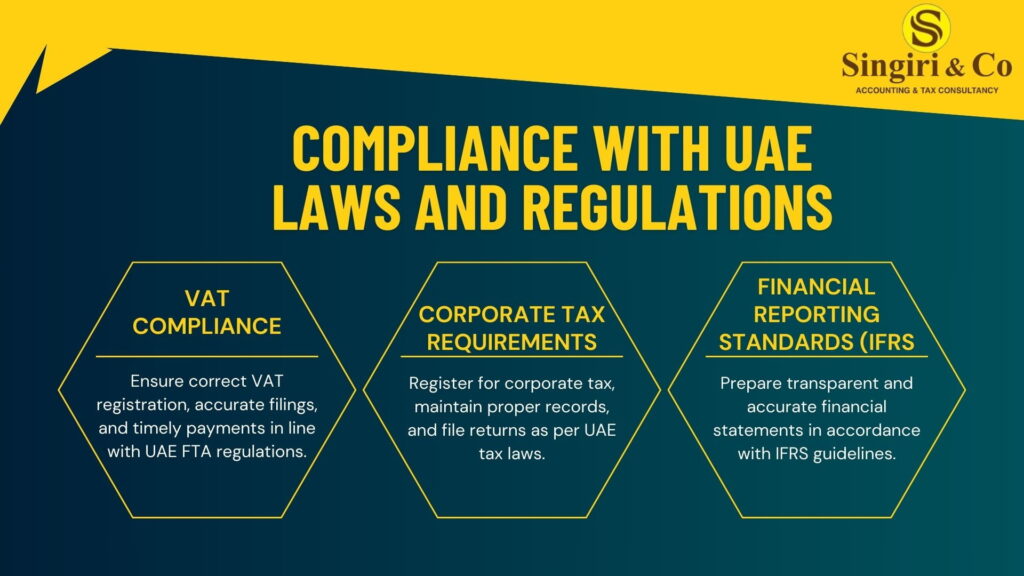
VAT Compliance
Value Added Tax (VAT) compliance plays a positive and strategic role for businesses operating in the UAE, emphasizing the importance of accounting in the UAE. By accurately recording and reporting all taxable transactions, including sales and purchases, companies ensure smooth adherence to VAT laws. Strong accounting practices support precise VAT calculations, whether payable or refundable, and help maintain well-organized records for audit purposes.
Timely filing of VAT returns promotes regulatory confidence and uninterrupted business operations. Through effective VAT compliance processes, businesses enhance transparency, strengthen credibility, and operate efficiently within the UAE’s regulatory framework.
Corporate Tax Requirements
Corporate tax compliance is a critical aspect of accounting for businesses in the UAE, highlighting the importance of accounting in the UAE in meeting regulatory requirements. Companies must accurately calculate and report their taxable income in accordance with UAE corporate tax laws. Maintaining proper financial records and supporting documentation is essential to ensure transparency and strengthen tax filings.
Timely submission of corporate tax returns and payment of liabilities helps businesses avoid penalties and legal complications. By following corporate tax requirements through effective accounting practices, businesses enhance regulatory compliance, build credibility with stakeholders, and maintain smooth financial operations.
Financial Reporting Standards (IFRS)
Financial reporting standards, particularly IFRS (International Financial Reporting Standards), are crucial for ensuring consistency and transparency in accounting practices, highlighting the Importance of Accounting in the UAE. They provide a uniform framework for preparing accurate and reliable financial statements that are clear to investors, regulators, and stakeholders.
Compliance with IFRS promotes accountability, enhances comparability of financial data, and supports well-informed decision-making, further emphasizing the Importance of Accounting in the UAE. Following these standards also ensures regulatory compliance and strengthens credibility in both local and international markets.
Accounting for Financial Transparency
Financial transparency is essential for building trust with stakeholders, investors, and regulatory authorities, highlighting the Importance of Accounting in the UAE for all businesses. Accurate accounting ensures that all financial transactions are recorded clearly, consistently, and in compliance with accounting standards.
Transparent financial reporting helps organizations demonstrate their financial health, avoid fraud, and make informed decisions, further emphasizing the Importance of Accounting in the UAE. It also enhances credibility, supports effective auditing, and strengthens investor confidence. Businesses that prioritize transparency are better positioned to attract investment, maintain compliance, and sustain long-term growth.
Benefits of Financial Transparency in Accounting:
- Ensures clarity in financial reporting and statements.
- Builds trust with investors, regulators, and stakeholders.
- Reduces risk of fraud and errors in financial records.
- Supports informed decision-making and strategic planning.
- Enhances organizational credibility and investor confidence.
Importance of Accurate Bookkeeping
Accurate bookkeeping is vital for maintaining reliable and trustworthy financial records, reinforcing the importance of accounting in the UAE for businesses of all sizes. It ensures that all business transactions are recorded systematically, reducing errors and preventing discrepancies. Proper bookkeeping enables businesses to monitor cash flow, control expenses, and evaluate financial performance effectively.
It also supports regulatory compliance, facilitates smooth audits, and builds confidence among investors and stakeholders. Maintaining precise accounting records helps businesses make informed decisions and achieve sustainable growth in the UAE’s competitive market.
Benefits of Accurate Bookkeeping:
- Records all transactions systematically and accurately.
- Helps monitor cash flow and manage expenses.
- Supports compliance with accounting regulations.
- Facilitates smooth audits and reporting.
- Strengthens investor and stakeholder confidence.
Supporting Informed Business Decisions
Accurate accounting and financial reporting play a crucial role in supporting informed business decisions, emphasizing the Importance of Accounting in the UAE for all businesses. By providing timely, reliable, and relevant financial information, companies can evaluate performance, identify trends, and assess risks effectively.
Clear and well-structured financial data enables management to plan budgets, allocate resources efficiently, and develop strategies aligned with organizational goals. Informed decision-making through strong accounting practices reduces uncertainty, improves operational efficiency, and supports sustainable business growth across the UAE.
How Accounting Supports Better Decision-Making:
- Provides reliable financial data for strategic planning.
- Helps identify trends, risks, and growth opportunities.
- Supports effective budgeting and resource allocation.
- Improves operational and financial performance.
- Enables long-term, sustainable business decisions.
Accounting for SMEs and Startups in the UAE
Accounting plays a vital role in the success of SMEs and startups in the UAE, highlighting the importance of accounting in the UAE by ensuring strong financial control and regulatory compliance from the early stages of business. Proper accounting helps entrepreneurs track expenses, manage cash flow, and evaluate profitability, enabling informed and confident decision-making.
It also supports compliance with UAE regulations, VAT requirements, and financial reporting standards, while strengthening credibility with investors, banks, and government authorities. Effective accounting systems create a solid financial foundation that supports sustainable growth, scalability, and long-term business success in the UAE
Benefits of Proper Accounting for SMEs and Startups:
- Helps SMEs and startups maintain financial control.
- Supports cash flow management and expense tracking.
- Ensures compliance with UAE accounting and tax regulations.
- Enhances credibility with investors and financial institutions.
- Builds a strong foundation for business growth and scalability.
Role of Accounting in Audit and Risk Management
Accounting plays a critical role in supporting effective audits and risk management within an organization, underscoring the importance of accounting in the UAE. Accurate and well-maintained financial records ensure transparency, making it easier to conduct audits and verify compliance with accounting standards and regulatory requirements. Strong accounting practices help identify financial risks, detect irregularities, and prevent fraud at an early stage. By providing reliable financial information, accounting supports risk assessment, strengthens internal controls, and enhances overall financial stability for businesses operating in the UAE.
Importance of Accounting in Audit and Risk Control:
- Ensures transparency and accuracy in financial records.
- Facilitates smooth and efficient audit processes.
- Helps identify and manage financial risks.
- Detects irregularities and prevents fraud.
- Strengthens internal controls and financial stability.
Digital Accounting and Automation in the UAE
Digital accounting and automation are transforming financial management for businesses in the UAE, reinforcing the importance of accounting in the UAE through improved accuracy, efficiency, and regulatory compliance. Automated accounting systems reduce manual errors, streamline routine financial tasks, and deliver real-time financial insights.
These technologies support compliance with UAE regulations, including VAT and corporate tax requirements, while enabling faster reporting and informed decision-making. By adopting digital accounting solutions, businesses enhance operational efficiency and build scalable, future-ready financial systems that support sustainable growth in the UAE.
Benefits of Digital Accounting and Automation:
- Automates routine accounting and reporting tasks.
- Reduces manual errors and improves accuracy.
- Provides real-time financial data and insights.
- Supports compliance with UAE tax and regulatory requirements.
- Enhances efficiency and scalability for business growth.
Conclusion
Accounting plays a fundamental role in ensuring financial transparency, regulatory compliance, and informed decision-making for businesses in the UAE. From accurate bookkeeping and IFRS-based reporting to digital accounting and audit support, strong accounting practices help organizations manage risks and maintain credibility with stakeholders.
For SMEs, startups, and growing enterprises, effective accounting systems provide a solid financial foundation that supports efficiency, compliance, and long-term sustainability. Embracing modern accounting practices enables businesses to adapt to regulatory changes, improve financial control, and achieve sustainable growth in a competitive market