1. Introduction
Corporate Tax in the UAE is a major development in the country’s taxation framework, introduced to improve transparency and align with international tax standards. It is now a mandatory compliance requirement for all businesses, including mainland companies and eligible free zone entities. Understanding the Corporate Tax Rate UAE 2026 is crucial for businesses to manage their tax obligations accurately and efficiently. Knowledge of the Corporate Tax Rate UAE 2026 supports effective financial planning, proper calculation of taxable income, and full compliance with Federal Tax Authority (FTA) regulations. It also helps businesses assess tax exposure, plan cash flows, and avoid penalties or reassessments. The introduction of Corporate Tax and the Corporate Tax Rate UAE 2026 impacts business operations, accounting practices, and overall compliance responsibilities, requiring companies to adapt for smooth operations and long-term sustainability.
Key impacts of Corporate Tax on businesses include:
- Improved Financial Accuracy – Encourages precise accounting and detailed financial reporting.
- Awareness of Tax Obligations – Businesses must understand applicable tax rates, thresholds, and exemptions.
- Stronger Compliance – Increases the need for proper documentation and adherence to tax regulations.
- Penalty Risk – Non-compliance or incorrect filings can lead to fines and legal consequences.
- Strategic Financial Planning – Influences budgeting, investment decisions, and overall business strategy.
2. What Is UAE Corporate Tax?
UAE Corporate Tax is a federal tax on the net profits of businesses operating in the UAE, including mainland companies, eligible free zone entities, foreign branches, and licensed individuals. Understanding the Corporate Tax Rate UAE 2026 helps businesses plan effectively and calculate profits accurately. Its purpose is to strengthen the UAE’s tax framework, ensure fair taxation, and align with international standards. The Federal Tax Authority (FTA) administers, monitors, and enforces Corporate Tax, overseeing registration, filing, payments, and compliance. Businesses must maintain proper accounting records and calculate profits accurately. It applies to all relevant financial periods after the effective date. Compliance ensures avoidance of penalties and supports long-term business planning.Corporate Tax Rate UAE 2026
Key aspects of UAE Corporate Tax include:
- Tax levied on net business profits
- Applicable to mainland, free zone, and foreign branch entities
- Introduced to align with global tax standards
- Regulated and enforced by the Federal Tax Authority (FTA)
3. Effective Date of Corporate Tax
The UAE Corporate Tax became effective on 1 June 2023, introducing federal corporate taxation across the country. All businesses operating in the UAE are required to register with the Federal Tax Authority (FTA), maintain accurate financial records, and file tax returns on time. Understanding the Corporate Tax Rate UAE 2026 is essential for businesses to calculate, report, and pay tax on profits for the relevant financial periods. For 2026, Corporate Tax is fully applicable, and the rules cover all financial years starting from the effective date, meaning companies must account for profits earned even if the tax return is filed later. Proper accounting methods, documentation, and planning are essential to ensure compliance and avoid penalties.Corporate Tax Rate UAE 2026
Key points regarding the effective date of Corporate Tax:
Corporate Tax became applicable on 1 June 2023
- Fully enforceable for the year 2026
- Applies to all relevant financial years after the effective date
- Businesses must comply with FTA filing and payment requirements
4. UAE Corporate Tax Rates 2026
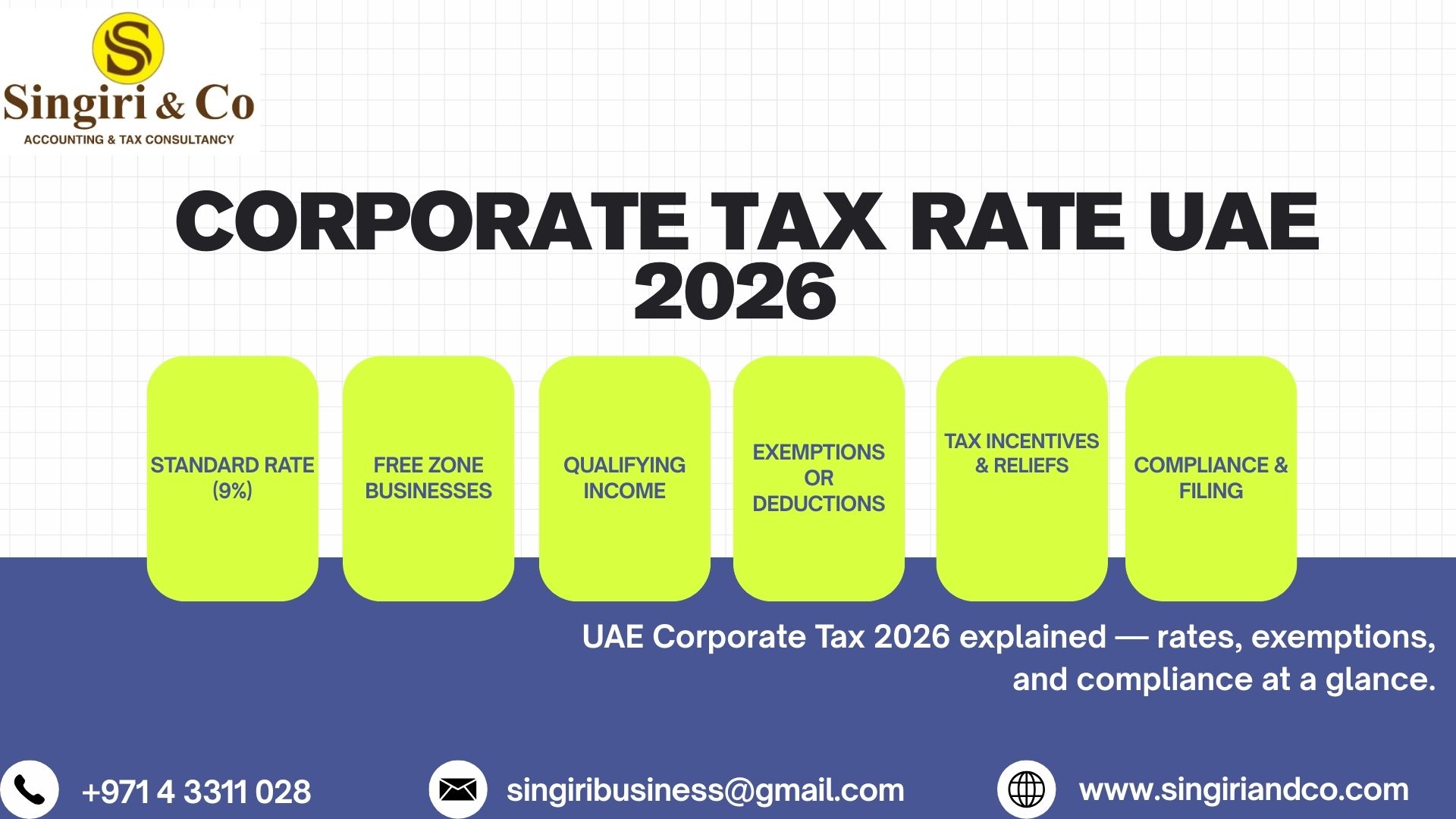
Understanding the corporate tax rates in the UAE for 2026 is essential for businesses to ensure proper compliance and tax planning. The UAE has introduced a tiered corporate tax system to accommodate different types of businesses, promote investment, and maintain a competitive economic environment.
Key Highlights of UAE Corporate Tax Rates 2026:
- Standard Rate: Businesses with taxable income above AED 375,000 are subject to a 9% corporate tax.
- Zero Tax for Small Businesses: Companies earning up to AED 375,000 pay no corporate tax, encouraging growth for startups and small enterprises.
- Large Multinationals: Certain multinational firms may be taxed differently under global minimum tax rules aligned with international standards (Pillar Two of BEPS 2.0).
- Free Zone Entities: Eligible Free Zone companies can continue enjoying a 0% tax rate if they comply with regulations and maintain proper records.
- Exemptions & Incentives: Certain eligible sectors and authorized entities may benefit from tax relief or exemptions, helping to lower their overall corporate tax burden.
- Financial Planning: Understanding the Corporate Tax Rate UAE 2026 helps businesses plan effectively, manage tax obligations, and ensure accurate filings with the Federal Tax Authority (FTA).Corporate Tax Rate UAE 2026
Proper understanding of these rates allows businesses to plan their finances effectively, optimize tax obligations, and avoid penalties. Applying the correct rate ensures accurate corporate tax calculations when filing returns with the Federal Tax Authority (FTA).
5. Corporate Tax Rate for Free Zone Companies
Free zone companies in the UAE are eligible for a 0% corporate tax rate on qualifying income. Understanding the Corporate Tax Rate UAE 2026 is essential for businesses to maintain eligibility and plan accurately. Companies must meet specific conditions set by the Federal Tax Authority (FTA) to benefit from the 0% corporate tax rate. For 2026, free zone companies must ensure their income qualifies under free zone regulations, comply with reporting obligations, and maintain proper documentation to benefit from the tax exemption. Non-qualifying income, or income earned outside the Free Zone, may be subject to the standard 9% corporate tax rate. Therefore, businesses must carefully separate qualifying and non-qualifying income to ensure accurate reporting.Corporate Tax Rate UAE 2026
Key points regarding the corporate tax rate for free zone companies:
- Eligible Free Zone companies can benefit from a 0% corporate tax rate on qualifying income.
- Companies must comply with FTA reporting and documentation requirements to maintain tax benefits
- Income earned outside free zones or from non-qualifying activities may be taxed at the standard 9% rate
- Proper bookkeeping and compliance are essential to avoid losing the free zone tax exemption
6. Small Business Relief (SBR)
Small Business Relief (SBR) is introduced to reduce the corporate tax burden on qualifying small businesses operating in the UAE. SBR allows eligible small businesses to benefit from a 0% corporate tax rate on profits up to a specified threshold. For 2026, businesses must meet the eligibility criteria, including turnover limits and compliance with FTA registration and reporting requirements, to qualify for SBR. Proper accounting and accurate record keeping are essential to ensure the correct application of SBR and to avoid penalties.
Key points regarding Small Business Relief (SBR):
- SBR provides a 0% corporate tax rate on profits for qualifying small businesses
- Eligibility depends on annual turnover and compliance with FTA registration and reporting
- Reduces overall corporate tax liability for small businesses in the UAE
- Businesses must maintain accurate financial records to benefit from SBR
7. Who Is Subject to Corporate Tax in 2026?
Free zone companies in the UAE are eligible for a 0% corporate tax rate on qualifying income. Understanding the Corporate Tax Rate UAE 2026 is essential for companies to maintain eligibility and plan effectively. Companies must meet specific conditions set by the Federal Tax Authority (FTA) to benefit from the 0% corporate tax rate. For 2026, free zone companies must ensure their income qualifies under free zone regulations, comply with reporting obligations, and maintain proper documentation. Non-qualifying income, or income earned outside the free zone, may be subject to the standard 9% corporate tax rate, so businesses must carefully separate qualifying and non-qualifying income for accurate reporting.
Key points regarding the corporate tax rate for free zone companies:
- Eligible free zone companies can benefit from a 0% corporate tax rate on qualifying income
- Companies must comply with FTA reporting and documentation requirements to maintain tax benefits
8. Corporate Tax Exemptions
Certain entities in the UAE are exempt from Corporate Tax to support public interest, social welfare, and specific investment activities. Understanding the Corporate Tax Rate UAE 2026 helps businesses identify applicable exemptions and plan accordingly. Exemptions ensure that government functions, charitable activities, and eligible investment structures are not unduly taxed, promoting economic stability and social development. For 2026, these exemptions remain applicable under the UAE Corporate Tax Law, provided entities meet the conditions set by the Federal Tax Authority (FTA).
Key points regarding Corporate Tax exemptions:
- Government entities are fully exempt from Corporate Tax
- Public benefit organizations conducting charitable or social welfare activities may qualify for exemptions
- Investment and pension funds may be exempt where applicable under FTA regulations
- Entities must maintain proper records and comply with reporting requirements to preserve their tax-exempt status
- Income earned outside free zones or from non-qualifying activities may be taxed at the standard 9% rate
- Proper bookkeeping and compliance are essential to avoid losing the free zone tax exemption
9. Corporate Tax Registration, Filing, and Payment
All businesses and taxable persons operating in the UAE must register for Corporate Tax with the Federal Tax Authority (FTA). Understanding the Corporate Tax Rate UAE 2026 helps businesses plan and ensure accurate tracking of taxable entities. Registration ensures compliance, and businesses must file annual Corporate Tax returns reflecting financial statements, adjusted taxable income, and any deductions or exemptions. Filing ensures transparency and correct calculation of tax liability. Corporate Tax payments must be made according to FTA timelines to avoid penalties or interest. Businesses should plan cash flows and maintain sufficient funds to meet deadlines.
Key points regarding registration, filing, and payment:
- All taxable persons must register with the FTA
- Annual returns must be filed accurately and on time
- Payments must meet FTA deadlines to avoid penalties
- Proper bookkeeping and documentation are essential
10. Impact of Corporate Tax Rates on Businesses
The Corporate Tax rates in the UAE directly impact businesses’ financial planning, profit allocation, and operational decisions. Understanding the Corporate Tax Rate UAE 2026 allows companies to forecast liabilities, manage budgets, and optimize profitability. Proper tax planning is essential to minimize tax exposure while remaining compliant with UAE regulations. Businesses must also maintain accurate records, supporting documents, and financial statements to meet Federal Tax Authority (FTA) requirements and avoid penalties.
Key points regarding the impact of Corporate Tax rates on businesses:
- Corporate Tax affects financial planning and operational decisions
- Effective tax planning helps reduce liabilities and optimize cash flow
- Accurate record-keeping is essential for compliance and audits
- Non-compliance may result in penalties, fines, or reassessments
11. Penalties for Non-Compliance
Businesses that fail to comply with UAE Corporate Tax requirements may face various penalties imposed by the Federal Tax Authority (FTA). Understanding the Corporate Tax Rate UAE 2026 and maintaining timely registration is essential to avoid fines. Delays in filing tax returns or making payments can attract additional penalties, while incorrect or inaccurate tax reporting exposes businesses to reassessments, fines, and legal consequences. Maintaining accurate records and proper documentation is crucial to mitigate these risks.
Key points regarding Corporate Tax penalties:
- Penalties apply for late registration of Corporate Tax
- Late filing of tax returns or delayed payments incurs fines
- Incorrect or inaccurate reporting may lead to reassessments and legal consequences
- Timely compliance and proper record-keeping help avoid penalties
12. How Businesses Can Prepare for Corporate Tax 2026
To ensure full compliance with UAE Corporate Tax regulations, businesses must review their accounting systems regularly to guarantee accurate profit calculations. Understanding the Corporate Tax Rate UAE 2026 is crucial for proper tax planning and reporting. Maintaining proper financial records, invoices, and supporting documentation is essential for correct tax submissions and audits. Seeking professional tax advice from qualified accountants or tax consultants helps businesses understand their obligations, optimize tax planning, and avoid errors that could result in penalties
Key points for ensuring Corporate Tax compliance:
- Regularly review accounting systems for accuracy
- Maintain proper financial records and supporting documentation
- Seek professional tax advice for guidance and planning
- Ensure timely filing and payment to remain compliant
13. Conclusion
The UAE Corporate Tax rates, including the standard 9% rate for taxable income and 0% for qualifying free zone companies, represent a significant step in the country’s evolving tax framework. Understanding the Corporate Tax Rate UAE 2026 is essential for businesses to plan effectively, calculate taxable income accurately, and manage cash flows efficiently. Compliance with the Federal Tax Authority (FTA) requirements, including registration, record-keeping, filing, and timely payment, remains crucial to avoid penalties and ensure smooth business operations. By staying informed, maintaining proper documentation, and seeking professional guidance when necessary, businesses can manage their Corporate Tax obligations effectively while sustaining long-term growth and operational stability in 2026.
(FAQS)
1. What is the Corporate Tax rate in 2026?
Standard rate is 9%; free zone companies may get 0% on qualifying income.
2. When did Corporate Tax start?
Effective from 1 June 2023.
3. Who must pay Corporate Tax?
Mainland companies, free zone entities, foreign branches, and business individuals.
4. Are any entities exempt?
Yes, government entities, public benefit organizations, and some investment/pension funds.
5. What about free zone companies?
Eligible for 0% on qualifying income if FTA conditions are met; non-qualifying income taxed at 9%.
6. How do businesses register?
Register online with the FTA before filing the first return.
7. What are the filing and payment rules?
File annual returns and pay tax by FTA deadlines.
8. What are the penalties?
Fines for late registration, filing, payment, or incorrect reporting.
9. How to ensure compliance?
Maintain records, review accounting systems, seek professional advice.
10. Why is understanding Corporate Tax important?
Helps plan finances, manage tax liability, avoid penalties, and stay compliant.