
What Documents Are Needed for a Financial Audit of a UAE Company?
A financial audit helps a company verify whether its financial records, transactions, and financial statements are accurate and properly supported. For businesses operating in the UAE, preparing the right documents before an audit can make the process more organized and efficient.
Many companies ask, “What Documents Are Needed for a UAE Company Audit?” The answer depends on the company’s activities, size, accounting system, industry, and the scope of the audit. However, auditors generally need access to UAE audit records, supporting documents, financial statements, tax records, bank information, and important company documents.
The UAE Federal Tax Authority also requires taxable persons to maintain records supporting information reported for corporate tax purposes. These include records of transactions, assets, liabilities, and shares held at the end of the tax period. Relevant records generally need to be retained for at least seven years after the end of the relevant tax period.
Table of Contents
Why Are Documents Important for a Financial Audit?
Financial audit documents provide evidence supporting the figures shown in a company’s accounts. What documents are needed for a UAE company audit is important for proper UAE audit preparation and financial audit documentation.
Auditors examine financial transactions, accounting data, supporting documents, and financial statements as part of the audit process.
Having complete documentation can help auditors understand how transactions were recorded and verify whether financial information is supported by appropriate evidence.
What documents are needed for a UAE company audit generally include accounting records, bank documents, sales and purchase records, payroll information, asset records, tax documents, and corporate records.
1. Company Formation and Legal Documents
The auditor may need basic information about the legal structure and operations of the company. What Documents Are Needed for a UAE Company Audit may include the following UAE audit documentation requirements:
- Valid UAE trade license
- Memorandum of Association
- Articles of Association
- Shareholder information
- Company incorporation documents
- Board resolutions
- Shareholder agreements, where applicable
- Previous annual general meeting minutes
- Branch or subsidiary information, where applicable
The exact documents required can vary depending on the company’s legal structure and UAE company audit requirements.
2. Financial Statements
Financial statements are among the most important documents for an audit. Businesses should normally prepare and provide relevant financial statements and supporting schedules.
These may include:
- Balance sheet or statement of financial position
- Income statement or profit and loss account
- Cash flow statement
- Statement of changes in equity
- Notes to financial statements
- Trial balance
- General ledger
- Accounts receivable report
- Accounts payable report
The auditor uses these records to understand the company’s financial position and examine whether reported figures are supported by underlying accounting information.
3. Trial Balance and General Ledger
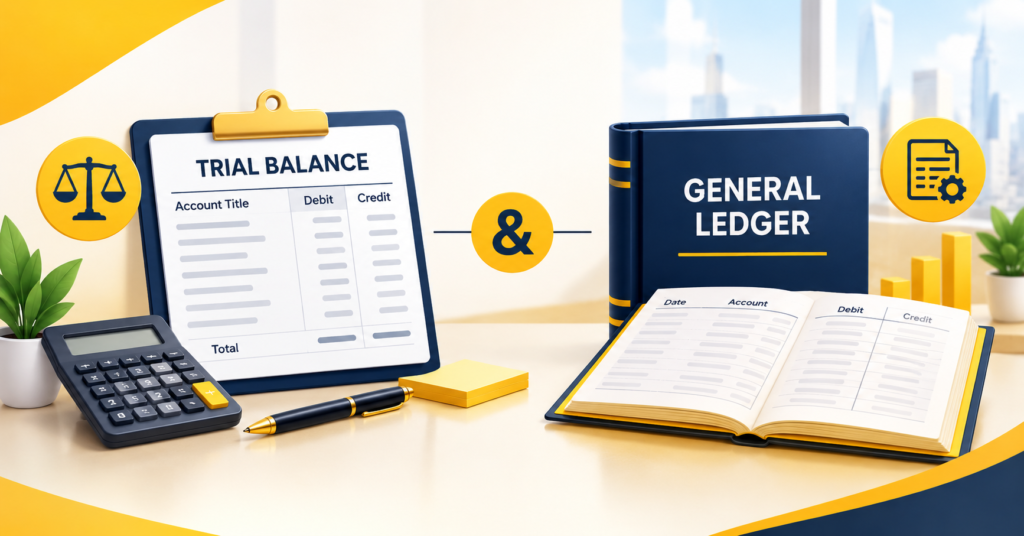
The trial balance provides an overview of account balances at the end of a financial period. The general ledger provides detailed information about individual transactions recorded under different accounts.
Companies should keep the trial balance and general ledger properly reconciled with the financial statements.
Auditors may review ledger entries and select transactions for further testing. Supporting invoices, receipts, bank records, contracts, and other evidence may then be requested for selected transactions.
Therefore, what documents are needed for a UAE company audit should include both summary accounting records and the supporting documents behind those records.
4. Sales and Revenue Documents
Businesses should maintain appropriate evidence for revenue transactions. Depending on the nature of the business, this may include:
- Sales invoices
- Customer statements
- Sales agreements
- Receipts
- Credit notes
- Debit notes
- Sales reports
- Customer contracts
- Delivery documents
- Point-of-sale reports, where applicable
These documents can help auditors verify whether recorded revenue is supported by actual business transactions.
5. Purchase and Expense Records
Purchase and expense records are another important area of an audit. Companies should organize documents such as:
- Supplier invoices
- Purchase orders
- Supplier agreements
- Expense receipts
- Credit notes
- Debit notes
- Import and customs documents
- Utility bills
- Professional service invoices
- Office and operating expenses
Proper documentation allows auditors to trace expenses recorded in the accounting system back to supporting evidence.
6. Bank and Cash Records
Bank information is commonly reviewed during a financial audit because it provides evidence of cash movements and balances.
A company should prepare:
- Bank statements
- Bank reconciliation statements
- Details of bank accounts
- Cheque records
- Deposit records
- Cash book
- Petty cash records
- Loan statements
- Bank confirmation information, where required
Bank reconciliations should ideally be completed regularly before the audit begins. Any unexplained differences should be investigated and corrected where necessary.
7. Accounts Receivable and Payable Records
Companies should also prepare detailed customer and supplier records for UAE audits as part of What Documents Are Needed for a UAE Company Audit. Maintaining proper accounts receivable and accounts payable records can support accurate financial reporting and UAE audit preparation.
For accounts receivable, useful documents include customer ageing reports, outstanding invoices, receipts, credit notes, and customer statements.
For accounts payable, companies may provide supplier ageing reports, unpaid invoices, supplier statements, payment records, and supporting purchase documents.
These audit documents for UAE companies help auditors examine outstanding balances and assess whether receivables and liabilities are properly recorded.
8. Fixed Asset and Inventory Records
Companies with property, equipment, vehicles, machinery, furniture, or other assets should maintain a fixed asset register for UAE company audits. This forms part of What Documents Are Needed for a UAE Company Audit and supports proper UAE audit documentation.
The register may include:
- Asset description
- Purchase date
- Purchase cost
- Depreciation
- Accumulated depreciation
- Disposal details
- Current carrying value
Businesses that hold inventory should also maintain inventory records for audit, stock reports, purchase records, sales records, and stock count information.
9. Payroll and Employee Records
Payroll records can also form part of the audit documentation. Depending on the business, these may include:
- Employee salary records
- Payroll reports
- Employment contracts
- Allowance details
- Bonus records
- End-of-service calculations
- Leave records
- Wage payment records
- Other employee benefit information
Auditors may examine payroll expenses and compare accounting records with supporting payroll information.
10. VAT and Corporate Tax Records
Tax-related documents are increasingly important for UAE businesses. Knowing what documents are needed for a UAE company audit helps companies organize UAE audit documents and maintain proper tax records in the UAE.
Companies should organize relevant:
- VAT returns
- VAT workings
- Tax invoices
- Tax credit notes
- VAT payment records
- VAT registration information
- Corporate Tax returns
- Corporate Tax calculations
- Tax registration information
- Tax adjustments and supporting schedules
The FTA requires taxable persons to maintain records supporting information submitted for corporate tax purposes. These records should generally be retained for at least seven years following the end of the relevant tax period.
11. Previous Audit Reports
If the company has been audited in previous years, it should keep previous audit reports and financial statements readily available.
These can help auditors understand:
- Previous accounting treatments
- Prior-year balances
- Previous audit adjustments
- Outstanding matters
- Comparative financial information
- Changes in accounting policies
Providing previous audit documentation can help create continuity between financial years.
12. Loans, Leases, and Other Agreements
Companies should also prepare agreements that may affect their financial statements, such as:
- Bank loan agreements
- Lease agreements
- Financing agreements
- Shareholder loans
- Related-party agreements
- Insurance policies
- Major customer contracts
- Major supplier contracts
These documents can provide evidence for liabilities, expenses, commitments, related-party transactions, and other financial statement items.
How Should a UAE Company Prepare for an Audit?
What Documents Are Needed for a UAE Company Audit is an important question for businesses preparing for an external review. Companies can make the process easier by creating a structured audit folder before the auditor starts the engagement.
A practical approach is to:
- Finalize the bookkeeping for the financial year.
- Reconcile bank accounts.
- Review accounts receivable and payable.
- Update the fixed asset register.
- Complete inventory records, where applicable.
- Organize sales and purchase invoices.
- Prepare tax-related documentation.
- Keep previous audit reports available.
- Collect important contracts and agreements.
- Review unusual or significant transactions.
Companies should also make sure that electronic records are accessible and that supporting documents can be retrieved when requested. UAE tax rules provide for accounting records and commercial books to be maintained as required.
Conclusion
Preparing complete and well-organized documentation can make a financial audit more efficient and help a UAE company respond to auditor requests with greater clarity. From financial statements and general ledgers to bank records, invoices, payroll information, tax documents, contracts, and asset registers, each document can provide important evidence supporting the company’s financial records.
Understanding What Documents Are Needed for a UAE Company Audit is therefore an important part of maintaining proper financial and compliance records. The exact documentation required can differ based on the company’s business activity, legal structure, transactions, and audit scope.
For businesses looking for professional support with accounting, auditing, VAT, corporate tax, and financial compliance in Dubai, Singiri & Co – Accounting & Bookkeeping LLC provides professional accounting and auditing support for businesses in Dubai, UAE. Their services can help businesses organize financial records, prepare for audits, and manage ongoing accounting and tax requirements in a structured manner.
If your company is preparing for its next financial audit, getting the accounting records and supporting documents organised in advance can help create a smoother audit process and improve overall financial record management.
FAQS
1. What documents are required for a financial audit in the UAE?
Common documents include financial statements, trial balance, general ledger, bank statements, invoices, expense records, payroll records, fixed asset registers, inventory records, tax documents, contracts, and corporate documents.
2. Do UAE companies need audited financial statements?
Not every entity subject to UAE corporate tax is automatically required to have audited financial statements. The Federal Tax Authority states that only categories of taxable persons specified by the relevant ministerial decision are required to prepare and maintain audited or certified financial statements.
3. How long should UAE companies keep accounting records?
For UAE corporate tax purposes, relevant records and documents generally need to be retained for at least seven years after the end of the relevant tax period.
4. Are bank statements needed for a company audit?
Yes. Bank statements and bank reconciliation records are commonly important supporting documents for verifying cash balances and transactions.
5. Should previous audit reports be provided to the auditor?
Yes. Previous audit reports and financial statements can provide useful information about prior-year balances, audit adjustments, and accounting treatments.
6. Can accounting records be maintained electronically?
UAE rules allow accounting records and commercial books to be maintained through appropriate registers and preserved information from original documents, subject to applicable requirements.
7. What Documents Should a UAE Company Prepare for an Audit before the auditor arrives?
The company should ideally prepare its financial statements, trial balance, general ledger, bank reconciliations, invoices, expense records, payroll information, asset records, inventory information, tax documents, contracts, and previous audit records.