Submitting an accurate VAT return is an important responsibility for businesses registered for VAT in the UAE. However, mistakes can happen because of incorrect calculations, missing invoices, wrong input tax claims, incorrect output VAT, or data-entry errors. When a business discovers an error after submitting its VAT return, it should take the appropriate corrective action instead of ignoring the mistake.
Understanding how to correct errors in VAT returns in UAE requirements can help businesses avoid unnecessary compliance problems and ensure that their VAT records remain accurate. Proper VAT records are also important for businesses preparing for a Tax Audit in UAE, as accurate documentation can support the information reported in VAT returns.
The Federal Tax Authority (FTA) provides specific procedures for correcting errors in previously submitted VAT returns. The size of the error and whether it led to an underpayment of VAT are the primary factors that determine the proper approach.
Table of Contents
What Is a VAT Return Error?
When the data submitted to the FTA does not precisely reflect the company’s VAT transactions for a specific tax period, a VAT return error occurs.
Common examples include:
- Incorrect calculation of output VAT
- Claiming more input VAT than permitted
- Missing taxable sales
- Incorrect treatment of zero-rated or exempt supplies
- Incorrect VAT classification of transactions
- Omitting eligible input tax
- Entering incorrect figures in the VAT return
- Errors involving credit notes or adjustments
- Reporting transactions in the wrong VAT period
These mistakes may result in either an underpayment or overpayment of VAT. Therefore, businesses should review their accounting records and determine the impact of an error as soon as it is identified.
How to Correct Errors in UAE VAT Returns
The first step in understanding how to correct errors in VAT returns in the UAE is to determine the value and nature of the mistake.
The FTA states that if a mistake in a previously filed VAT return causes payable tax to be less than necessary by AED 10,000 or less, the remedy can often be made in the current VAT return for the tax period in which the error was found. The correction should be reported in the appropriate VAT amount field. citeturn0search0turn0search30
The company must file a Voluntary Disclosure to the FTA if the inaccuracy results in an understatement of the payable tax of greater than AED 10,000. citiurn0search0turn0search3
This distinction is particularly important when carrying out a VAT return correction UAE process because using the wrong procedure may create additional compliance issues.
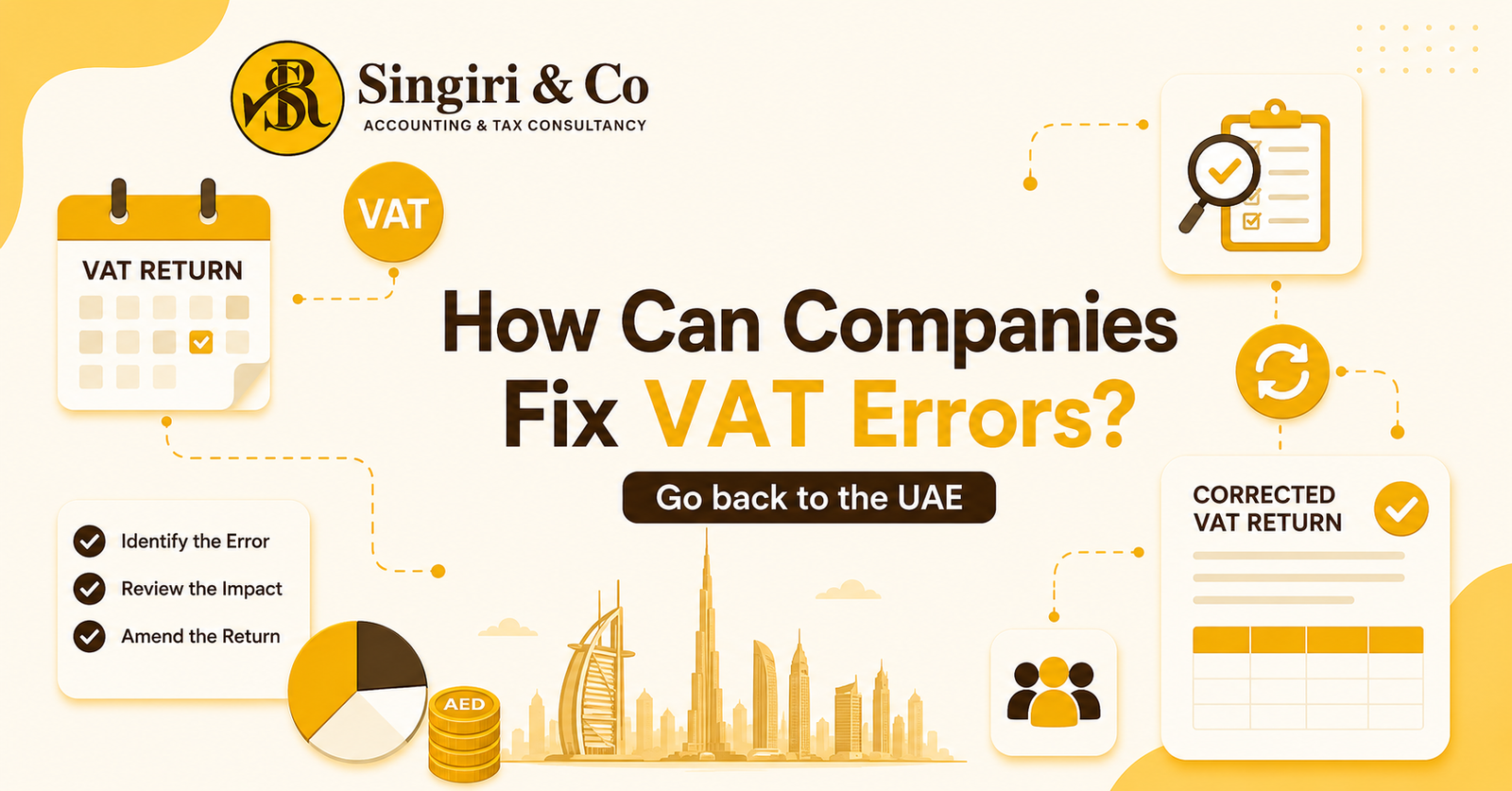
Step 1: Identify the Error
Businesses should first identify exactly what went wrong.
Review:
- Sales invoices
- Purchase invoices
- Credit and debit notes
- Bank statements
- Accounting ledgers
- VAT reports
- Previous VAT returns
- Input and output VAT calculations
The business should determine the affected tax period, transaction value, VAT amount, and whether the error caused VAT payable to be understated or overstated.
This process can be made much simpler by properly reconciling accounting data with VAT returns.
Step 2: Calculate the VAT Difference
Here’s your paragraph with the exact keyword how to correct errors in VAT returns in UAE added naturally:
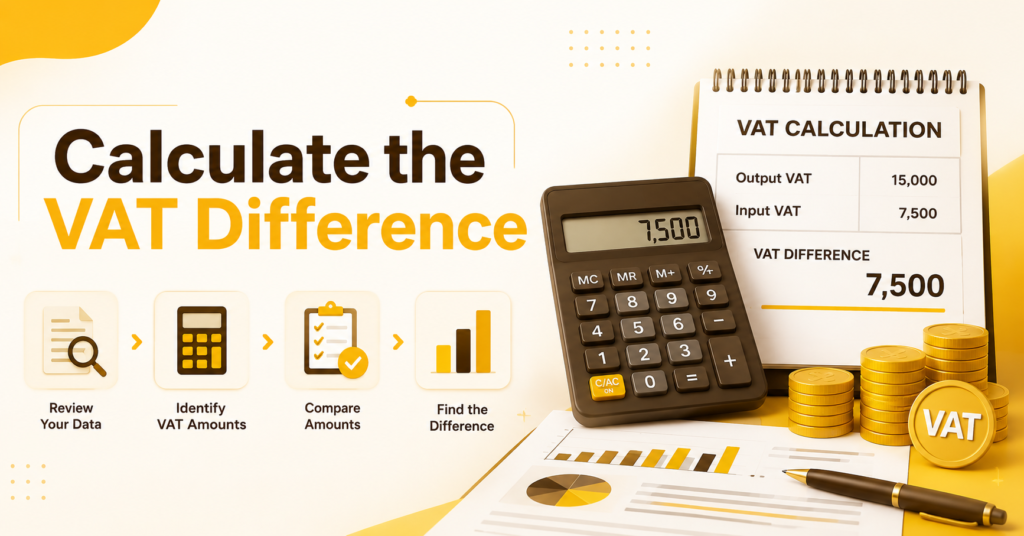
After identifying the mistake, calculate the actual VAT difference. For example, suppose a company accidentally omitted a taxable sale that resulted in AED 7,000 of VAT being underreported. Following the FTA’s guidelines, the company can usually fix the problem in the current VAT return where it was found because it is under the AED 10,000 level.
The company should consider the Voluntary Disclosure method if the inaccuracy leads to an underestimation of payable VAT exceeding AED 10,000. This calculation is an important part of how to correct errors in VAT returns in UAE, as the appropriate correction method depends on the impact of the error.
Step 3: Use the Current VAT Return to Fix Minor Mistakes
Understanding how to correct errors in VAT returns in UAE is important for businesses that discover mistakes after submitting their VAT returns. The FTA permits qualified adjustments to be submitted through the VAT return for the period in which the error has been identified when the required correction is AED 10,000 or less.
The FTA’s VAT Return User Guide states that, for qualifying errors, the VAT amount of the correction should be reported in the relevant section of the current VAT return.
Businesses should maintain supporting documentation explaining:
- What the original error was
- How the error was discovered
- The affected transaction or transactions
- How the correction was calculated
- Which VAT return contains the correction
- Supporting invoices and accounting records
Maintaining this documentation provides a clear audit trail and helps businesses demonstrate that the VAT correction was properly identified, calculated, and reported.
Step 4: Submit a Voluntary Disclosure for Larger Errors
A voluntary disclosure may be necessary if a VAT error results in an understated tax amount of more than AED 10,000. Understanding how to correct errors in VAT returns in UAE helps businesses take timely action when significant mistakes are discovered.
Businesses should avoid delaying correction after identifying a major VAT error. The required correction details must be submitted through the FTA’s tax system, supported by accurate accounting records and relevant documentation.
Can a Submitted VAT Return Be Edited?
Businesses should understand how to correct errors in VAT returns in UAE and the available correction functionality in the FTA’s electronic system. According to the FTA, taxpayers may make changes to a VAT return that has been filed before the applicable tax period’s filing deadline. The FTA’s FAQ explains that taxpayers can use the Edit option to correct the return before the filing deadline, without penalties under that particular process.
Understanding the VAT return correction procedure in the UAE can help businesses identify and resolve mistakes promptly while maintaining accurate VAT records. This means businesses should carefully review their VAT return before and immediately after submission. Early identification of mistakes can make the correction process simpler and help maintain proper VAT compliance.
Common VAT Errors Businesses Should Avoid
Preventing errors is generally better than correcting them later. Businesses should establish a consistent VAT review process.
Some common mistakes include:
1. Incorrect Input VAT Claims
Businesses may claim input VAT without properly checking whether the expense qualifies for recovery or whether the required tax invoice is available.
2. Missing Sales Transactions
Every taxable supply should be properly recorded and considered when preparing the VAT return.
3. Wrong VAT Treatment
Transactions may sometimes be incorrectly classified as standard-rated, zero-rated, or exempt. Businesses should review the VAT treatment of unusual or complex transactions carefully.
4. Duplicate Entries
Duplicate invoices can cause output VAT or input VAT to be reported incorrectly.
5. Incorrect Credit Note Treatment
Credit notes and adjustments should be properly reflected in accounting records and VAT reporting.
6. Data-Entry Mistakes
Even a simple typing error can affect the final VAT payable amount. A second-level review before submission can help identify these issues.
Why Professional VAT Support Can Help
Businesses registered for VAT in the UAE are required to maintain accurate accounting records, issue compliant tax invoices, and report their taxable supplies, purchases, output VAT, and input VAT correctly in each VAT return. However, errors can sometimes occur because of incorrect calculations, omitted transactions, duplicate entries, misclassified supplies, or the late discovery of supporting documentation.
Understanding how to correct errors in VAT returns in UAE helps businesses determine the appropriate corrective action and avoid further compliance issues. Depending on the nature and value of the error, a business may be able to make an adjustment in a subsequent VAT return or may need to submit a Voluntary Disclosure to the Federal Tax Authority (FTA).
How to Correct Errors in VAT Return UAE: A Practical Checklist
Businesses can use the following checklist when a VAT error is discovered:
- Identify the incorrect transaction or amount.
- Determine the affected VAT return and tax period.
- Reconcile the transaction against invoices and accounting records.
- Calculate the VAT difference.
- Determine whether the error falls within the applicable AED 10,000 threshold.
- Correct eligible smaller errors through the appropriate current VAT return.
- Submit a Voluntary Disclosure where required.
- Keep supporting documentation and calculations.
- Review the accounting system to prevent the same mistake from recurring.
- Seek professional VAT advice where the correction is complex.
Following these steps can make the VAT return correction UAE process more structured and reduce the risk of repeated reporting mistakes.
Conclusion
Knowing how to correct errors in VAT returns in UAE is essential for maintaining accurate tax records and meeting UAE VAT compliance requirements. Small qualifying errors may be corrected through a subsequent VAT return, while certain larger errors may require a Voluntary Disclosure to the FTA.
Businesses should act promptly when errors are identified. Regular VAT reconciliations, proper documentation, and professional review can help prevent recurring mistakes.
If you need reliable VAT return correction UAE support, Singiri & Co can assist with VAT return reviews, corrections, voluntary disclosures, and ongoing VAT compliance.
FAQS
1. How to correct errors in VAT returns in UAE?
If a previously submitted VAT return contains an error, the business should first calculate the impact of the mistake. Eligible errors of AED 10,000 or less can generally be corrected in the current VAT return in which the error was discovered, while an error causing an understatement of payable VAT exceeding AED 10,000 generally requires a Voluntary Disclosure.
2. What if the VAT error is more than AED 10,000?
If the error resulted in payable VAT being understated by more than AED 10,000, the business should submit a Voluntary Disclosure to the FTA within the applicable time limit.
3. Can I correct a VAT return after submitting it?
Yes, the FTA indicates that a submitted VAT return can be edited before the filing due date of the relevant tax period.
4. Is there a deadline for submitting a Voluntary Disclosure?
For an error resulting in an understatement of payable tax exceeding AED 10,000, the FTA’s current Voluntary Disclosure User Guide specifies 20 business days from the date the taxable person becomes aware of the error.
5. What records should businesses keep when correcting VAT errors?
Businesses should retain relevant invoices, accounting records, VAT calculations, reconciliation statements, and documentation explaining how the error was identified and corrected.
6. Why is professional VAT assistance useful?
Professional VAT support can help businesses identify errors, calculate the correct VAT adjustment, prepare the necessary documentation, and select the appropriate correction procedure.