
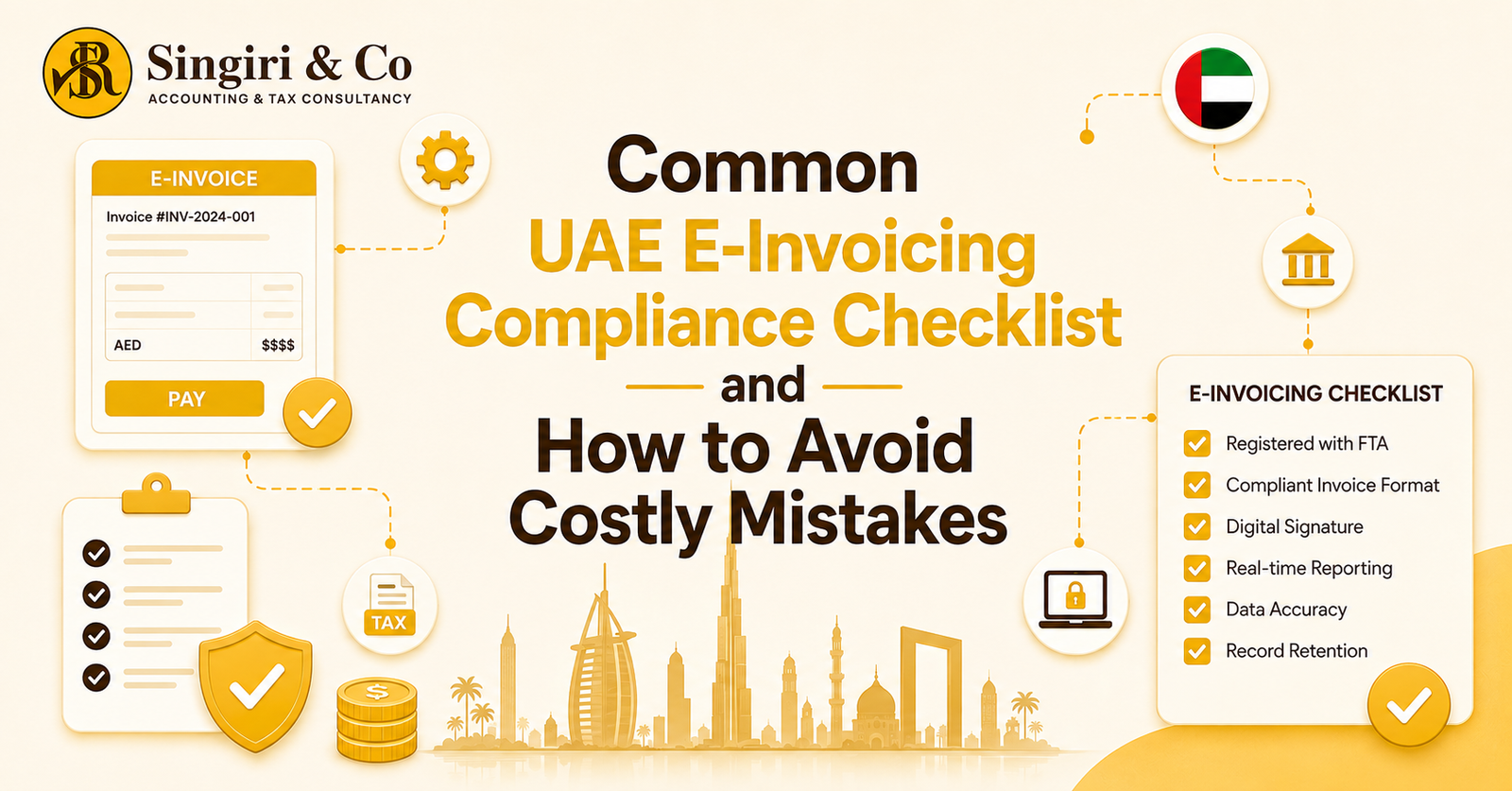
Common UAE E-Invoicing Compliance Checklist and How to Avoid It
The UAE is moving toward a more structured and digital invoicing environment. Businesses preparing for electronic invoicing need to review their accounting systems, tax data, technology, and internal processes. E-invoicing can reduce manual work, improve invoice accuracy, and strengthen financial controls.
However, poor preparation may result in incorrect invoice data, system problems, processing delays, and compliance risks.
Many businesses think e-invoicing simply means creating an invoice electronically or sending a PDF by email. However, the UAE UAE e-invoicing compliance checklist businesses involve structured invoice data, accurate VAT information, electronic transmission, system integration, and proper digital record-keeping.
A practical UAE E-invoicing compliance checklist for businesses can help businesses identify gaps and prepare their systems effectively.
Table of Contents
What Is UAE E-Invoicing?
UAE electronic invoicing enables businesses to create and exchange invoice information digitally in a structured format. Unlike ordinary PDF invoices, structured e-invoices are designed to be processed and validated by accounting and tax systems.
UAE electronic invoicing can help businesses reduce manual data entry, improve transaction visibility, simplify reconciliation, and strengthen financial records. Following a UAE e-invoicing compliance checklist, businesses can help businesses organize the key steps required for a smoother implementation.
1. Do Not Mistake a PDF for an E-Invoice
One common mistake is assuming that a PDF sent by email is automatically a compliant e-invoice. A PDF is an electronic document, while structured e-invoicing requires invoice information in a machine-readable format.
Businesses preparing for UAE e-invoicing 2026 should understand this difference before choosing their technology.
How to Avoid It
Review your invoice process and check whether your software supports:
- Required invoice fields
- Customer information
- VAT details
- Invoice numbering
- Structured data
- Electronic transmission
- Digital storage
Your UAE e-invoicing compliance checklist businesses should include all these areas.
2. Do Not Delay Preparation
Waiting until the last moment can create unnecessary pressure. Businesses may need to upgrade software, clean customer data, update workflows, train employees, and test integrations.
How to Avoid It
Start with a readiness assessment covering:
- Current invoicing procedures
- Accounting and ERP systems
- Customer databases
- VAT records
- Invoice numbering
- Approval workflows
- Credit notes
- Record retention
Regularly update your UAE e-invoicing compliance checklist businesses to track completed and pending tasks.
3. Check Invoice Data Accuracy
Accurate information is essential for successful UAE e-invoicing compliance checklist businesses. Incorrect customer names, tax registration details, addresses, invoice amounts, or VAT treatment can create processing and accounting problems.
How to Avoid It
Review your data and confirm that:
- Customer details are accurate
- Tax registration information is complete
- Addresses are updated
- Product descriptions are consistent
- VAT treatment is correctly configured
- Invoice numbers are controlled
- Duplicate customer records are removed
Good data management supports UAE e-invoicing compliance checklist businesses and general accounting accuracy.
4. Check Your Accounting Software
Having accounting software does not automatically mean that it is ready for applicable UAE e-invoice requirements. Your system may need upgrades, additional configurations, or integrations.
How to Avoid It
Ask your software provider whether the system supports:
- Structured invoice data
- Electronic transmission
- Credit notes
- Invoice corrections
- Validation
- System integration
- Secure record retention
Also check whether technical support and software updates are available.
5. Review ERP Integration
Businesses often use separate systems for sales, inventory, procurement, customer management, and accounting. If these systems do not communicate properly, invoice information can become inconsistent.
For example, customer tax information in one system may differ from the accounting platform.
How to Avoid It
Review the complete invoice process:
Transaction → Invoice Creation → Approval → Validation → Transmission → Accounting → Storage
Test the integration to identify missing information, duplicate records, incorrect calculations, and transmission failures.
6. Separate VAT Compliance From E-Invoicing
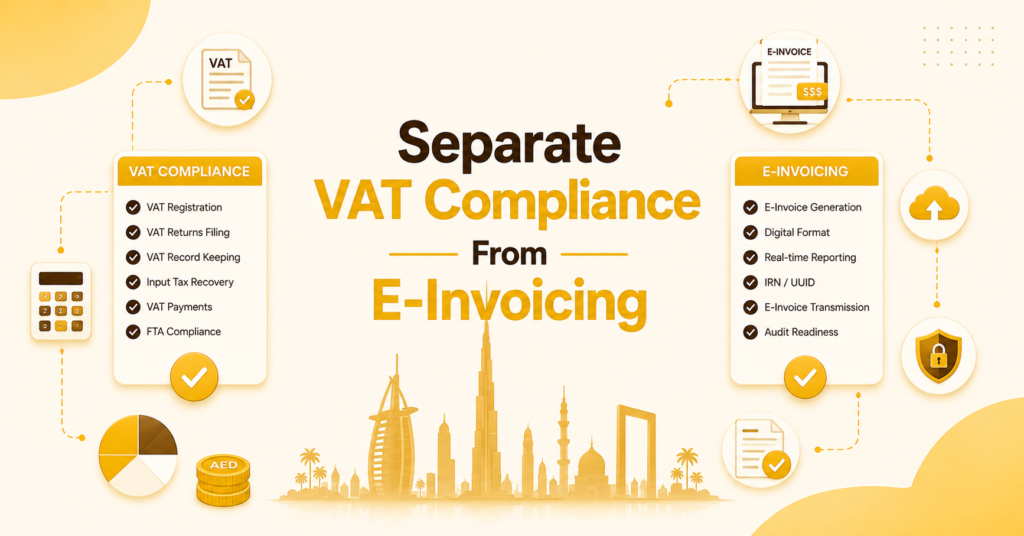
VAT compliance and the UAE e-invoicing compliance checklist businesses need are related but different. A business may calculate VAT correctly but still face issues with its electronic invoicing process.
For VAT compliance, review:
- VAT calculations
- Tax treatment
- Tax invoices
- VAT records
- VAT return information
For e-invoicing, review:
- Structured invoice data
- Electronic transmission
- System integration
- Data validation
- Digital records
This is particularly important when reviewing UAE VAT e-invoicing procedures.
7. Include Credit Notes and Refunds
Businesses should prepare for more than standard sales invoices. The UAE e-invoicing compliance checklist businesses should follow must also cover refunds, returns, discounts, cancellations, credit notes, and corrections, as these are common business transactions.
How to Avoid It
Test your system with:
- Standard invoices
- Credit notes
- Refunds
- Returns
- Discounts
- Cancellations
- Corrected invoices
- Partial adjustments
Testing these situations helps businesses meet the UAE e-invoicing compliance checklist for businesses across the complete transaction lifecycle.
8. Maintain Proper Digital Records
Electronic invoicing does not remove the need for organized record-keeping. Businesses should securely store, protect, retrieve, and review invoice information.
Poor records can make reconciliations, tax reviews, and audits more difficult.
How to Avoid It
Create procedures for:
- Storing invoices
- Backing up data
- Restricting access
- Retrieving records
- Tracking corrections
- Protecting confidential information
- Retaining records for the required period
Digital record management should be an important part of your UAE E-Invoicing Compliance Checklist.
9. Train Employees
Technology alone cannot guarantee successful implementation. Employees involved in creating, approving, reviewing, and recording invoices need to understand the new process. As part of the UAE e-invoicing compliance checklist, businesses should provide proper training to employees before implementation.
Training Should Cover
- Creating invoices
- Checking invoice details
- Correcting errors
- Processing credit notes
- Updating customer information
- Using accounting software
- Maintaining digital records
Different departments may require different training based on their responsibilities.
10. Treat E-Invoicing as a Business Process
E-invoicing affects more than the IT department. It can impact accounting, taxation, finance, sales, operations, and management.
Businesses should consider involving:
- Accountants
- Finance professionals
- Tax specialists
- IT staff
- Operations teams
- Management
A cross-functional approach can strengthen UAE e-invoicing implementation and improve coordination between departments.
11. Test the Complete Workflow
A system may work during a basic demonstration but fail when processing different products, customers, VAT treatments, or adjustments.
Testing should include:
- Different customers
- Products and services
- VAT transactions
- Credit notes
- Discounts
- Refunds
- Corrections
- Cancellations
- Payment terms
Test the entire process from invoice creation to storage and retrieval.
12. Monitor UAE E-Invoicing Regulations
Businesses should not rely on outdated information. Changes may affect technical requirements, procedures, timelines, or reporting expectations.
Assign responsibility for monitoring official announcements and relevant guidance. Regular reviews can improve UAE e-invoicing readiness.
An updated UAE e-invoicing compliance checklist can help businesses track regulatory and operational requirements.
How to Prepare for UAE E-Invoicing
Businesses can follow a simple preparation process:
Review Your Processes
Check how invoices are created, approved, issued, corrected, cancelled, and stored.
Review Your Data
Verify customer information, VAT details, invoice values, and transaction records.
Evaluate Technology
Check accounting software, ERP systems, integrations, security, backups, and structured data capabilities.
Train Employees
Make sure employees understand their responsibilities and the new invoicing workflow.
Test Before Implementation
Test different transaction types and identify problems before using the system for daily operations.
Monitor Changes
Regularly review regulatory updates, software changes, and system performance.
Following these steps makes the UAE e-invoicing compliance checklist for businesses a useful management tool for maintaining e-invoicing readiness.
Benefits of Early E-Invoicing Preparation
Preparing early can help businesses:
- Improve invoice accuracy
- Reduce manual work
- Strengthen financial controls
- Simplify reconciliation
- Improve record management
- Reduce implementation pressure
- Improve transaction visibility
For small and medium-sized businesses, early preparation can be particularly useful because accounting resources may be limited.
Conclusion
The transition to structured digital invoicing is an important development for UAE businesses. Proper preparation can help companies improve invoice accuracy, strengthen financial controls, reduce manual work, and maintain organized records. Understanding the UAE e-invoicing compliance checklist businesses prepare their accounting, bookkeeping, and VAT processes effectively.
Businesses should review their accounting systems, verify invoice data, test integrations, train employees, maintain digital records, and monitor UAE e-invoicing regulations. Using a UAE e-invoicing compliance checklist provides a practical way to identify gaps and track UAE e-invoicing compliance. Accurate accounting records, organized bookkeeping, and proper VAT documentation can also support a smoother transition to electronic invoicing.
Businesses looking for professional support with accounting, bookkeeping, VAT compliance, tax compliance, and financial processes can consider Singiri & Co. Its accounting and advisory services can help UAE businesses strengthen their financial processes, improve UAE e-invoicing readiness, and prepare for changing compliance requirements.
With accurate data, reliable technology, trained employees, and regular monitoring, businesses can approach UAE electronic invoicing with greater confidence. Strong accounting, consistent bookkeeping, and effective VAT management can help companies build stronger financial systems for the future.
FAQS
1. What are common UAE e-invoicing compliance mistakes?
Common mistakes include treating PDFs as structured e-invoices, delaying preparation, using incorrect data, overlooking software compatibility, failing to test integrations, and not training employees.
2. Is a PDF the same as an e-invoice?
Not necessarily. A PDF is an electronic document, while structured e-invoicing involves invoice information being exchanged in a machine-readable format according to the applicable framework.
3. Why should businesses check their accounting software?
Businesses should confirm whether their software can support applicable UAE e-invoicing regulations, structured data, integrations, corrections, validation, and record retention.
4. How can businesses improve e-invoicing readiness?
Businesses can review their processes, clean their data, evaluate technology, train employees, test different transactions, and monitor regulatory developments.
5. Does e-invoicing replace VAT compliance?
No. Businesses must continue following applicable VAT requirements while also meeting relevant electronic invoicing requirements.
6. Should small businesses prepare for e-invoicing?
Yes. Small businesses should assess their accounting systems, data, workflows, and employee responsibilities early.