
UAE VAT Registration Threshold and Eligibility Requirements Explained
Understanding VAT registration requirements is important for businesses operating in Dubai and across the UAE. Whether you are running a startup, small business, consultancy, trading company, or growing enterprise, knowing when VAT registration becomes mandatory can help you maintain proper tax compliance.
One of the most common questions businesses ask is how to calculate UAE VAT registration threshold and determine whether their taxable turnover has reached the required limit. The UAE Federal Tax Authority (FTA) sets specific thresholds for mandatory and voluntary VAT registration, and businesses need to monitor their taxable supplies, imports, and eligible expenses carefully.
This guide explains the UAE VAT registration threshold, eligibility requirements, calculation methods, registration rules, and common questions businesses should understand.
Table of Contents
What Is the UAE VAT Registration Threshold?
The amount of qualifying taxable imports and supplies that establishes whether a business needs to register for VAT is known as the VAT registration threshold. Businesses can evaluate their eligibility for VAT registration in the UAE by knowing the VAT registration threshold.
The required VAT registration level for enterprises based in the United Arab Emirates is AED 375,000. Businesses must assess their taxable supplies and imports over the previous 12 months or expected supplies within the next 30 days.
The threshold for voluntary VAT registration is AED 187,500. When their qualifying taxable supplies, imports, or taxable expenses above this threshold, eligible firms may choose to explore voluntary VAT registration in the UAE.
Understanding these thresholds helps businesses determine when to register for VAT in the UAE and maintain proper tax compliance.
ChatGPT can make mistakes. Check important info.
Mandatory VAT Registration in the UAE
VAT registration becomes mandatory when a UAE-resident business crosses the mandatory threshold.
The FTA considers two main situations:
- The value of taxable supplies and imports exceeded AED 375,000 during the previous 12 months.
- The business expects the value of taxable supplies and imports to exceed AED 375,000 during the next 30 days.
Businesses should not wait until the end of the financial year to check their VAT position. The assessment is based on the relevant rolling period and forward-looking requirement.
For example, if a business has generated AED 360,000 in taxable supplies during the previous 12 months but expects another AED 30,000 of taxable supplies in the coming weeks, it needs to assess whether the mandatory registration requirement has been triggered.
How to Calculate UAE VAT Registration Threshold
A common question among business owners is how to calculate the UAE VAT registration threshold accurately.
The calculation requires the business to identify the value of supplies and imports that are relevant under UAE VAT rules. Businesses should maintain proper sales records, invoices, import documentation, and accounting records to establish the value of qualifying transactions.
A simplified approach is:
Relevant taxable supplies + relevant taxable imports = amount considered for threshold assessment
The business should then compare the relevant amount with the applicable VAT registration threshold.
However, not every transaction should automatically be treated as part of the calculation. The VAT treatment of each supply can depend on whether it is taxable, zero-rated, exempt, or otherwise excluded under the applicable rules.
Therefore, businesses should review their transactions rather than simply using total accounting revenue.
Voluntary VAT Registration Threshold
Businesses that have not reached the mandatory threshold may still be eligible for voluntary VAT registration.
The current voluntary threshold is AED 187,500. A UAE-resident business may generally apply voluntarily when the value of its taxable supplies, imports, or taxable expenses exceeds this threshold during the previous 12 months or is expected to exceed it within the next 30 days.
Voluntary registration can be relevant for businesses that are growing and expect their taxable turnover to increase.
For example, a startup generating AED 200,000 in qualifying taxable supplies may not yet have reached the mandatory threshold, but it may meet the voluntary registration threshold.
How to Calculate UAE VAT Registration Threshold for a Growing Business
For a growing business, how to calculate UAE VAT registration threshold should not be treated as a one-time calculation.
Businesses should regularly review their sales and purchasing records. A monthly review can help identify when the business is approaching the threshold and reduce the risk of missing a registration obligation.
A useful internal process can include:
- Review taxable sales each month.
- Track taxable imports separately.
- Identify zero-rated and exempt transactions correctly.
- Review taxable expenses where relevant to voluntary registration.
- Monitor the previous 12-month period.
- Consider expected taxable supplies over the next 30 days.
- Keep supporting invoices and financial records.
This approach makes VAT monitoring more systematic and helps businesses make informed registration decisions.
VAT Registration Eligibility Requirements
Eligibility depends on the nature of the business, its taxable activities, turnover, and whether it is resident or non-resident for UAE VAT purposes.
For UAE-resident businesses, mandatory registration generally applies when the taxable supplies and imports exceed AED 375,000 over the previous 12 months or are expected to exceed the threshold within the next 30 days.
Non-UAE-resident businesses have different considerations. The FTA states that a non-resident business making taxable supplies in the UAE may be required to register regardless of the value of its supplies where there is no other person in the UAE responsible for accounting for the VAT.
This means businesses should not assume that staying below AED 375,000 automatically removes VAT registration obligations in every situation.
How to Calculate UAE VAT Registration Threshold for Small Businesses
Small businesses often have fluctuating sales, making regular monitoring especially important. If you are wondering how to calculate the UAE VAT registration threshold for a small business, review qualifying taxable supplies and imports while considering VAT registration requirements for small businesses in the UAE.
For instance, a business may have low profits but still have significant taxable sales. VAT registration is therefore not based solely on profitability.
Businesses should distinguish between revenue, taxable supplies, exempt supplies, and other transactions when reviewing their VAT position. Accurate bookkeeping services in uae also help with UAE VAT compliance for small businesses.
Documents and Information Needed for VAT Registration
Once a business determines that it is eligible or required to register, it must complete the VAT registration process through the FTA’s EmaraTax platform.
The FTA’s current process includes creating or accessing an EmaraTax account, creating a taxable person profile, accessing the taxable person’s account, selecting VAT registration, and completing the application.
Depending on the business structure and circumstances, supporting information may include business registration details, identification documents, financial information, customs information where applicable, and other evidence requested during the application.
Businesses should make sure the information submitted is accurate and consistent with their accounting and commercial records.
Why Accurate VAT Threshold Monitoring Matters
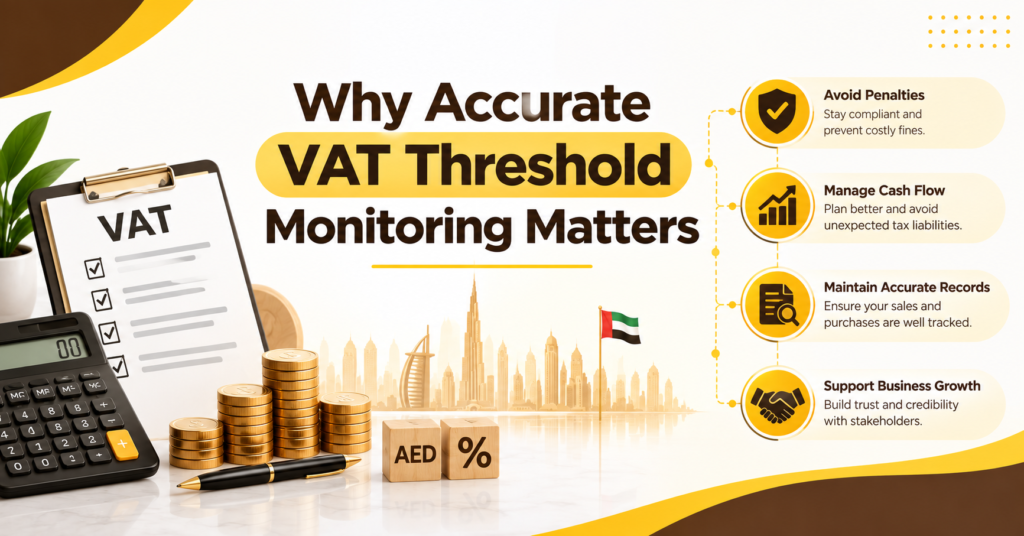
Incorrectly assessing the VAT threshold can create compliance problems. A business that should have registered may face consequences for delaying registration.
The FTA states that a person required to register for VAT must submit the registration application within 30 days of becoming required to register. Late registration can result in a penalty under the applicable tax legislation.
This is why businesses should monitor their taxable turnover continuously instead of checking only when preparing annual accounts.
How to Calculate UAE VAT Registration Threshold Without Errors
When considering how to calculate UAE VAT registration threshold, businesses should avoid simply adding every transaction appearing in their accounting software.
A proper review should consider:
- The type of supply.
- Whether the transaction is taxable or exempt.
- Relevant imports.
- Zero-rated supplies where applicable.
- The applicable 12-month period.
- Expected taxable supplies within the next 30 days.
- Taxable expenses when assessing voluntary registration eligibility.
Where transactions are complex, professional VAT advice can help businesses interpret the rules correctly.
How to Calculate UAE VAT Registration Threshold for VAT Planning
Knowing How to calculate UAE VAT registration threshold can also support better financial planning.
A business approaching AED 375,000 should consider its expected sales pipeline and future transactions. Monitoring the threshold can help management prepare for VAT registration, update invoicing procedures, maintain tax records, and understand how VAT may affect pricing and cash flow.
Businesses approaching the voluntary threshold may also evaluate whether voluntary registration is commercially appropriate.
The key is to make VAT registration part of regular financial management rather than treating it as a last-minute administrative task.
Common Mistakes Businesses Make
Some common VAT registration mistakes include:
- Monitoring only annual turnover.
- Ignoring the previous 12-month calculation.
- Failing to consider expected transactions.
- Treating all revenue as taxable without reviewing VAT treatment.
- Not maintaining supporting documents.
- Assuming free zone businesses are automatically outside VAT requirements.
- Delaying registration after becoming required to register.
Regular accounting and VAT reviews can help identify these issues early.
Conclusion
Understanding UAE VAT registration requirements is essential for businesses that want to remain compliant while managing their financial growth. Knowing how to calculate UAE VAT registration threshold helps businesses identify when mandatory registration may apply and whether voluntary registration could be an option.
For businesses in Dubai and across the UAE, accurate bookkeeping, transaction classification, and regular VAT reviews can make threshold monitoring easier and reduce compliance risks.
If you need professional support with VAT registration, bookkeeping, tax compliance, or accounting, Singiri & Co in Dubai, UAE, can assist businesses with practical accounting and VAT-related services. Their team can help businesses review financial records, understand VAT requirements, monitor registration thresholds, and maintain organized accounting processes.
FAQS
1. What is the UAE’s obligatory VAT registration threshold?
AED 375,000 is the required VAT registration threshold for UAE-resident companies, depending on the applicable regulations’ qualifying taxable imports and supplies.
2. What is the UAE’s optional VAT registration threshold?
The threshold for voluntary VAT registration is AED 187,500. When the relevant taxable supplies, imports, or taxable expenses exceed this amount under the relevant conditions, eligible UAE-resident firms may apply.
3. How to calculate the UAE VAT registration threshold?
Compare qualifying taxable supplies and imports with the VAT threshold, considering the previous 12 months and expected transactions for the next 30 days
4. Does VAT registration depend on business profit?
No. VAT registration is generally linked to qualifying taxable supplies, imports, and relevant taxable expenses for voluntary registration, rather than simply the amount of business profit.
5. Do small businesses need VAT registration in the UAE?
If a small business reaches the required threshold, it can be required to register. It might qualify for voluntary registration if it surpasses the voluntary threshold and meets the necessary conditions but does not satisfy the mandatory threshold.
6. Do non-resident businesses have the same VAT threshold?
Not necessarily. Regardless of the AED 375,000 barrier, non-resident companies that make taxable deliveries in the UAE may be required to register for VAT even if no other UAE citizen is accountable for the VAT.
7. When should businesses check their VAT registration position?
Businesses should regularly monitor their taxable supplies, particularly when sales are growing or nearing the VAT threshold. Monthly monitoring helps businesses identify registration requirements early and maintain VAT compliance
8. How to calculate UAE VAT registration threshold for voluntary registration?
For voluntary registration, businesses should review their taxable supplies, imports, and eligible expenses to determine whether they exceed the AED 187,500 threshold