VAT in the UAE—When Was It Introduced? Complete Guide for Businesses (2025)
The United Arab Emirates (UAE) is one of the most popular business destinations in the world. It offers a strong economy, modern infrastructure, and business-friendly policies.
For many years, the UAE was known as a tax-free country. But to support long-term growth, the government introduced value-added tax in the UAE. Many businesses and entrepreneurs still ask, “When was VAT introduced in the UAE?”
In this complete guide, you will learn everything about VAT in the UAE—including when it was introduced, how it works, registration thresholds, filing requirements, penalties, and how professional VAT services in Dubai can help your business stay fully compliant.
When Was VAT Introduced in the UAE?
| VAT in the UAE was introduced on January 1, 2018 |
This was a landmark change in the country’s financial system. Before 2018, there was no general tax on goods and services in the UAE.
The government introduced a 5% VAT rate in the UAE, which applies as the standard tax rate on most goods and services. This step helped the UAE establish a new, sustainable source of income and reduce dependence on oil revenue.
What Is Value Added Tax (VAT) in the UAE?
Value-added tax in the UAE is an indirect tax applied at every stage of the supply chain.
In simple terms:
- Businesses charge VAT to customers
- They collect the tax
- Then they pay it to the government
Example: If a product costs AED 100, the 5% VAT in the UAE adds AED 5—making the total cost AED 105.
This structured system ensures tax is collected efficiently at every stage of the transaction.
Why Was VAT Introduced in the UAE?
There are several key reasons why VAT in the UAE was introduced in 2018.
1. Reduce Dependence on Oil
The UAE economy was historically dependent on oil, which creates revenue instability when global oil prices fluctuate. By introducing value added tax in UAE, the government created a steady, reliable revenue stream that supports public services even during periods of low oil income.
2. Support Government Projects
VAT revenue funds critical national infrastructure, including roads, hospitals, and schools. Through VAT in the UAE, the country continues to improve healthcare, education, and overall quality of life.
3. Strengthen the Economy
VAT creates long-term financial stability for the UAE by diversifying government income beyond oil and supporting sustainable economic development.
4. Align With Global Tax Standards
The introduction of VAT in the UAE brought the country in line with international tax systems. This improves transparency and international compliance and makes the UAE more accessible for multinational businesses—especially when supported by professional VAT services in Dubai and the best VAT consultants in Dubai.
How VAT Works in the UAE
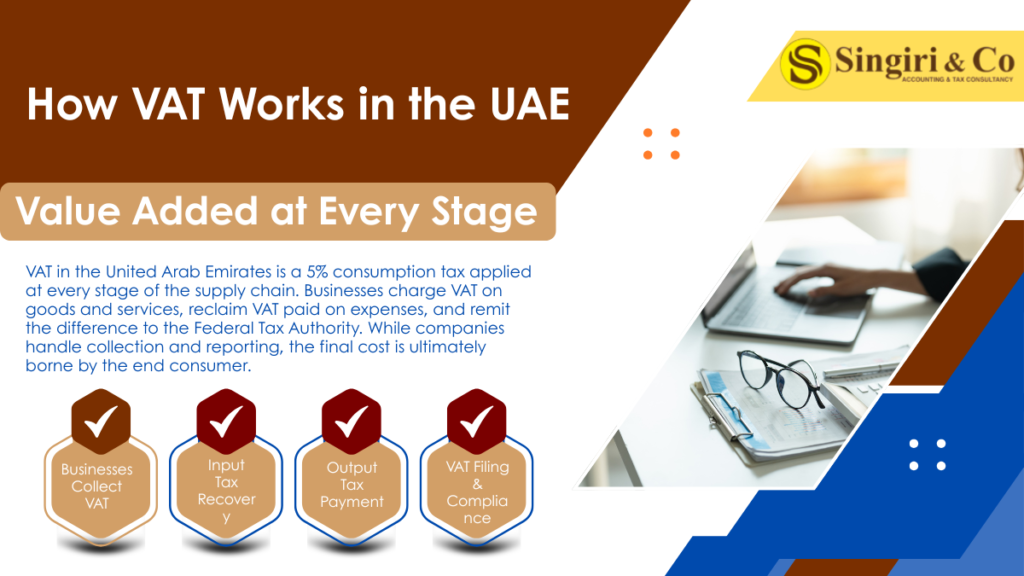
Businesses must:
- Add 5% VAT to goods and services sold
- Collect VAT from customers
- File regular VAT returns
- Pay the collected VAT to the Federal Tax Authority (FTA)
Accurate record-keeping is the foundation of proper VAT compliance in the UAE.
VAT Registration in the UAE
Businesses must understand the VAT registration UAE requirements to operate legally and avoid penalties.
| Registration Type | Threshold | Requirement |
| Mandatory Registration | AED 375,000/year | Compulsory—must register with FTA |
| Voluntary Registration | AED 187,500/year | Optional—can reclaim input VAT |
Many companies work with the best VAT consultants in Dubai to complete the registration process accurately and efficiently.
Why VAT Matters for Your Business
VAT in the UAE plays a direct role in how businesses operate, manage finances, and grow.
- ✔ Better Financial Management—VAT improves accounting systems and discipline
- ✔ Transparency—Businesses become more accountable and credible
- ✔ Legal Compliance—VAT registration and filing ensure companies follow government rules
- ✔ Audit Readiness—VAT compliance prepares businesses for a single audit in the UAE
VAT and Accounting in the UAE
Proper accounting is the backbone of managing value-added tax in the UAE effectively. Businesses must:
- Maintain complete tax invoices
- Track all sales and purchases
- Record VAT collected and VAT paid separately
Without proper accounting, VAT compliance becomes difficult and costly. This is why many businesses choose professional VAT services Dubai to manage their ongoing tax responsibilities.
What Is a Single Audit in the UAE?
A single audit in the UAE is a formal review of a company’s financial records conducted by the FTA. The audit checks:
- VAT calculations and returns
- Tax payments and timing
- Supporting financial reports and invoices
It ensures businesses are following VAT rules correctly, helps avoid penalties, and significantly improves business credibility with government authorities.
VAT Filing in the UAE
Once registered, businesses must file VAT returns on a regular basis—typically quarterly. VAT filing in the UAE includes:
- Total sales for the period
- Total purchases for the period
- VAT collected from customers
- VAT paid to suppliers
Timely VAT filing UAE is critical to avoid penalties. Many companies rely on VAT services Dubai or hire the best VAT consultants in Dubai for smooth, error-free filing.
VAT Penalties in the UAE
The UAE Federal Tax Authority enforces strict rules for VAT compliance. Common penalties include:
- Late VAT registration
- Late or incorrect VAT filing
- Incorrect VAT calculations on invoices
- Failure to maintain proper records
Managing VAT in the UAE proactively is the best way to avoid these penalties and protect your business.
Benefits of VAT for the UAE Economy
- ✔ Stable Government Revenue—A consistent income source independent of oil prices
- ✔ Better Public Services—VAT funds infrastructure, healthcare, and education
- ✔ Stronger Economy—Reduced reliance on oil supports long-term financial stability
- ✔ Business Professionalism—Companies maintain proper accounting and financial systems
Challenges Businesses Faced After VAT Introduction
When VAT in the UAE was first introduced in 2018, businesses faced several transition challenges:
- Lack of Awareness—Many businesses were unfamiliar with VAT rules and requirements
- System Updates—Accounting and billing systems needed significant upgrades to handle VAT
- Compliance Pressure—Regular filing cycles increased administrative workload
Over time, businesses successfully adapted—many with the guidance of the best VAT consultants in Dubai.
Tips to Manage VAT in the UAE Effectively
- ✔ Maintain Proper Records—Keep all tax invoices, receipts, and documents organized
- ✔ Use Accounting Software—Automation reduces errors and simplifies VAT tracking
- ✔ File Returns on Time—Never miss a VAT filing deadline
- ✔ Hire VAT Experts—Professional VAT services Dubai save time and reduce costly mistakes
- ✔ Prepare for Audits—Always maintain audit-ready records for a single audit in the UAE
Role of VAT Consultants in Dubai
Professional VAT consultants in Dubai are an invaluable resource for businesses of all sizes. The best VAT consultants in Dubai provide:
- VAT Registration—Ensuring compliant and timely registration with the FTA
- VAT Filing—Accurate and on-time return submissions
- Tax Planning—Minimizing VAT liability within legal boundaries
- Audit Support—Representing and guiding businesses during FTA audits
Using professional VAT services Dubai makes the entire process simpler, faster, and stress-free.
Future of VAT in the UAE
The future of VAT in the UAE is set for continued growth and tighter compliance:
- Digital tax systems and e-invoicing are expanding
- FTA compliance rules are becoming more stringent
- Businesses will increasingly rely on automation for VAT management
VAT in the UAE will remain a central pillar of the country’s financial framework for the foreseeable future.
Conclusion
VAT in the UAE was introduced on January 1, 2018—and since then, it has become an essential part of business operations across the country.
The 5% VAT rate in the UAE is straightforward in principle but requires careful management, proper documentation, timely filing, and audit preparedness to remain fully compliant.
With the support of the best VAT consultants in Dubai and reliable VAT services Dubai, your business can manage all VAT obligations confidently—and focus on what matters most: growth.