E-Invoicing UAE 2026: Detailed Guide for Businesses
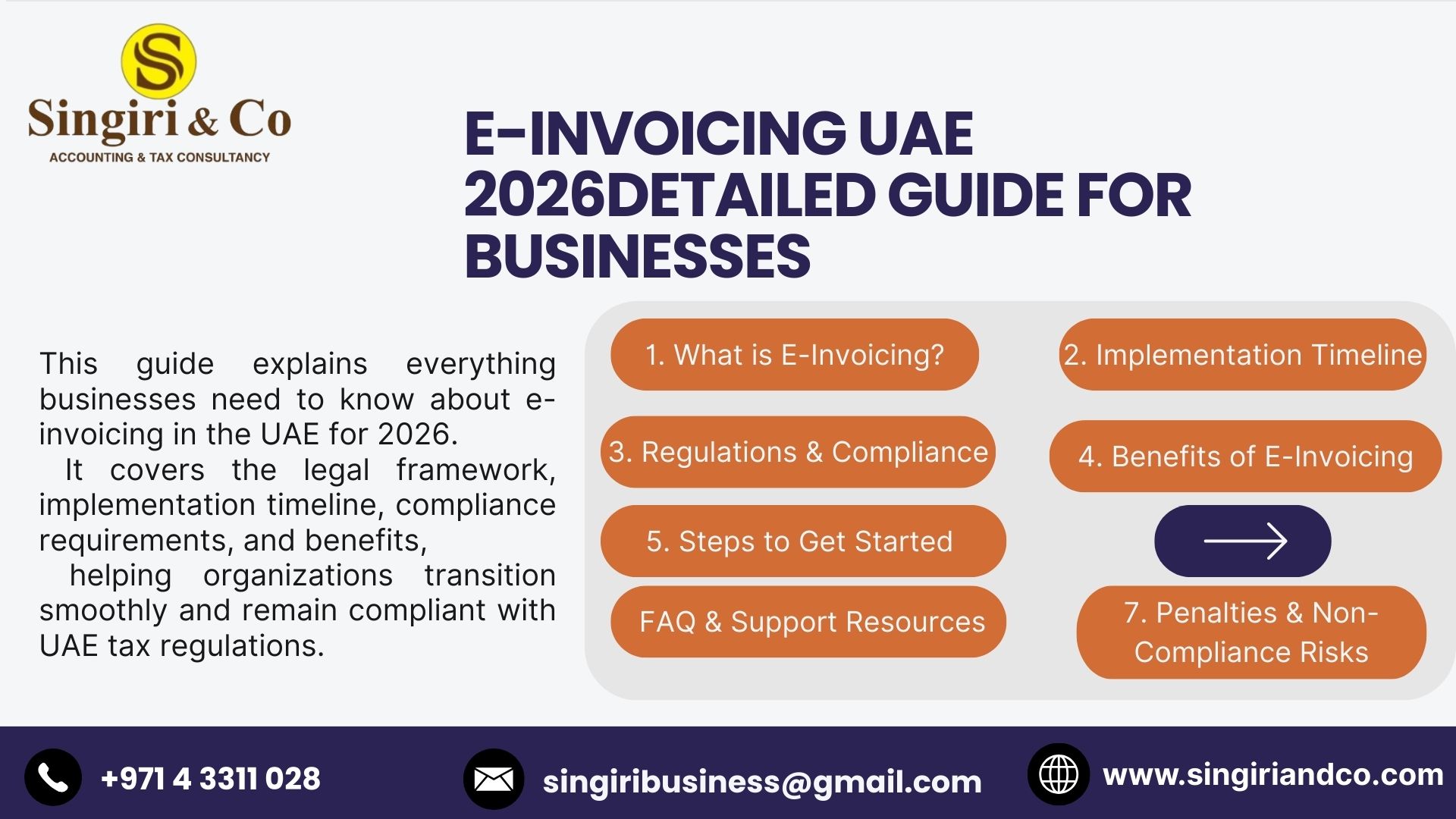
E-invoicing UAE 2026 explained. Discover legal requirements, rollout phases, and how businesses can prepare for mandatory e-invoicing compliance.
Table of Contents
E-Invoicing UAE 2026
Video Credit: mohammed shihab
The UAE government is set to introduce mandatory E-Invoicing UAE 2026, marking a major milestone in the country’s tax and digital compliance landscape. Overseen by the Federal Tax Authority (FTA), E-Invoicing UAE 2026 will fundamentally transform how businesses generate, issue, report, and store invoices across the UAE.
This initiative aligns E-Invoicing UAE 2026 with global best practices followed by countries such as Saudi Arabia, Italy, and India. The new system will streamline VAT reporting, reduce manual errors in invoice processing, and improve overall efficiency. Additionally, E-Invoicing UAE 2026 will enhance transparency between businesses and tax authorities, enabling faster audits and more accurate compliance checks. Early adoption of E-Invoicing UAE 2026 will help businesses remain compliant and gain a competitive edge in the evolving UAE market.
Understanding the UAE E-Invoicing Framework
E-invoicing in the UAE is not simply about sending invoices by email or PDF. It involves the electronic creation of invoices in a structured data format that allows automatic processing by tax authorities. This structured approach ensures invoices are generated in standardized formats such as XML. It enables seamless data exchange between businesses and approved e-invoicing service providers.
Invoice details can be validated automatically, reducing human errors and discrepancies. The system also supports real-time or near real-time reporting to the Federal Tax Authority. Overall, e-invoicing enhances accuracy, transparency, and regulatory compliance.
Under the proposed framework:
- Invoices will be generated in XML or structured formats
- Invoice data will be shared through accredited service providers
- The FTA will receive invoice information in real time or near real time
- Manual invoice uploads will no longer be accepted
UAE E-Invoicing Model: How It Works
The UAE is expected to adopt the PEPPOL-based 5-Corner Model, a globally recognized system that enables secure invoice exchange. This model connects buyers, sellers, and tax authorities through accredited service providers. It ensures standardized communication and data interoperability across systems. Invoices are securely transmitted and validated within the network. The framework reduces fraud risks and enhances data integrity. It also supports scalability for businesses of all sizes.
Key stakeholders in the model include:
- Supplier (seller)
- Buyer (customer)
- Accredited E-Invoicing Service Provider
- PEPPOL Network
- Federal Tax Authority (FTA)
Types of Invoices Covered Under E-Invoicing
The e-invoicing mandate in the UAE will apply to various invoice types issued under VAT regulations. It includes standard tax invoices generated for taxable supplies of goods and services. Simplified tax invoices issued for retail and low-value transactions will also be covered. Credit notes and debit notes issued for adjustments or corrections fall within the scope of e-invoicing. In certain cases, self-billing invoices may also be required to follow the e-invoicing framework. All covered invoices must comply with FTA-prescribed formats and data requirements.
- Tax invoices
- Simplified tax invoices
- Credit notes
- Debit notes
- Self-billing invoices (where applicable)
Who Will Be Impacted by E-Invoicing in the UAE?
E-invoicing will impact nearly all VAT-registered entities, regardless of size or industry. Both mainland companies and eligible free zone businesses will be required to comply with the new regulations. The mandate will apply to businesses issuing tax invoices for goods or services within the UAE. Companies using manual, paper-based, or PDF invoicing systems will need to upgrade their processes. Even small and medium-sized enterprises must align with the e-invoicing framework as per the phased rollout plan.
Industries most affected include:
- Retail and e-commerce
- Manufacturing and trading
- Logistics and transportation
- Healthcare and education
- Professional services
- Construction and real estate
Timeline and Phased Implementation (Expected)
Although final dates will be announced by the FTA, the UAE is expected to implement e-invoicing in phases. The phased approach is designed to allow businesses adequate time to adapt to the new system. Large taxpayers and multinational companies are likely to be included in the initial phase. Medium-sized and small businesses may be covered in subsequent stages. This gradual rollout will help reduce operational disruptions and ensure smoother nationwide adoption.
Probable rollout structure:
- Phase 1: Large taxpayers and multinational companies
- Phase 2: Medium-sized enterprises
- Phase 3: Small businesses and startups.
Mandatory Data Elements in UAE E-Invoices
Each e-invoice must contain specific data fields to comply with FTA standards. These fields ensure accurate identification of both the supplier and the customer. Mandatory details include the supplier’s name, address, and Tax Registration Number (TRN). Invoice-specific information such as invoice number, issue date, and taxable amount must also be included. VAT rate, VAT amount, and total invoice value are essential for correct tax reporting. Invoices missing required data may be considered non-compliant and subject to penalties.
Common mandatory fields include:
- Supplier name, address, and TRN
- Customer name and TRN (if applicable)
- Unique invoice number
- Invoice issue date
- VAT rate and VAT amount
- Total invoice value
- Digital signature or validation reference
Integration With Accounting and ERP Systems
Businesses will need to integrate their accounting, billing, or ERP systems with approved e-invoicing platforms. This integration enables automated invoice generation and real-time data exchange. Commonly used systems such as ERP and accounting software must be configured to support structured invoice formats. Proper integration helps reduce manual intervention and data entry errors. It also ensures seamless transmission of invoice data to accredited service providers. Effective system integration is essential for maintaining ongoing compliance with FTA requirements.
Systems commonly used in the UAE include:
- Odoo
- SAP
- Oracle
- Zoho Books
- Tally
- QuickBooks
Benefits of E-Invoicing Beyond Compliance
Although compliance is mandatory, e-invoicing offers long-term operational advantages. It helps businesses streamline invoicing processes and reduce administrative workload. Automated invoice handling improves accuracy and minimizes human errors. Faster invoice validation can lead to quicker payment cycles and improved cash flow. Digital record-keeping simplifies audits and financial reporting. Overall, e-invoicing supports better efficiency and scalability for growing businesses.
Key benefits include:
- Reduced manual data entry and errors
- Faster invoice approval and payments
- Improved cash flow management
- Real-time VAT tracking
- Simplified audits and inspections
- Lower risk of penalties
Penalties and Compliance Risks
Failure to comply with e-invoicing requirements may lead to penalties imposed by the Federal Tax Authority. Businesses may face administrative fines for issuing non-compliant invoices. Incorrect or missing invoice data can result in rejection of invoices by customers or authorities. Non-compliance may also trigger increased audits and inspections. In addition, delayed payments and reputational risks can arise from repeated compliance failures.
- Administrative penalties imposed by the FTA
- Rejection of VAT invoices
- Delays in customer payments
- Increased audit scrutiny
- VAT return discrepancies
How Businesses Can Prepare for UAE E-Invoicing
Early preparation is the key to smooth implementation. Businesses should begin by reviewing their current invoicing and accounting processes. Existing systems may need upgrades to support structured e-invoice formats. Selecting FTA-approved e-invoicing service providers is also essential. Finance and accounting teams should be trained on new compliance requirements. Proper planning will help businesses avoid last-minute disruptions and ensure seamless adoption.
Recommended preparation steps:
- Conduct an internal invoicing process review
- Identify system gaps and upgrade software
- Choose FTA-approved e-invoicing service providers
- Train finance and accounting teams
- Test e-invoice generation and transmission
- Update internal VAT compliance policies
Role of Tax Consultants and Accounting Firms
Professional tax consultants and accounting firms play a crucial role in ensuring smooth compliance. They assist businesses in assessing e-invoicing readiness and identifying system gaps. Experts provide guidance on regulatory requirements and FTA standards. They also support ERP integration and process optimization. Ongoing advisory services help businesses remain compliant and adapt to regulatory updates.
They can help businesses with:
- E-invoicing readiness assessments
- ERP and system integration support
- VAT compliance alignment
- Staff training and documentation
- Ongoing compliance monitoring
Future Impact of E-Invoicing in the UAE
E-invoicing will not only strengthen VAT compliance but also pave the way for greater digital transformation. It will enable more efficient tax monitoring and data-driven decision-making by authorities. Businesses can expect increased automation in VAT reporting and reconciliation. The system will support faster audits and improved transparency in transactions. Over time, e-invoicing will form the foundation of a fully integrated digital tax ecosystem in the UAE.
- Automated VAT return filing
- Advanced data analytics by the FTA
- Faster dispute resolution
- Greater transparency in business transactions
Conclusion
The introduction of e-invoicing in the UAE in 2026 represents a significant compliance shift for businesses. While the transition may require initial investment in systems and training, the long-term benefits of accuracy, efficiency, and transparency outweigh the challenges. Businesses that prepare early will be better positioned to adapt smoothly and remain compliant with FTA regulations.
Proactive planning will also help minimize operational disruptions during implementation. Adopting e-invoicing early can provide businesses with improved control over financial processes. Ultimately, timely compliance will support sustainable growth in an increasingly digital regulatory environment.
FAQ’s
What is e-invoicing in the UAE?
E-invoicing is the electronic creation, exchange, and storage of invoices in a structured digital format that allows automatic processing and reporting to the Federal Tax Authority.
When will e-invoicing become mandatory in the UAE?
E-invoicing is expected to become mandatory from 2026, with implementation likely introduced in phases as announced by the FTA.
Who is required to comply with UAE e-invoicing regulations?
All VAT-registered businesses in the UAE, including mainland and eligible free zone entities, will be required to comply.
Are PDF or paper invoices allowed under e-invoicing?
No, traditional paper or PDF invoices will not be considered compliant once e-invoicing becomes mandatory.
What invoice types are covered under e-invoicing?
Tax invoices, simplified tax invoices, credit notes, debit notes, and certain self-billing invoices will fall under the e-invoicing framework.
What is the PEPPOL 5-Corner Model?
It is a globally recognized e-invoicing exchange model that connects suppliers, buyers, service providers, and tax authorities through a secure network.
Do small businesses need to follow e-invoicing rules?
Yes, small and medium-sized enterprises will also be required to comply, usually as part of a phased rollout.
What systems are required for e-invoicing compliance?
Businesses need accounting or ERP systems capable of generating structured e-invoices and integrating with approved e-invoicing platforms.
What happens if a business does not comply with e-invoicing rules?
Non-compliance may result in administrative penalties, invoice rejections, delayed payments, and increased audit scrutiny by the FTA.
How can businesses prepare for e-invoicing in advance?
Businesses should review current invoicing processes, upgrade systems, choose approved service providers, and train staff ahead of implementation.